Proekspert achieves Microsoft Solutions Partner status

We are proud to announce that Proekspert has officially been recognized by Microsoft as a Solutions Partner for Data & AI (Azure) under the Microsoft AI Cloud Partner Program. This recognition highlights our ability to deliver successful customer outcomes with advanced technical capabilities in the Microsoft Cloud ecosystem.

A milestone in our Microsoft partnership

Solutions Partner certification places Proekspert among the first organizations globally to achieve this recognition. The certification is proof of our team’s commitment to excellence, and is a demonstration and validation of Proekspert’s technical expertise, as well as its commitment to customers. By achieving Solutions Partner status, we’ve proven our ability to:

  • Deliver data-driven insights that support smarter decision-making.
  • Implement AI-powered solutions that enhance business efficiency and create new opportunities.
  • Build scalable, cost-efficient, and resilient systems tailored to your needs.

Why partner with Proekspert

“Since 2013, we’ve worked within the Microsoft Azure ecosystem, building scalable, cost-efficient, and resilient solutions,” says Raido Lepp, Proekspert IoT-cloud integration and applications Delivery Lead. “Over the past year, we’ve focused on becoming a recognized partner in the Digital Apps and Innovation category and now we are also certified in Data & AI. Our developers proved their skills through expert-level Microsoft training and exams. This designation is solid evidence for ourselves and our customers that we deliver business value daily.”

Choosing a Microsoft-certified partner means you get more than just technology – you get peace of mind. First: proven competence – developers are trained and tested at the highest level on Azure Machine Learning, Power BI, SQL, and AI services. Second: practical solutions – Microsoft exams validate not just knowledge but real-world application, so we’re prepared to solve your toughest challenges.

Jana Ratassepp, Data Unit Delivery Lead, adds: “Earning the Solutions Partner for Data & AI (Azure) designation under the Microsoft AI Cloud Partner Program is a strong endorsement of our Data and BI team’s advanced expertise in Azure Machine Learning, Power Platform, Power BI, Fabric, and large-scale data engineering. This recognition demonstrates our ability to architect resilient and scalable data platforms, and to deliver intelligent analytics solutions that drive real value for our customers.”

We see this recognition as a stepping stone toward even greater innovation. As a Microsoft Solutions Partner for Data & AI, we are better equipped than ever to help you leverage AI and data to transform your business.

For more information on what the Microsoft Solutions Partner designation means, visit aka.ms/MicrosoftSolutionsPartner.

Get in Touch

Since 2013, Proekspert has been deeply engaged with the Microsoft Azure ecosystem, building scalable, cost-efficient, and resilient solutions. In recognition of our expertise, we’ve earned the prestigious Microsoft Solutions Partner designations in Digital Apps and Innovation and now in Data & AI (Azure).

If you’re looking for a trusted partner who combines proven technical expertise with a commitment to delivering measurable business value, we’d love to hear from you.

Raido Lepp
IoT-cloud integration and applications Delivery Lead
raido.lepp@proekspert.ee
LinkedIn

Jana Ratassepp
Data Unit Delivery Lead
jana.ratassepp@proekspert.ee
LinkedIn

How I automated Gmail for Telegram notifications using AI and Google Apps Script

If you’re like me, your Gmail inbox gets many new emails every day – but only a few of those are truly important. I found myself constantly refreshing my inbox, endlessly checking for the one reply I was waiting on. Instead, I wanted a smart way to be alerted only to those important emails. That’s why I decided to automate Gmail notifications. The whole process, including figuring out what tools to use and testing it out, took me about two hours.

Automating with AI, Telegram, and Google Apps Script 

With the help of AI tools (Windsurf with OpenAI o4 model), brainstorming and researching the solution took about 15 minutes. I needed something easy, with no costs or monthly fees, and I wanted to run it on my own Google account, instead of dealing with third-party servers or subscriptions. Also, I needed to forward these messages to some app that I use during the day – I chose Telegram. 

To make it work, I went with Google Apps Script for automation, since it’s free and runs right inside your Google account, which made the process much quicker – generating scripts for checking Gmail and sending Telegram messages. 

Creating a Telegram bot was straightforward: with the @BotFather in Telegram, I got my bot token and chat ID, then plugged those into my script. 

My script ran this procedure: check Gmail for new, unread emails with a specific subject or from certain key senders, send the details and a direct link as a Telegram message, and then label and mark those emails as read so I wouldn’t get duplicate alerts. 

Getting the right search filters in place was easy and customizable if my needs change. It runs as a Google Apps Script and is set to run every five minutes using time-based triggers.

Testing was as easy as sending myself some emails matching the right criteria, and the Telegram alerts popped up just as planned – sender, subject, preview, and a link. What really works for me is that I can set Telegram notifications just for the chat with the bot, so I don’t get distracted by every single thing, but never miss something urgent. 

Why this setup works – and how AI helped me build it faster 

If you want a simple, zero-cost fix to avoid getting lost in email noise, this combo of Google Apps Script and Telegram (with some help from AI) is perfect for solving your daily problems. 

Working with an AI tool like Windsurf is really for solving technical problems such as automating Gmail notifications to Telegram. You simply state your problem, and the AI helps organize your ideas, lay out a step-by-step plan, write down requirements, and build your task list. I was able to quickly decide on the right tools, map out my workflow, generate an automation script, and adjust every part of the process without getting bogged down in technical details. This approach kept me focused, allowed me to solve issues faster, and reach a working solution much more quickly than if I’d done it manually. Plus, AI can guide you through even the most difficult tasks you can imagine.  

Setting up a Telegram bot is easy: 

  • In the Telegram app, search for [@BotFather](Bots: An introduction for developers ). 
  • Start a chat with BotFather and use the `/newbot` command to create a new bot. Follow the prompts to give your bot a name and username. 
  • After setup, you’ll get a bot token. Copy and save this somewhere safe – you’ll use it in your script. 
  • To get your chat ID, send a message to your new bot, then check updates via the Telegram API. This lets your script know where to send the alerts. 

Here’s how to make it work for you: 

  • Paste the script into Google Apps Script (open [Apps Script  |  Google for Developers ](Apps Script  |  Google for Developers ) from Google Drive). 
  • Enter your bot token and chat ID at the top of the script. 
  • Edit the query rules – change the subject or email addresses to whatever is important to you. 
  • Save and run the script once manually to give it permission to access your Gmail and send the Telegram message.  
  • Set up a trigger in Google Apps Script to run the function `checkMail()` at whatever interval suits you (e.g. every 5 minutes). 

You can try it out yourself here.

How AI tools are transforming manufacturing: practical solutions

Manufacturing companies face persistent operational challenges: complex reporting processes, inconsistent data quality, slow incident response, and the burden of manual, repetitive tasks. Through recent conversations with industry peers, a clear trend has emerged: AI is no longer just a buzzword – it’s a practical toolkit for solving these problems and driving operational excellence.

Common manufacturing challenges addressed by AI

Every manufacturing operation encounters similar obstacles. Legacy reporting systems create slow, error-prone processes that disengage frontline teams. Safety incidents require extensive documentation, but incomplete reports limit the ability to extract actionable insights, hampering safety and compliance efforts.

When problems arise, finding relevant information from past incidents becomes a time-consuming search through scattered documents and databases. The result is delayed decision-making that risks operational downtime, while skilled employees spend too much time on routine tasks instead of focusing on strategic work that requires their expertise.

Custom solutions versus off-the-shelf products

Generic AI products rarely align with manufacturing operations’ specific needs. Your processes, compliance requirements, and integration points are unique. What works for one industry won’t necessarily fit another’s operational demands.

Companies achieving real success take a different approach. They partner with teams who understand that effective AI implementation means co-creating solutions tailored to specific business needs. Using platforms like Azure OpenAI and Microsoft cloud technologies, they develop AI applications that integrate with existing workflows rather than forcing workflows to adapt to generic solutions.

This approach enables organizations to develop AI applications specifically for their business requirements, set up secure, scalable Azure infrastructure, and integrate AI into existing systems and processes.

Real-world examples: AI in action

A global manufacturer addressed persistent safety reporting challenges. Their legacy system created incomplete, inconsistent data and disengaged employees. They implemented a cloud-native AI chatbot powered by Azure OpenAI that enables staff to report safety events conversationally, in any language, with photos. The system automatically fills known details, classifies reports, and ensures privacy by masking sensitive information.

The transformation was measurable: reporting became faster, easier, and more accurate. Data quality improved significantly, compliance became straightforward, and safety teams gained richer insights with reduced manual effort. Employee engagement increased as the natural reporting process became more inclusive and accessible.

An aerospace organization needed to accelerate incident management processes. Incident resolution was slow due to manual searches and multi-step committee reviews, creating costly delays. They implemented an AI assistant integrated with Jira and technical document repositories, using advanced search and retrieval-augmented generation to surface relevant past incidents and solutions instantly.

The impact was immediate: incident resolution accelerated, manual effort decreased, and decision-making became more confident. The modular platform design supports future growth and additional automation capabilities.

What works with AI in manufacturing

Through these projects and industry discussions, clear patterns have emerged. AI delivers value when it automates routine tasks, freeing people for higher-value work. It improves data quality by ensuring reports and records are accurate, complete, and actionable. It enhances decision-making by surfacing relevant information at the right time.

Most importantly, AI adoption succeeds when it integrates with existing workflows. Employees adopt AI tools more readily when they work with familiar systems and processes rather than requiring entirely new operational approaches.

Failures typically occur when companies implement generic solutions that don’t align with specific reporting needs, compliance requirements, or integration points. This is why a tailored, modular approach is essential for sustainable success.

Key benefits for manufacturing companies

When AI is implemented appropriately, the benefits are tangible and measurable. Efficiency improves through automated reporting, validation, and classification, saving time while reducing errors. Decision-making improves with high-quality, structured data and AI-powered recommendations supporting faster, more informed choices.

Scalability becomes achievable with modular, cloud-based solutions that grow with business needs and adapt to new challenges. Cost savings result from reduced manual workload, minimized delays, and freed skilled staff for strategic initiatives that require human expertise.

Industry takeaways

AI isn’t a universal solution, but when tailored to specific business needs and integrated thoughtfully, it can transform how organizations manage reports, incidents, and daily operations. The most successful projects start with a clear understanding of actual pain points and evolve through close collaboration between business and technology teams.

The companies seeing sustained success focus on practical applications that address real operational challenges rather than implementing AI for its own sake. They prioritize solutions that enhance existing processes rather than completely replacing established workflows.

If you’re considering how AI can address your manufacturing challenges, remember that a custom solution will deliver the agility, compliance, and operational impact you need more effectively than generic products. The question isn’t whether AI can help your operation – it’s whether you’re ready to implement it strategically for your specific situation.

Introducing our next CEO: Marco Spielmann joins Proekspert in August

We are excited to announce that Marco Spielmann has been appointed as the new CEO of Proekspert, starting August 2025. Marco will lead the next phase of our international growth – especially in Central European markets – building on our strengths in industrial software and digital innovation.

Allan Urb, Chairman of the Board at Proekspert, explains:

“Our goal is to strengthen our international presence and accelerate growth in our target markets across Central Europe. We were looking for a leader who combines strategic vision with the hands-on ability to build and nurture customer relationships in new business environments. Marco Spielmann brings exactly these qualities, along with an international network that will help Proekspert take its international expansion to the next level.”

Marco Spielmann brings both strategic vision and practical leadership experience to Proekspert. He has held senior roles with technology consultancies such as Birkle IT and helped scale and exit startups like Friday Flats. Marco has delivered digital transformation projects across the Baltics and Scandinavia, launched multiple cloud-based and enterprise solutions, and led international teams through rapid change. He also serves on the board of the German-Baltic Chamber of Commerce, contributing to digital business policy and cross-border innovation.

Marco shared his excitement about the future:

“Proekspert will continue to build on its core strengths we’ve already proven. As the world is fastly changing, so must we. By embracing emerging technologies not as disruptions, but as opportunities we want to lead the path of growth, innovation and industry expertise in our core markets.”

With Marco on board, Proekspert will:

  • Strengthen its international presence
  • Deepen strategic partnerships
  • Drive innovation in AI, cloud, and industrial digitalization

Until August, our current leadership team ensures continuity and smooth transition. We look forward to welcoming Marco and beginning this exciting new chapter for Proekspert together.

Invisible impact: How smart and secure digital solutions created in Estonia are changing the world

Milton, Proekspert’s AI assistant, helped formulate the interview questions. Our marketing team gave Milton the following prompt as the basis for the interview: “Create three journalistic questions related to the invisible impact of digitalization, sustainability, and security.” This is how the questions were born, which Ilmar Pralla, Proekspert’s COO / Member of the Board, answered.

Milton: Ilmar, digitalization is discussed daily but is often associated with visible consumer solutions or the simplification of everyday life. How important is the sustainability and responsibility side? How does Proekspert contribute here?

Ilmar Pralla: When we talk about digitalization, we tend to think primarily of visible applications – web portals or phone apps. However, many digital solutions that affect our everyday lives operate automatically in the background and remain unnoticed: heating in our homes, ventilation, elevators in office buildings, electricity- and water networks, and production line management in industrial plants. At Proekspert, we focus on solutions that keep our society running in the background. We create solutions that make our lives easier and our devices more energy-efficient and safer.

One example is our cooperation with a European green technology company. We gave this client’s heating and air conditioning devices the ability to calculate NordPool electricity spot market exchange prices and automatically schedule energy consumption to more favorable periods. The result is lower costs for the user, lower peak loads for the energy system, and a decreasing need for fossil fuels. This is precisely how digitalizing devices helps save resources and moves toward a greener living environment.

As another example, our software helps optimize the operation of hundreds of thousands of industrial electric motors around the world. We help reduce the need for technicians to make maintenance trips using real-time remote management and data analytics. Again, the result of such digitalization is lower energy consumption, a cleaner environment and lower costs.

Milton: The more complex the system, the greater the risks – that’s why security is more important than ever. How does Proekspert help meet these challenges?

IP: It’s true that the increasing number of cyber threats, and new regulations and international standards created in response to them, are making life increasingly complicated for every technology company. It’s easy to see this as annoying bureaucracy, but these requirements help us build a stronger and more resilient digital environment. This is especially important in industry and critical services, where unexpected failures or cybersecurity incidents can affect entire cities and communities.

Our engineers help international manufacturing companies map security risks and vulnerabilities, conduct compliance assessments, and create secure software solutions. For example, we help manage devices’ digital identities and have developed solutions that ensure that software updates to devices come from the device manufacturer and not from malicious third parties. In doing so, we help protect the devices and systems around us, both for users and businesses.

We often say, “Build so that no one even has to think about it.” The goal is to make technology as secure as possible daily and operate smoothly in home and industrial environments. At the same time, we must always be vigilant and keep up with the times because cybersecurity requires constant attention and cooperation.

Milton: Now, thinking about the future, what is Proekspert’s responsibility, and what is your most significant contribution?

IP: We have a clear vision: although our team is not large on the world stage, our impact is far reaching through our services to our customers. We work with major European industries whose equipment determines a significant portion of the world’s resource use and energy flows. Our work makes widely used devices smarter and more efficient, thereby reducing the environmental burden. Sustainability is central to our service, not just a trendy keyword.

We develop systems that can be flexibly updated and have a long lifespan. We avoid unnecessary waste, and we consider each solution’s environmental impact and energy consumption from the beginning of development. At the same time, we never compromise at the expense of safety.

We are an honest and transparent partner who offers the best technological solutions and carries a sustainable mindset. Every day, we see how the technologies we develop make life more comfortable, greener, and safer in different parts of the world, and that is why we know we are on the right track. And since many of these changes happen “in the background” for the average person, we can say that the more imperceptibly everything works, the better we have done our job.

Further reading

Proekspert receives Silver Label as Responsible Business

We are proud to have received the Silver Label in Estonia’s Responsible Business Index 2025. This recognition highlights our ongoing work to integrate responsibility, sustainability, and good governance into everything we do.

The Responsible Business Index is organized by the Responsible Business Forum and relies on a methodology developed in cooperation with international experts, following the UN Global Compact principles, ESG frameworks, and the UN Sustainable Development Goals. Evaluation is based on a multi-step process, including self-assessment and validation by external experts.

As our COO Ilmar Pralla puts it:

“Receiving the Silver Label is a proud milestone that shows our commitment to making a real difference – often behind the scenes – by building smarter, safer, and more resource-efficient digital solutions,” says COO Ilmar Pralla. “For us, responsible business isn’t just something we talk about; it’s what we deliver for our clients and the world, every single day.”

EBS special award for supporting education

At the same ceremony, Proekspert received the EBS (Estonian Business School) special award in recognition of our significant contribution to education over the years. In the past, we’ve supported initiatives like the Kood/Jõhvi programming school, math camps, and collaborations with universities and vocational centers. Through these efforts, we’ve helped encourage interest in technology and science among young people and contributed to building a smarter, more sustainable future.

We remain dedicated to advancing sustainability, supporting fair practices, and maintaining high standards of data security and transparency. Our commitment is reflected in our environmental certifications, ethical principles, and robust approach to data protection.

Thank you to our team, clients, and partners for making this achievement possible. We’re excited to continue raising the bar for responsible business.

Learn more about our commitment to ESG principles and other company achievements.

Legal compliance vs. device security in the real world

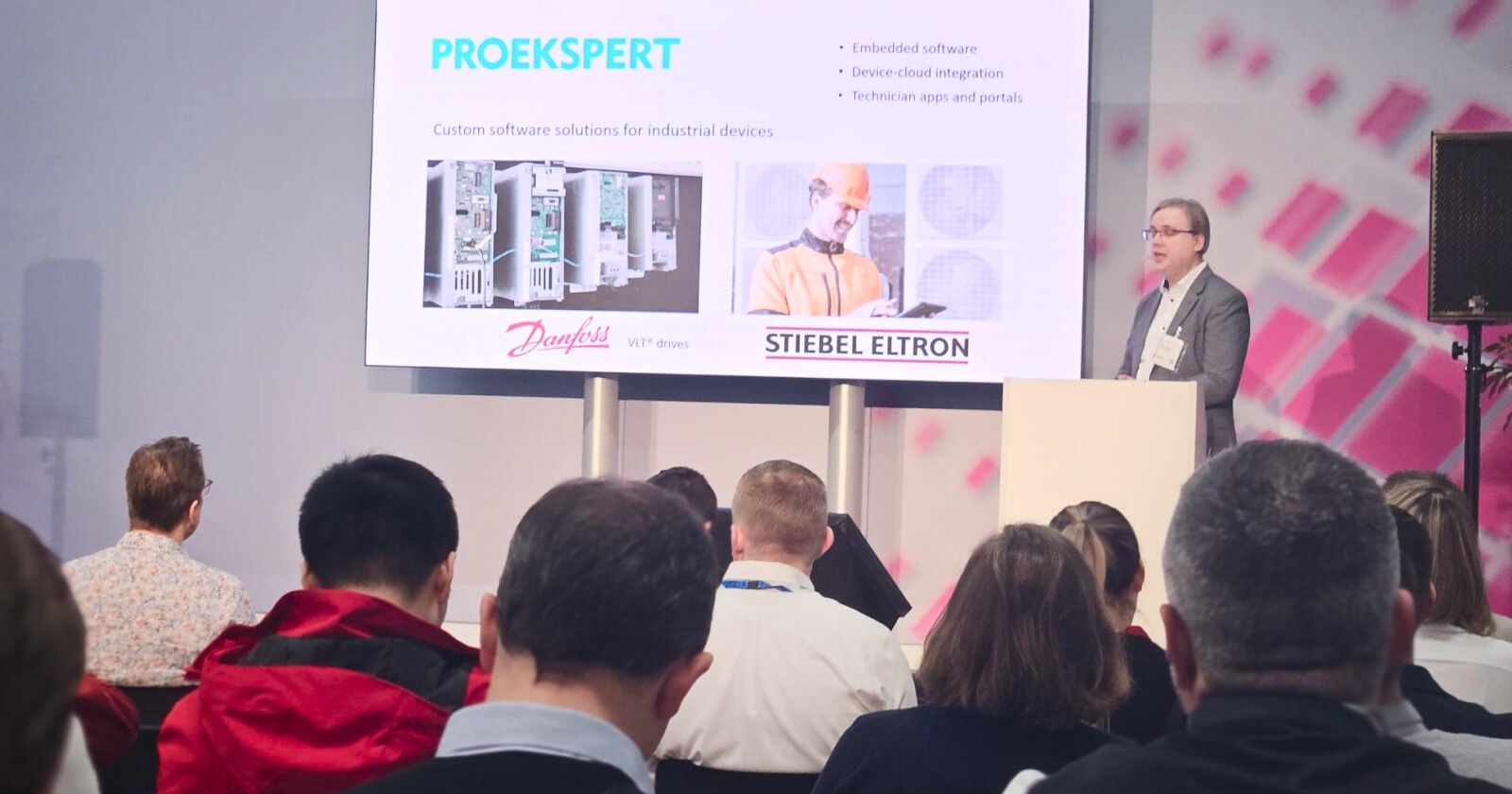
This article summarizes the main points from Terry London’s speech at the trade event, Embedded World 2025. Drawing on his experience at Proekspert, Terry explains how the EU Cyber Resilience Act will affect industrial device security, outlines practical steps for compliance, and highlights best practices for balancing security with business needs.

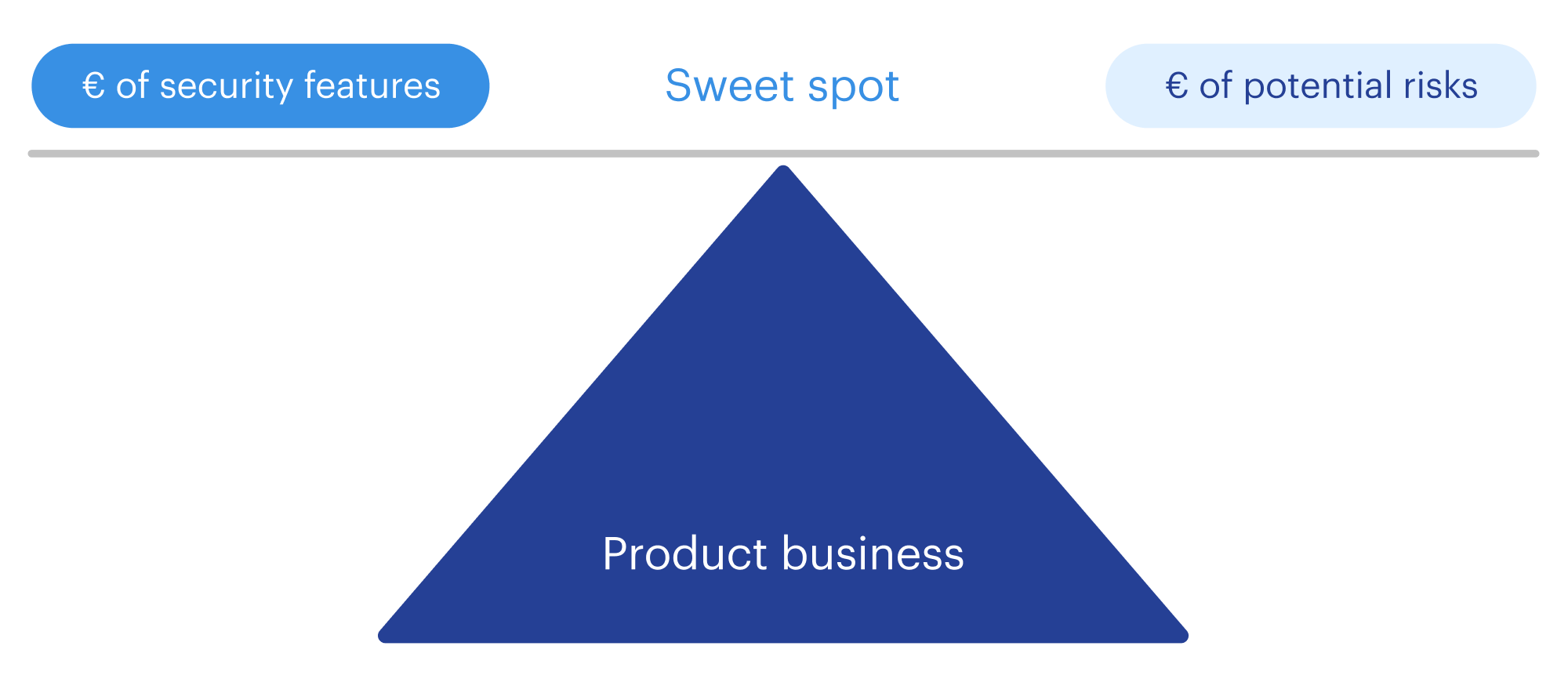
To avoid pitfalls in device cybersecurity implementations, begin with a comprehensive risk assessment to identify the optimal balance between investment and outcome when building cybersecurity equipment.

Cyber security requirements in product development cycle

The use of digital technology in manufacturing has changed how factories work. Automation, connected systems, and quick data analysis are important for success. At the same time, keeping these digital products secure and reliable is more important than ever, especially as new rules are introduced for industrial automation.

Understanding the EU Cyber Resilience Act

The European Union’s Cyber Resilience Act (EU CRA), released in December 2023, is a landmark regulation designed to strengthen cybersecurity for all products containing digital elements. Set to take effect in December 2027, it gives businesses a little over two years to adapt—the blink of an eye in complex R&D cycles.

At Proekspert, we’ve already observed the effects of the upcoming act, impacting not just new development, but also forcing updates to longstanding products. Industrial device manufacturers now face crucial decisions on how to meet these new requirements without upward spiraling costs or introducing unnecessary complexity.

Balancing security and business needs

Security comes at a price, and adding it later or doing it without proper planning can end up costing much more. The key is to make thoughtful business and engineering decisions from the start.

We’ve seen instances where ambitious security goals dictated by management led to excessive costs or features that failed real-world usability tests. The lesson? Security must serve both compliance requirements and the end-user experience. Ultimately, security is of little value if it makes products unusable or uncompetitive.

Demystifying the EU CRA

The EU CRA is not just another directive by the EU, it’s a binding regulation that covers all products with digital components sold in the EU. If your product carries a CE marking, it will almost certainly be affected. The Act enforces risk-based security measures, with a strong focus on protecting end users and maintaining transparency across product lifecycles. From a market perspective, compliance isn’t just about ticking boxes—it can give customers confidence, differentiate products, and drive business success.

In practice, the EU CRA requires manufacturers to:

1. Follow essential cybersecurity requirements and conduct cybersecurity risk assessments.

2. Set policies and processes to report on and handle vulnerabilities, including the Software Bill of Materials (SBOM).

3. Perform conformity assessments according to product class.

4. Report exploited vulnerabilities and incidents promptly and transparently.

5. Provide security updates for as long as a product is supported, a minimum of five years.

Begin with risk assessment

The first and most crucial step toward compliance is a comprehensive cybersecurity risk assessment. This process involves:

  • Mapping all use cases and foreseeable environments.
  • Identifying vulnerabilities and critical data flows.
  • Evaluating the balance between usability, security, and cost.
  • Documenting which essential requirements and standards (such as IEC 62443) apply.

For industrial devices, legacy complexity only adds to the challenge. Products may have been developed over decades with intricate codebases and unpredictable interdependencies. Risk analysis helps navigate this complexity intentionally, rather than reactively.

Best practices for compliance

Start with analysis: Assess and understand realistic risks before prescribing security features.

Prioritize usability and business goals: Choose security measures that are sustainable and aligned with how your clients actually use your products.

Plan for the product lifecycle: Cybersecurity isn’t a one-off; it must be maintained, updated, and verified as technology and threats evolve.

Supporting our customers

Our core mission at Proekspert is developing secure systems—EU CRA compliance is now seamlessly built into our process. We specialize in:

  • Guiding clients through self-assessment and gap analysis (especially with IEC 62443).
  • Establishing processes for vulnerability reporting and SBOM maintenance.
  • Implementing tailored security update mechanisms.

We work directly with our clients’ engineering teams, ensuring security investments are reasonable and effective, avoiding unnecessary costs and complexity. Proekspert helps clients integrate these practices into their core development processes, from initial architecture to post-launch support.

Final thoughts

The EU CRA represents both a challenge and opportunity for industrial device manufacturers. By approaching it as a chance to build better, safer products—balanced for real-world use—you can not only comply but excel.

About Proekspert

Proekspert is a skilled software development company with over 30 years of experience. We have encountered many diverse approaches to equipment, software engineering, and cybersecurity. Our expertise covers embedded software, device-cloud integrations, technician apps, and portals.

Power BI overload: when more dashboards mean less clarity

Data promised decisions, but delivered dashboard chaos. When reports multiply endlessly, dashboards gather dust despite their visual appeal, and trust evaporates as numbers clash and definitions vary – even with powerful tools like Power BI, a deeper issue is lurking. Management confidence wanes as the promised clarity remains elusive.

Many organisations in the recent decade(s) have adopted Power BI or a similar tool, seeking data clarity and informed decision-making. However, a common scenario unfolds: a proliferation of reports, datasets disconnected from reliable sources (often flat files), and dashboards that, despite their visual appeal, suffer from low usage or outright mistrust.

Numbers don’t align, definitions vary, and management confidence wanes. This isn’t usually a failing of Power BI itself, but rather a symptom of underlying issues in data structure, governance, and adherence to established Business Intelligence (BI) and Data Warehousing (DW) best practices. We often see companies struggling with problems that have clear solutions based on proven best practices.

Navigating BI maturity: common pain points

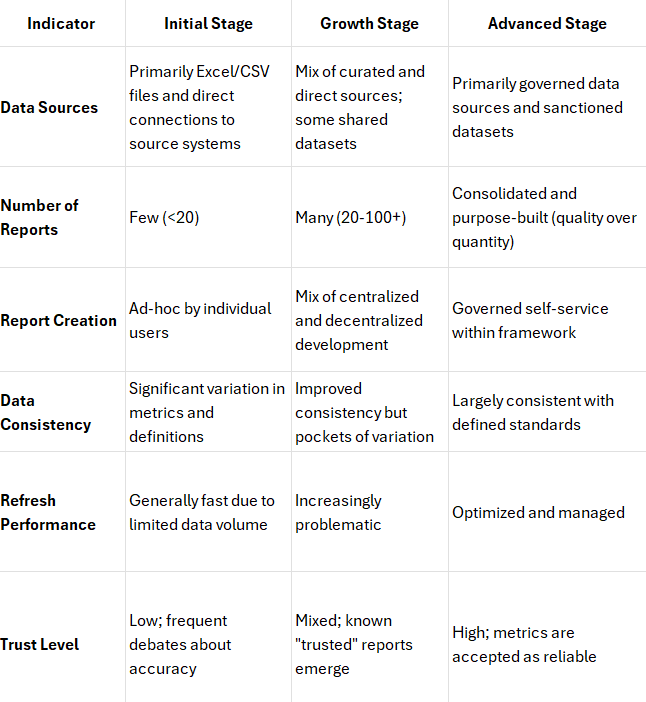
Organizations exist on a spectrum of BI maturity. Recognizing your stage helps identify specific, often predictable, challenges:

1. The initial stage: ad-hoc analytics and spreadsheet feeds

  1. Characteristics. Power BI often connects directly to operational systems or, commonly, flat files (Excel, CSVs). Reports are built independently, often by different users or departments.
  2. Core Challenges. Rampant inconsistency in metrics and definitions (“duelling dashboards”). High manual effort for data preparation leading to errors. Lack of historical context or integrated views. Difficulty establishing a single version of the truth, leading to low user adoption and trust issues from the outset.
  3. Expert Observation. At this stage, the lack of a structured, governed data foundation is the primary barrier. Power BI can visualize chaos, but it can’t inherently create order without addressing the source data structure.

2. The growth stage: the “Report Factory” and integration attempts

  1. Characteristics. Attempts are made to integrate data from multiple sources. Shared datasets might emerge, but report creation often outpaces governance. Automation is introduced, but potentially inconsistently.
  2. Core Challenges. Significant report sprawl – dozens or hundreds of reports with overlapping information and questionable usage. Performance degradation as models become unwieldy or data volumes increase without optimization. Maintaining consistent business logic across reports becomes a major hurdle. The first signs of Architectural Drift appear as quick fixes compromise design integrity.
  3. Expert Observation. This is the critical juncture where the absence of a well-designed central data repository, like a dimensional data warehouse adhering to Kimball or Inmon principles, creates significant friction, hindering scalability and reliability.

3. The advanced stage: complex platforms and lingering issues

  1. Characteristics. An established data warehouse or data platform exists. Power BI connects to curated, modelled data. Advanced analytics or ML initiatives may be underway.
  2. Core Challenges. Models become overly complex and slow to adapt to changing business requirements. Performance tuning becomes a constant battle. Ensuring true, governed self-service BI without compromising data integrity remains difficult. Semantic consistency across increasingly sophisticated use cases can erode.
  3. Expert Observation. Even with significant infrastructure investments, neglecting core principles like conformed dimensions, metadata management, and robust data governance frameworks leads to diminishing returns and user frustration.

Architectural drift: when best practices are compromised

A common thread across maturing organizations is Architectural Drift. This is the gradual, often unintentional, deviation from sound BI/DW architectural principles and best practices. It happens under pressure for quick results, fragmented development efforts, or a lack of deep expertise in foundational concepts like dimensional modelling, ETL/ELT discipline, and robust governance. This drift inevitably leads to increased technical debt, higher maintenance costs, reduced agility, and exacerbates the very trust and usability issues BI aims to solve. Getting back on track often involves revisiting and reapplying these proven methodologies.

Realigning with foundational principles

Addressing the challenges outlined above rarely involves simply adopting more tools. The solutions are typically found by stepping back and applying established BI/DW best practices:

  • For inconsistent data and trust issues (Initial Stage). Implementing basic data profiling, cleansing, and establishing even a simple, well-structured data mart can provide immediate improvements in consistency.
  • For report sprawl and scalability (Growth Stage). Designing and implementing a dimensional data warehouse provides a “single version of the truth,” simplifies reporting logic, improves performance, and enables scalable, governed BI. Consolidating redundant reports becomes feasible.
  • For complexity and performance (Advanced Stage). Optimizing the existing data warehouse/platform, refining ETL/ELT processes, strengthening governance, and implementing robust metadata management are key. Sometimes, modernization of the architecture is required.

Self-assessment: Where is your organization?

Evaluate your current BI maturity and challenges with this quick assessment:

BI Maturity Self-Assessment

Building sustainable BI

Power BI is a capable tool, but its long-term value is inextricably linked to the quality, structure, and governance of the data it consumes. If your organization experiences dashboard proliferation, inconsistent numbers, or eroding trust in your analytics, it’s often a sign that underlying architectural principles have been neglected or compromised by Architectural Drift.

Addressing these core challenges requires expertise in foundational BI and Data Warehousing methodologies. It’s about building sustainable, reliable data structures that deliver consistent, trustworthy insights through tools like Power BI.

If these challenges resonate with your experience, perhaps it’s time for a discussion focused on aligning your BI environment with proven best practices. Contact us to explore how applying established principles can strengthen your data foundation and restore confidence in your analytics.

Why dashboards fragment usually comes down to the platform underneath. See how Proekspert engineers cohesive, governed data platforms.

Proekspert and LAAVAT join forces as your device cybersecurity partner

Meeting customer security demands while complying with standards like IEC 62443 and regulations like the EU CRA can be complex and costly. Balancing device security with competitiveness often feels overwhelming without expert guidance.

That’s why Proekspert and LAAVAT have joined forces to offer a complete solution, combining decades of expertise in device software development with a trusted PKI & Signing Platform. Proekspert specializes in secure embedded software and application development, while LAAVAT provides PKI and signing capabilities essential for embedded security features. Together, we deliver a proven, collaborative approach to tackling even the toughest challenges in embedded security.

Whether it’s ensuring compliance with strict cybersecurity standards or leveraging the latest technology to create secure device experiences, Proekspert and LAAVAT work as your trusted partners. Together, we simplify everything from embedded device security features like secure boot and firmware updates to cryptographic key management and distribution during manufacturing. 

Proekspert`s partner and product owner Terry London: “Partnering with other strong companies in the field ensures our clients benefit from a synergy of expertise. By combining Proekspert’s software development for embedded device security with LAAVAT’s trusted PKI and signing platform, we’re offering clients a balanced solution to meet the highest cybersecurity standards. This partnership allows us to address complex challenges efficiently while maximizing cost-effectiveness for our clients.“

Proekspert specializes in embedded device security, providing advanced protection through features like Secure Boot, TrustZone, and Secure Firmware Updates, both wired and over-the-air. Their expertise extends to device-to-cloud connectivity, enabling real-time connections for tens of thousands of devices while managing complex parameters at scale. With a focus on balanced solutions, they ensure that cybersecurity measures not only minimize risks but also maximize cost-effectiveness.

The LAAVAT PKI & Signing Platform provides manufacturers with a cost-effective SaaS solution to securely manage cryptographic keys, establish a Public Key Infrastructure (PKI), and sign and encrypt a wide range of software packages for embedded devices. It ensures that keys are protected by Hardware Security Modules (HSMs), unauthorized cryptographic operations are prevented, and cryptographic assets are securely distributed during manufacturing.

LAAVAT CEO Kaustabh Debbarman: “By integrating the LAAVAT PKI and Signing Platform with Proekspert’s proven device security expertise, our partnership delivers a complete security solution for embedded devices. Manufacturers can implement critical features like secure boot, firmware updates, and trusted device identities through a streamlined, cost-effective solution—helping manufacturers across industries deliver secure embedded devices.”

About Proekspert 

With over 30 years of experience, Proekspert collaborates with R&D teams of leading industrial device manufacturers to create secure, cost-effective, and user-friendly custom software solutions.

About LAAVAT 

LAAVAT provides a cost-effective PKI and Signing Platform tailored for embedded device manufacturers, enabling security features like secure boot, firmware updates, and trusted device identities. LAAVAT is ISO 27001 certified.

Proekspert receives ISO27001:2022 cybersecurity certification

In February 2025, Proekspert received ISO 27001:2022 certification, demonstrating compliance with international best practices in information security, cybersecurity, and privacy protection. This certification underscores the company’s commitment to securing its operations and the services it offers.

As cybercrime continues to grow and new threats emerge, managing cyber risks has become increasingly complex. Proekspert chose to take a proactive approach by identifying potential risks and vulnerabilities and implementing measures to mitigate them. Receiving ISO 27001:2022 certification reflects the company’s dedication to ensuring security and maintaining the trust of customers and partners. 

ISO 27001:2022 is an internationally recognized standard for information security management systems (ISMS). It provides companies across all industries with a framework to establish, implement, maintain, and improve their security practices. “Our journey toward information security has been ongoing for years. We adopted ITL’s best practices for secure software development early on and have built our own in-house secure development process. We also assess the information security maturity of every project,” said Ilmar Pralla, COO of Proekspert.  

Pralla emphasized that security is a top priority because many of Proekspert’s clients are large international companies that have faced cyber threats firsthand. “They require the highest standards from their partners. Meeting these expectations is crucial for us,” he added. With new EU requirements, including the Cyber Resilience Act (CRA) and NIS2, impacting clients, Proekspert aims to not only guide and assist but also serve as a good example. 

Achieving ISO 27001:2022 certification required a year of thorough preparation. Proekspert assembled an ISO working group and collaborated with external consultants to assess and address areas of non-compliance. The team systematically planned and implemented changes across the organization, ensuring a successful certification audit. 

Proekspert’s Data Protection Officer, Marek Suur, highlighted the importance of readiness: “Risks are always present; the question isn’t if something will happen, but when. Being prepared means understanding the risks and having plans in place.” Suur acknowledged the challenges of working with limited resources but expressed confidence in the efforts made. “You can’t do everything you want, but I believe we’ve done enough.” The certification process has strengthened Proekspert’s ability to handle unexpected situations effectively, reinforcing a solid foundation for the future. 

Proekspert thanks all its team members who contributed to achieving this goal!