When AI reaches industrial operations, accuracy stops being enough

Industrial companies do not lack data. They lack a layer where machines can consume that data with the same confidence that experienced engineers do. That gap stays invisible during dashboards and reports. It becomes a blocker the moment copilots, agents, or automated workflows start influencing real decisions – quoting, planning, maintenance, delivery.

AI in industry is shifting from insights to decisions. Not just chat interfaces. Copilots and agents now draft service reports, propose delivery dates, recommend maintenance actions, support quoting, and automate parts of planning and customer communication.

When AI explores, imperfect data is inconvenient. When AI influences operations, imperfect data is a risk. The issue is rarely wild inaccuracy. It is fragmentation and unstable meaning across ERP, PLM, MES, historians, maintenance, quality, and service systems that people can interpret but machines cannot.

Industrial fragmentation is normal

Industrial systems evolve over years. Operations expand, lines change, vendors differ, acquisitions happen, and temporary integrations become permanent. Segmented networks keep domains apart. Each system holds only part of reality. People reconcile the gaps on the fly. Machines do not.

“Each system holds only part of reality. People reconcile the gaps on the fly. Machines do not.”

What changes when machines consume data

Copilots, agents, and automated workflows consume structure. They apply patterns to whatever they see.

They implicitly assume that:

  • identity is consistent across systems
  • business logic is defined once, not reimplemented everywhere
  • operational context is explicit, not implied
  • contradictions are resolved with rules and precedence, not left for people to interpret

These conditions are only partly true in most industrial architectures. AI will still produce answers. The problem is not that the answers look obviously wrong. The problem is that they are fragile, hard to reason about, and unsafe to scale.

Why adding AI to each system increases risk

Attaching AI to individual systems sounds efficient. In practice it multiplies disagreement. ERP sees commitments and costs with delays. MES runs at another grain. Historians see signals with limited context. Maintenance tracks work orders and taxonomy. Quality tracks nonconformities and holds. If each domain hosts its own intelligence, outputs disagree quietly and expensively. Teams end up reconciling whose AI is right instead of improving the process.

This is not a model problem. It is an architectural problem.

“Teams end up reconciling whose AI is right instead of improving the process.”

The missing layer: a machine‑readable decision foundation

For machines to be useful in operations, they need one place where reality is:

  • consolidated across systems
  • structured with clear entities and relationships
  • enriched with context such as units, calendars, and taxonomies
  • governed and traceable with lineage and change control
  • time‑aware so you can reproduce what was known at decision time

This is not a dashboard layer or a reporting warehouse. It is a decision foundation that acts as the interface between operational systems and anything that reasons over them. Analytics,

automation, and AI consume the same governed semantics. The foundation constrains what machines can see and do. That constraint is what makes outputs usable.

Integrated analytics environments – Microsoft Fabric is one example – make this practical by keeping semantics, pipelines, and governance close to each other. But the platform supports the method. The method stays the point.

“This is not a dashboard layer or a reporting warehouse. It is a decision foundation.”

What high‑quality data means for AI in industry

The decision foundation is the architecture. These are the properties that make it trustworthy.

High quality for AI is more than accuracy. It means five properties are explicit and testable:

  • conformed identity for assets, products, work centres, customers, and sites
  • versioned definitions for scrap, downtime, yield, lead time, and service completion
  • time semantics that align events, postings, batches, and shift calendars
  • grain contracts that control how order, operation, and sensor data combine
  • lineage from decision back to sources and rules

Without this, copilots remain demos and agents remain experiments.

Why most existing data platforms still fall short

Many companies already operate a data warehouse or a data lake. Pilots still stall because data is not engineered into a reusable decision asset. Core entities are not conformed. Definitions live in dashboards and spreadsheets. Logic is rebuilt in every report and model. Lineage is not strong enough for operational use. When people must reinterpret meaning, machines cannot safely take over parts of the reasoning.

A pragmatic way to build it: Building Blocks

Skip multi‑year platforms. Skip isolated pilots. Build the foundation in Building Blocks. Each block delivers a real operational outcome and leaves behind reusable assets for the next block.
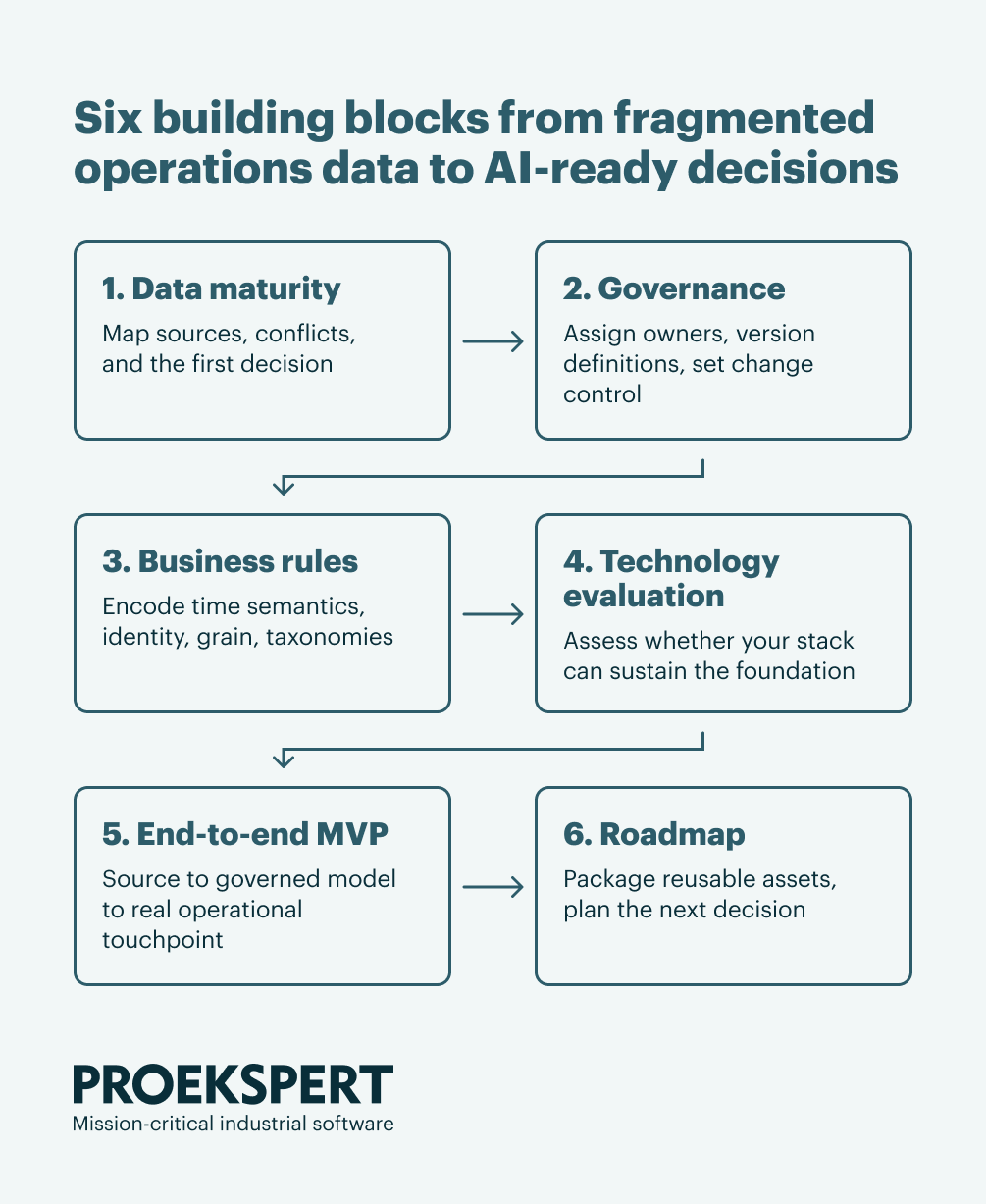
1. Data maturity, fast and practical

Pick one decision where scale matters. Map sources, constraints, and semantic conflicts. Define success and risk in operational terms.

Outputs

  • Decision statement and guardrails
  • Source map across ERP, PLM, MES, historians, maintenance, and quality, including time bases and latency
  • List of definition conflicts that block safe automation

2. Lightweight governance on what matters

Assign owners for the few things that make-or-break safe decisions.

Outputs

  • Owners for asset, product, work center, customer, site
  • Versioned definitions for scrap, downtime, yield, lead time, installed base, service completion
  • Change control and lineage expectations for decision‑critical logic

3. Business rules that make meaning explicit

Turn industrial reality into machine‑usable rules.

Outputs

  • Time semantics, shift calendars, unit conversions, exception handling, and taxonomies encoded as tests
  • Identity resolution across ERP and MES for assets, orders, and variants
  • Grain bridging contracts that explain how to combine order, operation, and sensor levels
  • Rule tests with golden datasets and lineage back to sources

4. Technology evaluation

Have an unbiased look at whether your current stack can sustain the decision foundation at the required scale and pace. If it can, use it. If not, identify a more optimal stack that delivers the semantics, lineage, security boundaries, and developer ergonomics you need, without losing sight of the bigger picture.

What we evaluate

  • Ability to model and serve a shared semantic layer to analytics and AI
  • Native support for time semantics, rule versioning, data quality testing, and lineage
  • Integration paths to ERP, PLM, MES, historians, maintenance, and quality
  • Security and access patterns that respect OT boundaries while enabling governed consumption
  • Cost and sustainability over multiple blocks, not just the first build
  • Fit with team skills and operating model
  • Migration risk and how to reuse what already works

Typical outcomes

  • Keep and harden the current approach with clear guardrails
  • Evolve to an integrated environment that combines ingestion and orchestration, lakehouse and warehouse patterns, a shared semantic model, and built‑in governance
  • A transitional plan that reuses existing pipelines and content where possible

This is where a platform like Fabric earns its place – not as a strategy, but as infrastructure that makes each building block reusable for the next one.

5. End‑to‑end MVP in a real workflow

Run from source to governed model to a real touchpoint. Include data quality checks, lineage, and a semantic layer so results do not change silently. Keep a human in the loop where risk is high.

Outputs

  • Pipelines with tests and lineage from source to decision
  • Semantic model that analytics and agents can query
  • Operator or planner UI and a documented human‑in‑the‑loop boundary
  • Runbook, SLA, and rollback criteria

6. Next steps and roadmap

Capture what is reusable and expand to the next adjacent decision.

Outputs

  • Conformed entities, connectors, definitions, and rule tests packaged for reuse
  • Short list of adjacent decisions now cheaper because semantics exist
  • Change log tying source changes to rule versions
  • Visibility and understanding of what is going to happen and when

How this works in practice: quoting in complex manufacturing

A European manufacturer of complex, engineer-to-order products wanted to improve how quoting decisions were supported. The challenge was not lack of data. It was fragmentation. Operational signals, cost drivers, and historical production performance lived across multiple systems. Experienced people bridged those gaps effectively, but the process was difficult to scale or transfer.

We did not add intelligence to individual systems. We built the decision foundation on the existing landscape and implemented it in an integrated environment. Operational and business data moved into one governed layer with a semantic model that both analytics and AI could use.

The results were concrete:

  • Process behaviour that was previously hard to share across teams became visible and queryable
  • Sales gained a shared, governed view of how production choices affect price and delivery
  • The knowledge of the most experienced people became embedded in the system, available to the whole team rather than locked to a few individuals
  • The foundation built for quoting is now reusable for adjacent decisions – planning, delivery performance, cost analysis

This is the pattern we repeat across use cases. The decision changes – quoting, planning, maintenance, delivery performance – but the method stays the same. One foundation, built in blocks, reusable for the next problem.

Where industrial AI actually fails

Industrial AI rarely fails at the model layer. It fails when machines are allowed to combine signals across domains, reason over operational state, and act without human reinterpretation. At that point, the absence of a machine‑readable decision layer becomes visible. This is why many AI initiatives stall after pilots. Not because the technology stops working, but because the risk becomes impossible to justify.

What experienced teams do differently

They invest first in a decision foundation that integrates fragmented systems, encodes business and operational logic once, serves humans and machines equally, and stays stable as tools and models change. With that in place, AI becomes practical and safe in operations.

The difference between experimenting and being ready

You do not need AI everywhere. You need one place where machines can reliably interact with operational reality. That place is not a model, a prompt, or a copilot. It is a decision foundation designed for machine consumption and delivered in repeatable Building Blocks. The platform helps, but the method is what reduces delivery risk.

Start with a data maturity assessment

The first building block – a lightweight data maturity assessment – takes days, not months. It maps your current landscape, identifies the highest-value decision to target first, and gives you a concrete starting point. We run these as standalone engagements with no commitment to continue.

To discuss how this applies to your situation, contact Urmas Kobin – or see how we engineer AI-ready data platforms end-to-end.

Contact us →

EU CRA reporting is now mandatory. Is your installed base ready?

Some EU Cyber Resilience Act guidance treats every manufacturer as if the answer is to re-architect the product urgently. For industrial devices operating inside larger systems, that is usually not true. The rules apply. The re-architecture usually does not. 

The EU CRA full requirements apply from 11 December 2027. Most industrial manufacturers we talk to know this date. Fewer have noticed that Article 14 starts fifteen months earlier, on 11 September 2026. Under Article 69(3), Article 14 applies to products already placed on the EU market before the full regulation applies. 

The CRA is often described as a new-product problem. For most industrial manufacturers with long product lifecycles, it is an installed-base problem first. 

Your installed base is every product you have shipped that is still in use somewhere in the EU. For an industrial manufacturer, that population is usually much larger than what you will ship this quarter. 

What Article 14 requires from 11 September 2026 

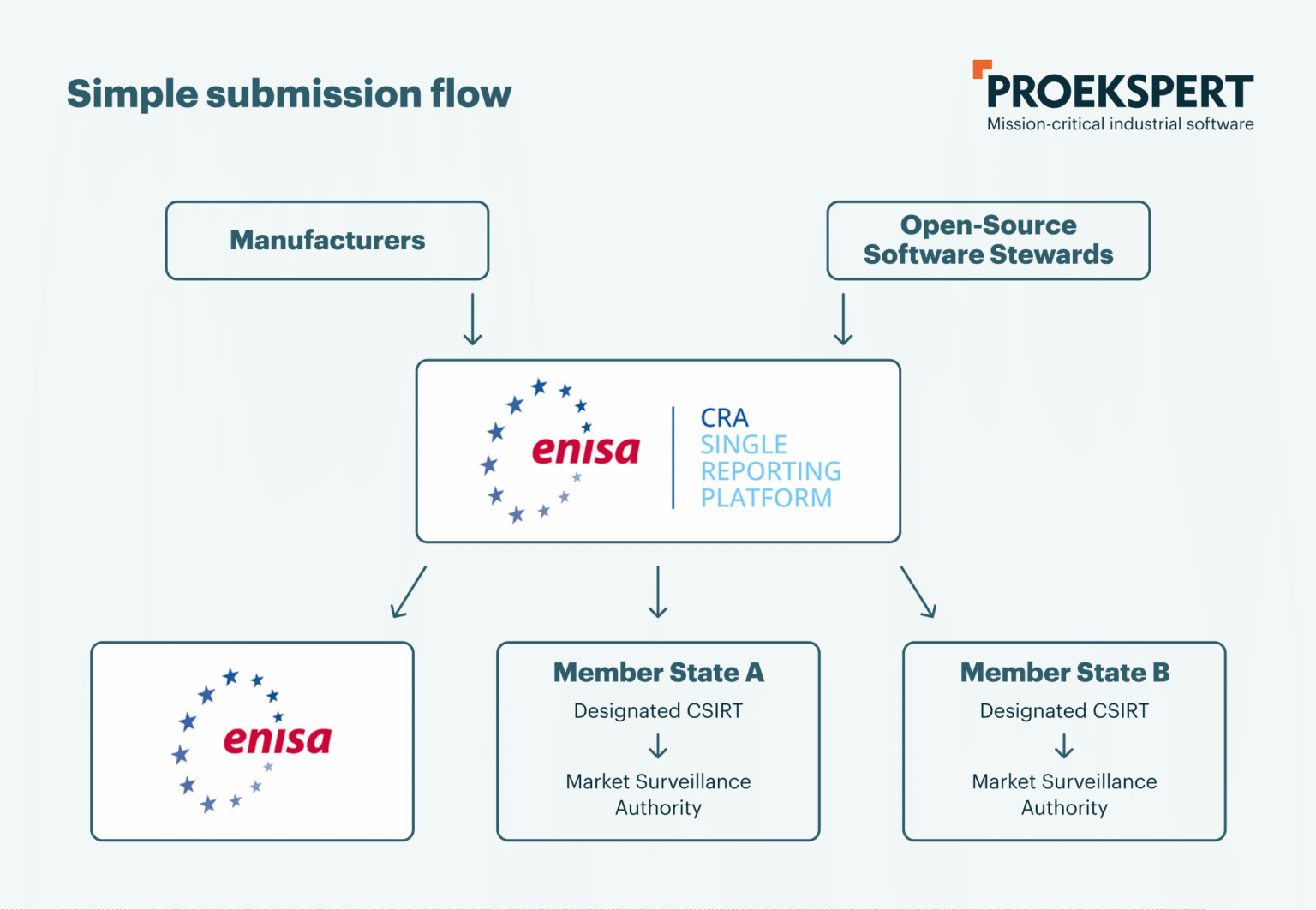
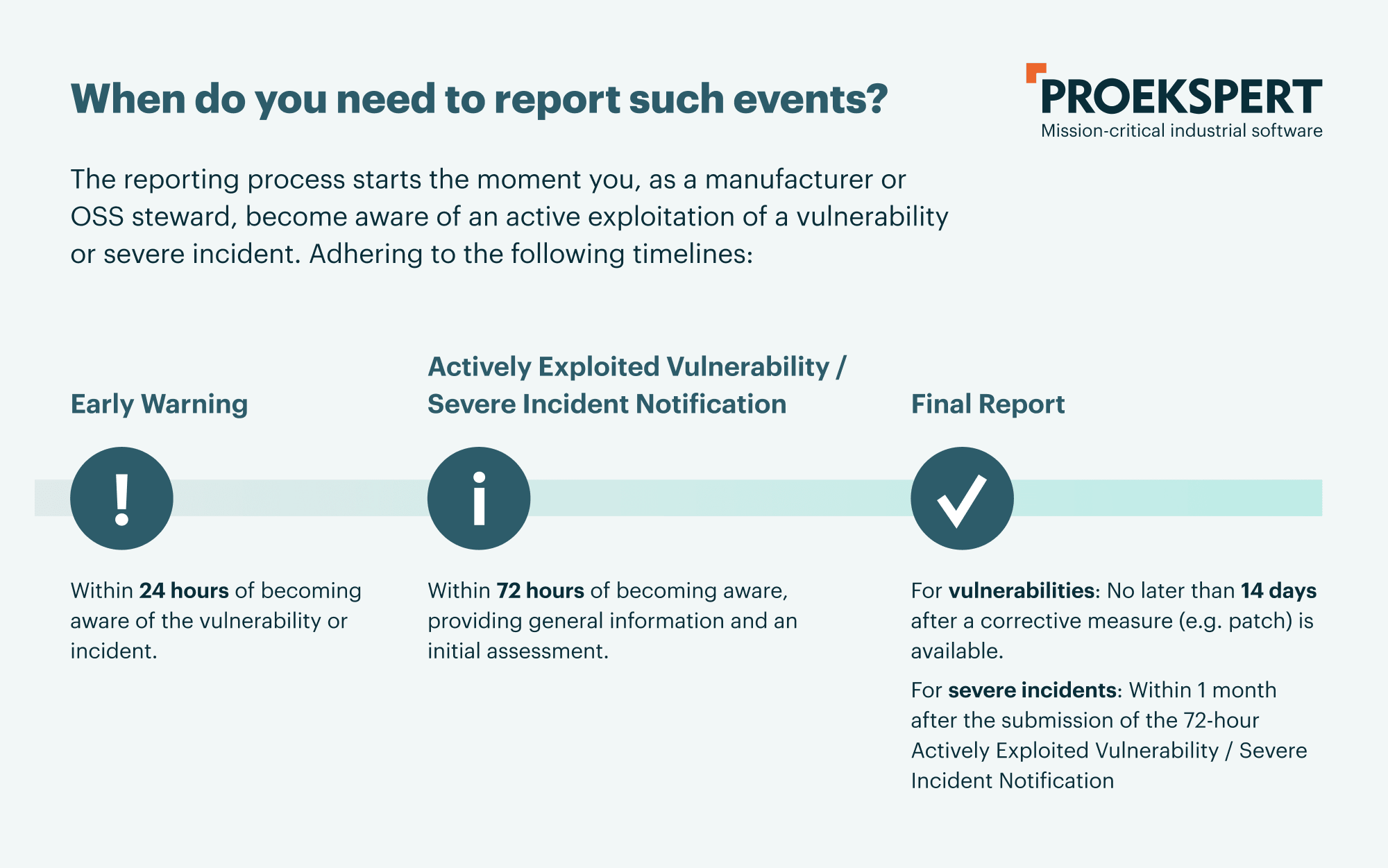
From 11 September 2026, manufacturers must report two categories of event: actively exploited vulnerabilities, and severe cybersecurity incidents that affect product security. Each category has its own reporting steps. 

For actively exploited vulnerabilities, reporting deadlines run from when the manufacturer becomes aware of the active exploitation:

  • 24 hours: an early warning to the CSIRT designated as coordinator for the manufacturer’s main establishment. The notification is made simultaneously available to ENISA. One submission, not two. 
  • 72 hours: a fuller notification with an initial assessment 
  • 14 days after a corrective or mitigating measure is available: a final report 

For severe incidents: 

  • 24 hours: an early warning 
  • 72 hours: a fuller notification 
  • One month after the 72-hour notification: a final report

Reporting goes through ENISA’s Single Reporting Platform (SRP), operational since 11 September 2026. Manufacturers can now submit mandatory notifications through the platform. ENISA provides user manuals, guidance and a field-by-field glossary to help manufacturers prepare and complete reports.

Article 14 also requires manufacturers to notify affected users about the vulnerability or incident, and where appropriate the corrective measures. This is a legal obligation, not good practice. 

Article 14 is written to apply going forward. What you become aware of on or after 11 September 2026 falls under the reporting duty. Pre-existing knowledge is not automatically pulled in by the date. 

What happens if you miss a deadline 

Article 14 reporting obligations have applied since 11 September 2026, but the CRA’s administrative penalty provisions under Article 64 generally apply from 11 December 2027. Those provisions envisage fines of up to €15 million or 2.5% of worldwide annual turnover, whichever is higher, for breaches of Article 14.

The reporting duty matters now, regardless of the penalty timetable. Manufacturers need to know when an event is reportable, which products are affected and how to inform customers.

The less visible risks matter more: 

  • Every notification you file becomes a record on the CSIRT and ENISA  
  • A notification of a vulnerability you cannot fix creates a documented finding while your customers are still using the product 

The last point turns the conversation from paperwork to customer relationship. 

Your real problem is the products you have already shipped 

For a new product in development, CRA compliance is a design and documentation problem. You make the architecture decisions once. You include the requirements from the start. You ship the product with a completed EU CRA Declaration of Conformity behind you.  

For products already in use, the shape of the problem is different. What has to work from 11 September is not the secure-by-design status of the product. It is your ability to detect, classify, report, and remediate a vulnerability across a product portfolio that shipped years ago. Different product generations may have different architectures. Different technical documentation. Different customer commitments. 

If you make drives, HVAC controllers or connected industrial equipment, your installed base is usually much larger than a quarter of new shipments. Article 14 reporting applies to existing products within the CRA’s scope, including those placed on the EU market before 11 December 2027. That does not automatically subject those products to the full cybersecurity requirements that take effect in December 2027.

Four questions about your own product 

The 24-hour, 72-hour, and 14-day clocks look manageable on paper. In practice, they are four engineering capabilities. 

  1. Would you know? Awareness of an actively exploited vulnerability can come from a customer report, security researcher, threat intelligence or your own telemetry. But once an issue is reported, could you establish whether a device you shipped in 2017 is affected? Security logs, firmware component records and reliable version information make that assessment easier. Without them, confirming exposure across an older product line can be slow and uncertain. 
  2. Could you scope it? Once awareness is reached on one product, the 72-hour notification asks which products and versions are affected. If your fleet has no unique per-device identity and no reliable version reporting, you cannot scope the exposure. You will either report too many products and alarm every customer, or report too few and give a regulator wrong information. On legacy embedded platforms, even the SBOM often has to be built by hand. Off-the-shelf tooling does not always work for older toolchains and firmware images. 
  3. Could you build a fix? The 14-day clock starts when a corrective measure is available. For a 2016 product family, “available” means the build chain still works. Is the toolchain archived? Is the build reproducible? Do you hold the signing keys? Does the device accept a signed update at all?  
  4. Could you deliver it to the field? Even if the fix exists, delivery is a separate problem. Does the field procedure require a technician with a laptop and a serial cable? Can you update the device over the air? Can you roll back a bad image without breaking a fleet of devices? 

The Article 14 rule that changes the conversation 

Article 14 does not require you to fix the vulnerability. It requires you to notify an EU authority, and your customers, that an actively exploited vulnerability has been identified in your product. 

If you cannot deliver a fix, you have created a documented finding with an EU authority that a product you shipped has a security problem. That is not a paperwork problem. It is a market access and customer relationship problem. Your customers then choose what to do. Some accept the risk. Some replace the product. Some wait for a fix. Where you sit in that conversation depends on whether you can offer one. 

The trap is not the patch. It is the architecture you build to deliver it. 

Under Article 69(2), products placed on the market before 11 December 2027 generally become subject to the full CRA requirements if they undergo a substantial modification after that date. Routine security updates that reduce cybersecurity risk without changing the product’s intended purpose or introducing new risks are generally not substantial modifications.

Adding remote update capability to a product line that never had it is a different engineering decision. New interfaces, data flows and dependencies may introduce risks that were not considered in the original design.

That does not automatically make the change a substantial modification. It requires a case-by-case assessment of the product’s intended purpose, cybersecurity risks and affected requirements.

The important question is not only whether you can deliver a security fix. It is whether the architecture you introduce to deliver it changes the product’s cybersecurity risk profile. 

If you have IEC 62443 work already 

Existing IEC 62443 work provides a useful starting point for CRA readiness, particularly for product security controls and documented engineering practices. But it does not automatically establish CRA compliance. Vulnerability handling, reporting, support obligations and documentation still need to be assessed against the specific product and the manufacturer’s processes.

The other clock: a decade-scale support obligation

Article 13(8) generally requires at least five years of security support, and longer where the product is reasonably expected to remain in use longer. An exception applies to products with a genuinely shorter expected lifetime. For equipment with 7 to 20 year field lifecycles, that is a decade-scale sustaining-engineering commitment covering security updates, technical documentation, EU Declaration of Conformity maintenance, and user instructions. Most industrial manufacturers have not planned for this yet. Worth asking now: which product families would you commit to supporting under Article 13 conditions, and which would you phase out before December 2027? 

What to do now 

Short and sequenced. 

  1. Inventory what is on the EU market. For each product family, name the legal entity that acts as the manufacturer under CRA. 
  2. Name a reporting owner and a deputy. Make sure both have EU Login accounts with multi-factor authentication enabled.
  3. Identify your CSIRT designated as coordinator. When you need to submit a notification, register through ENISA’s Single Reporting Platform and select that CSIRT. ENISA advises against registering on the platform pre-emptively. CSIRT validation can take place while the notification is being processed.
  4. Rehearse one report on paper. Use a real product family and ENISA’s published field list. Time yourselves. 
  5. Ask the harder question separately. If an actively exploited vulnerability is discovered in that product family, could you still build, validate and deliver a fix? The 14-day deadline applies to the final report after a corrective or mitigating measure becomes available, not to developing the fix itself. Building that capability may take months. 

Four of these are process work. Any competent consultancy can help. The fifth is engineering work on the actual device: whether you can build a fix, deliver it to the field, and prove which units received it. That is where Proekspert comes in. 

How we help 

We work on connected industrial devices that operate inside larger systems: drives, HVAC, weighing, process control. Not consumer electronics. The engineering that makes items like “could you build a fix” and “could you deliver it to the field” answerable: secure firmware update paths, device identity and versioning, IEC 62443 documentation, and CRA-readiness delivery for legacy platforms. 

We supported Danfoss Drives in achieving IEC 62443 Security Level 1 readiness on the VLT® platform and MCT10 configuration tool, without hardware redesign. The TÜV SÜD audit passed with no major issues. 

“Their team supported risk analysis and certification feasibility on legacy platforms, working closely with us to balance compliance, usability, and real customer needs. Their hands-on experts ensured our products are fit for today’s market and tomorrow’s regulations.” 

Tim Flintholm Fink, Product Owner, HVAC and Aqua Drives, Danfoss Drives 

We also supported BLH Nobel with CRA compliance analysis on a long-lived industrial weighing device deployed in cranes, mining, and process industries. Same conclusion: CRA and CE-marking alignment achievable through targeted software upgrades. No hardware redesign. 

The same engineers who find these gaps build the software that closes them. That is the difference between assessing CRA readiness and delivering it. 

Challenge us!

Bring one real product line. Tell us the product family, roughly how many units are in the field, and who owns the firmware. Our engineers will review what Article 14 actually means for that specific product and come back with a first read. 

This is for manufacturers placing connected products on the EU market. Get in touch through our CRA service page or by email at jukka.halttunen@proekspert.com. 

Agentic AI is moving from CEO discussions into real-world operations – and that’s where risk begins

Agentic AI has reached the CEO agenda 

In late 2025, something shifted. 

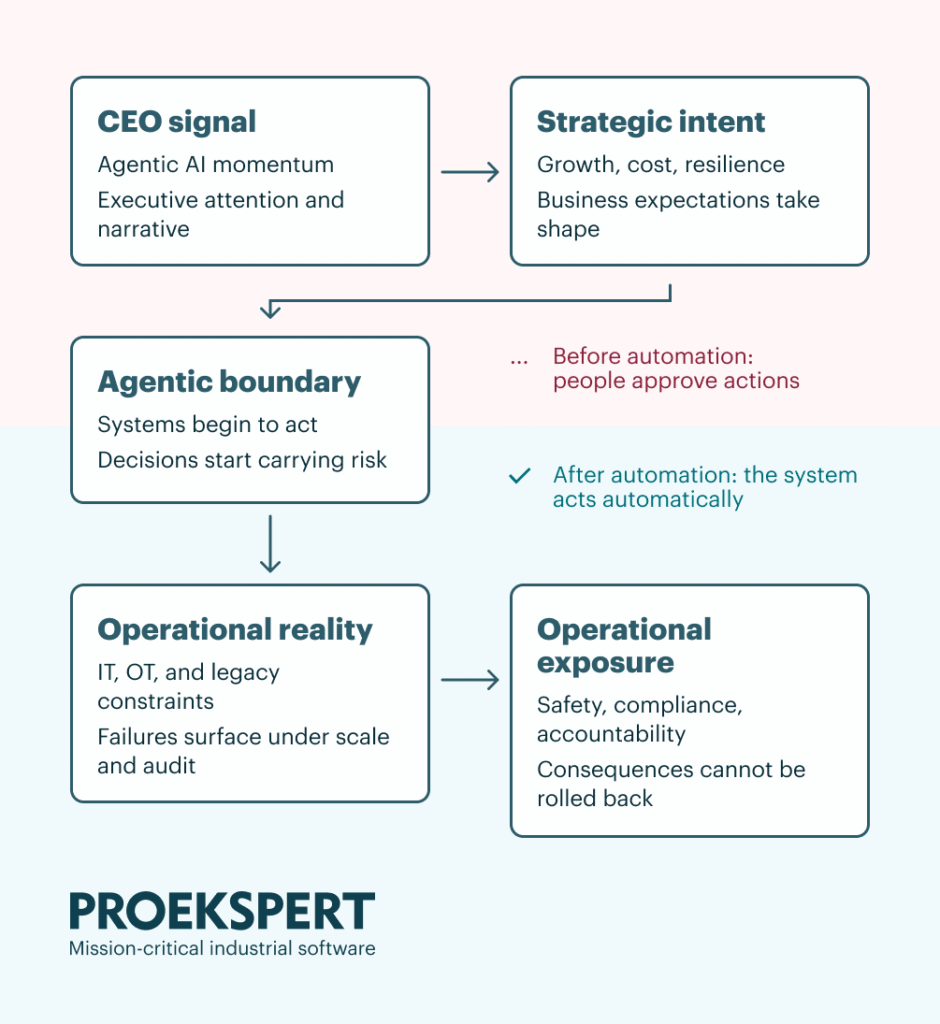
The Boston Consulting Group (BCG) CEO Data Point Interactive analyzes around 6,500 quarterly earnings calls across more than 2,000 keywords. The Q1 2026 picture is telling: agentic AI, AI agents, AI tools, and AI adoption have all settled into the established AI conversation alongside data centers and AI infrastructure. Mentions are no longer surging – they have stabilized at the level of expectation. The new wave of rising mentions belongs to physical AI and AI-native architectures, particularly in industrial contexts. Across all of them, the conversation has moved beyond tech companies into industrial and non-digital sectors. (Source: BCG CEO Data Point Interactive)

What was once a topic for innovation teams is now appearing in conversations about growth, cost discipline, and operational resilience. 

That matters. 

Because once a topic reaches earnings calls, it stops being optional. It becomes an expectation. 

And expectations travel fast – from strategy decks to product roadmaps to engineering teams who are expected to deliver, safely and on time. 

From strategic intent to operational reality 

Agentic AI is no longer discussed as a lab experiment or decision support tool. It is increasingly framed as a way to: 

  • orchestrate operations 
  • improve execution efficiency 
  • reduce cost and risk through autonomy 

In industrial contexts, that means agentic systems touching: 

  • planning and production workflows 
  • maintenance and field service execution 
  • compliance-relevant processes and documentation 

This is where the conversation changes. 

Because when AI starts acting inside core operations, failure modes are no longer theoretical. 

The risk loads at the agentic boundary – the moment decisions stop waiting for human approval and start carrying consequences directly. 

“In production” doesn’t mean “ready” 

Many organizations now report AI agents running in production environments. At the same time, far fewer can claim those systems are: 

  • trusted under audit 
  • resilient under failure 
  • accountable when something goes wrong 

This gap is not surprising. 

Most early agentic AI deployments in manufacturing stall because: 

  • data is fragmented across legacy systems 
  • ownership and permissions are unclear 
  • pilots work in isolation but fail under scale, integration, or regulatory scrutiny 

Pilots are easy.

Production – in regulated industrial environments – is where initiatives quietly break. 

Agentic AI raises the stakes – not just the upside 

Agentic AI is fundamentally different from analytics or copilots. 

Agents: 

  • coordinate across systems 
  • make decisions with downstream consequences 
  • execute actions, not just recommendations 

In practice, this means influencing: 

  • maintenance schedules 
  • safety and compliance logs 
  • procurement and supply chain decisions 
  • field service execution 

Errors are no longer “bad insights.”

They become operational events. 

This is why agentic AI in industrial operations exposes weaknesses that many organizations have lived with for years – legacy systems, unclear boundaries, and manual workarounds that never had to face autonomy. 

Where industrial companies see value first 

Despite the hype, early value from AI agents in manufacturing is pragmatic. One example from our delivery work: at a leading industrial manufacturer, an AI agent now processes every approved competitor manual automatically – replacing manual review that previously covered only 20% of the market. Extraction accuracy is up 20%, and analysis time has dropped from days to minutes.

Maintenance and field service 

Field operations are often the safest place to introduce agentic systems because: 

  • workflows are well defined 
  • compliance requirements are explicit 
  • outcomes are measurable 

This is why many manufacturers start with voice-enabled field AI agents – guiding technicians step by step, capturing structured data automatically, generating audit-ready records, and lifting first-time fix rates by transferring veteran knowledge to newer field staff in the flow of work. 

When implemented correctly, AI agents for field service operations reduce risk rather than increase it by making execution consistent, traceable, and defensible. 

See how Proekspert supports this here:

Cross-functional workflows 

Autonomous orchestration across planning, supply chain, and production promises larger gains – and far higher risk. 

Here, success depends less on models and more on: 

  • disciplined integration 
  • clear data ownership 
  • permissions, logging, and human oversight designed from day one 

The more autonomy an agent has, the more engineering discipline it requires. 

This is where custom AI agents for industrial workflows become essential, because off-the-shelf approaches rarely survive real operational complexity. 

Digital twins help – but they don’t replace delivery 

Digital and virtual twins are increasingly used to test and validate autonomous decisions before they reach real operations. This is a critical enabler for safe agentic AI deployment. 

But they are not a safety net. 

A digital twin amplifies reality: 

  • good data becomes powerful 
  • poor governance becomes dangerous 

Autonomy still lives or dies by architecture, integration, and accountability. 

Why most agentic AI initiatives stall after the pilot 

From real industrial delivery experience, scalable agentic AI succeeds only when teams: 

  • start with one painful, high-value workflow 
  • fix data access before adding intelligence 
  • integrate incrementally, never all at once 
  • design permissions, traceability, and fallback paths upfront 
  • prove value under real operating conditions before scaling 

This is engineering work.

Same discipline that ships any mission-critical industrial system – applied to AI. 

For many organizations, an AI readiness assessment is the fastest way to surface delivery and compliance risks before autonomy expands further. 

Proekspert’s AI assessment and innovation workshops: 

Autonomy is inevitable. Surprises are optional. 

Agentic AI is now firmly on CEO agendas. That means delivery pressure will only increase across manufacturing and industrial organizations. 

The real choice is not whether agentic AI in manufacturing arrives – but whether it arrives safely, compliantly, and under control. 

Organizations that treat agentic AI as a delivery discipline – grounded in real assets, real data, and real accountability – will move faster in the long run than those chasing impressive demos. 

At Proekspert, we’ve learned this in environments where failure is not an option: intelligence must earn trust before it earns autonomy. 

For three decades we’ve helped industrial companies embrace new technologies with a focus on real value. Now we’re helping them do the same with AI. 

About the author 

Carlos Lopes is AI-Powered Digital Services Lead at Proekspert. He works with industrial and manufacturing companies to design and deliver agentic AI and digital solutions that operate reliably under real-world constraints – from field service and maintenance to compliance-critical workflows. 

Meet Proekspert at the Data Innovation Summit 2026

6–8 May 2026, Stockholm, Sweden – Kistamässan

Industrial data and AI, where it has to actually work

Proekspert delivers mission-critical software for manufacturers and OEMs building long-lifecycle products in regulated, high-stakes environments. At the Data Innovation Summit 2026 in Stockholm, our team is there as participants — to listen to what is actually being built, exchange notes with peers, and talk through the practical side of turning industrial data into reliable products and services.

The Data Innovation Summit brings together the Nordic and European data and AI community across three days, fifteen stages, and several thousand practitioners. Our team will be at Kistamässan throughout the event.

Get in touch ahead of the event

If you would like to set up a short conversation with our team at the Data Innovation Summit 2026, the easiest ways to reach us are:

  • Email info@proekspert.com and we will coordinate a time at Kistamässan.
  • Reach any of our team members directly on LinkedIn — profile links are in the team section below.

What we are there to discuss

At the Data Innovation Summit 2026 our team is there for focused conversations on the practical side of industrial data and AI:

  • AI-ready data platforms. Why most stalled industrial AI initiatives have a data foundation problem underneath, not a model problem — and what it actually takes to fix it.
  • AI agents in industrial operations. Moving agents from demos to production in field service, predictive maintenance, inspections, and operational workflows. The places where a flaky agent is not a bug, it is a liability.
  • Embedded-to-cloud architecture for connected products. How firmware, device fleet management, and cloud platforms come together for products that have to keep running for ten or fifteen years, not ten or fifteen months.
  • Industrial AI in regulated, mission-critical contexts. Where reliability, security, and compliance matter as much as innovation, and the engineering discipline that makes AI dependable in those environments.

Our approach is pragmatic, focused on solutions that hold up through audits, updates, and years of operation.

Who you’ll meet

At the Data Innovation Summit 2026, you will meet Proekspert experts working across data platforms, industrial AI, embedded software, and cloud operations. They work closely with engineering, product, and service organizations in HVAC, drives, automation, energy, and industrial equipment, and understand the technical, operational, and regulatory realities behind industrial digitalization.

Urmas Kobin – Head of Data AI-ready data platforms, data engineering and architecture for industrial organizations, governance and lineage in production environments.

Carlos Lopes – AI-Powered Digital Services Lead AI agents for industrial field service, maintenance, inspections, and operational workflows, built around existing systems and trusted data.

Oskar Haavel – Principal Consultant & Partner Mission-critical software, industrial digitalization strategy, and compliance guidance for connected products.

Mika Kinnunen – Country Manager Finland Industrial software for connected products, embedded systems, and long-lifecycle equipment across Nordic manufacturers and OEMs.

Meet Proekspert at HANNOVER MESSE 2026

20–24 April 2026, Hannover, Germany – Hall 26, Stand F78 (Estonian Pavilion)

Mission‑critical software for connected, secure, and intelligent industry

Proekspert delivers mission‑critical software for manufacturers who can’t afford failure. We work with industrial companies and OEMs building long‑lifecycle products in regulated, high‑stakes environments, where reliability, security, and compliance matter as much as innovation.

At HANNOVER MESSE 2026, meet Proekspert at the Estonian Pavilion in Hall 26 (Automation & Digitalization). Our team shares hands‑on experience from production systems and discusses how embedded software, connectivity, data, and practical industrial AI form dependable, production‑ready solutions.

Book a 15-minute meeting at our stand

Reserve a short, focused meeting with our team during HANNOVER MESSE 2026. You can book directly through Calendly:

Book your 15-minute meeting

What you’ll gain at our stand

At Hall 26, Stand F78, our experts are available for short, focused discussions around common challenges manufacturers face when digitalizing products and operations:

  • Designing secure, maintainable embedded software for industrial products
  • Keeping devices reliable in the field through controlled firmware updates
  • Connecting industrial equipment to the cloud without unnecessary risk or cost
  • Understanding what the EU Cyber Resilience Act (CRA) means for your product development, documentation, and vulnerability handling, and how IEC 62443 maps to practical compliance steps
  • Operating connected device fleets over long product lifecycles
  • Applying industrial AI and automation where it delivers measurable value

The EU Cyber Resilience Act is reshaping how manufacturers design, document, and maintain connected products. If you’re working through what CRA means for your product roadmap, our team can walk you through the practical steps based on real compliance work with industrial OEMs. Learn more about how we help manufacturers meet EU CRA requirements.

Our approach is pragmatic, focused on solutions that fit industrial reality and remain reliable through audits, updates, and years of operation.

Who you’ll meet

At HANNOVER MESSE 2026, you’ll meet Proekspert experts working across embedded software, connected systems, cloud operations, digital services, and industrial AI.

They work closely with engineering, product, and service organizations in areas such as HVAC, automation, energy, and industrial equipment and understand the technical, operational, and regulatory realities behind industrial digitalization.

Oskar Haavel – Principal Consultant & Partner
Mission-critical software, strategy, and compliance guidance

Tiina Kalju – IoT-Cloud Integration and Applications Lead
IoT device connectivity, fleet management, and technician/end-user apps

Jukka Antero Halttunen – Embedded Software and Systems Lead
Embedded software, system architecture, secure firmware, and EU Cyber Resilience Act (CRA) compliance for connected products

Carlos Lopes – AI-Powered Digital Services Lead
AI agents for industrial field service, maintenance, inspections, and operational workflows, built around existing systems and trusted data

Free ticket voucher

We’re offering complimentary tickets to HANNOVER MESSE 2026. Activate yours in a few steps through our personal invitation link:

Get your free ticket

EU CRA and IEC 62443 compliance: what nobody tells you (until costs go off the rails)

About the author

Terry London is a Product Manager and Partner at Proekspert, working with industrial manufacturers on EU CRA and IEC 62443 compliance, cybersecurity risk assessment, and long-lived product platforms.


From what we’ve seen across dozens of projects, EU CRA compliance and overall cybersecurity improvement efforts often begin with the right intentions but can drift into trouble along the way. The toughest issues rarely show up on a checklist. Instead, they surface in legacy systems, scattered and outdated documentation, unclear responsibilities, and the challenge of getting all the right people and suppliers aligned.

Here’s what tends to come up repeatedly with industrial manufacturers:

  • Legacy platforms not designed for security – documentation that’s patchy at best.
  • Cybersecurity compliance requirements and feature discussions that turn into internal debates between R&D, IT, product, and management.
  • Suppliers and partners say their bits are “covered,” but gaps multiply when you try to connect the dots.
  • There’s plenty of technically excellent cybersecurity advice out there; but credible proof of what works for industrial devices under real-world conditions is much harder to find.

Insights from the field

A number of manufacturers have already started their CRA gap analyses, certified their operations for ISO 27001, and have a working knowledge of IEC 62443. The challenge is to understand what really works for their product in a business context, because this is where decisions become complicated:

  • Architectural questions sit at the integration and firmware level, especially when your product is part platform, part client customization, and you still carry the core responsibility.
  • Multiple generations of products create risk. New builds can fit with modern cybersecurity compliance requirements by design; years-old platforms force you to weigh what’s necessary and what’s practical to change.
  • Flagship products that are settled in the field and generating good business cannot be tied up for major rework. At the same time, you cannot afford to ignore potential vulnerabilities, lose track of who owns which fixes, or fall behind competitors that require official compliance with an IEC 62443 standard or EU CRA requirements.

Even organizations with strong internal processes often need focused, external help to close the last gaps, align decisions, and keep the project moving.

Where most compliance efforts fall short

  • Audit readiness depends on hands-on know-how. You need someone who understands your systems in detail. External advice is only as useful as your team’s ability to connect it to what’s running in production.
  • Evidence matters more than theory. Every compliance requirement needs to tie back to real features or test cases, so that when you really need to trace back to the source of an issue you have tools to do it efficiently.
  • Flexible controls are critical. Adding new security controls might look good on paper, but if it slows down your operations or causes other frictions in practice, you gain nothing.
  • Traceability is non-negotiable. Documentation needs to reflect actual processes and changes, not paperwork patched up at the last minute.

What actually keeps projects on track

  • Get all technical and business leads together early. R&D, IT, field support, suppliers – get aligned at the very start and clarify responsibilities before problems surface.
  • Test for failure, not just for show. Have one of your toughest engineers take an auditor’s approach and challenge everything. Catching weaknesses early lets you fix them before they become a crisis.
  • Push back on anything that doesn’t fit reality. Not every security control or update makes sense for active flagship products. Mainly, the answer comes from cybersecurity risk analysis, not the security features we would like to implement initially.
  • Build documentation as you go. Capture traceability and evidence through every step. Trying to recreate a paper trail at the end leads to wasted effort and provides a false impression that the documentation is up to date.

What hands-on support really looks like

On a recent project with a manufacturer supporting a range of connected products, the basics were already in place: internal policies and established processes. The tougher work was sorting out which decisions belonged to the platform team and which risks needed to be managed by customers building their own applications on top.

We worked shoulder to shoulder with their engineers on gap analysis and cybersecurity risk assessment. We drew clear boundaries, prioritized which gaps put them at cybersecurity risk, and put together documentation and software fixes that matched reality.

Within a few months, the team had a prioritized roadmap, audit-ready evidence for the in-scope industrial drive platform and its configuration tooling, and a clear split of responsibilities between platform and customer, so certification and ongoing sales could continue without blocking the wider product portfolio.

Most of the real conversations weren’t about the standard itself – they were about what’s “enough” and feasible at the same time – what’s realistic for products with limited resources and conflicting use cases, and what keeps business moving without chasing compliance for compliance’s sake.

That’s what field-level support is all about: giving clear input, driving decisions, and making sure work gets delivered so you aren’t betting everything on cutting‑edge cybersecurity controls that balloon the development cost, make technicians’ lives exponentially complex and in some cases may even contradict non-functional requirements of the device – that’s the case especially with devices meant to operate in industrial environments.

What our compliance analysis actually includes

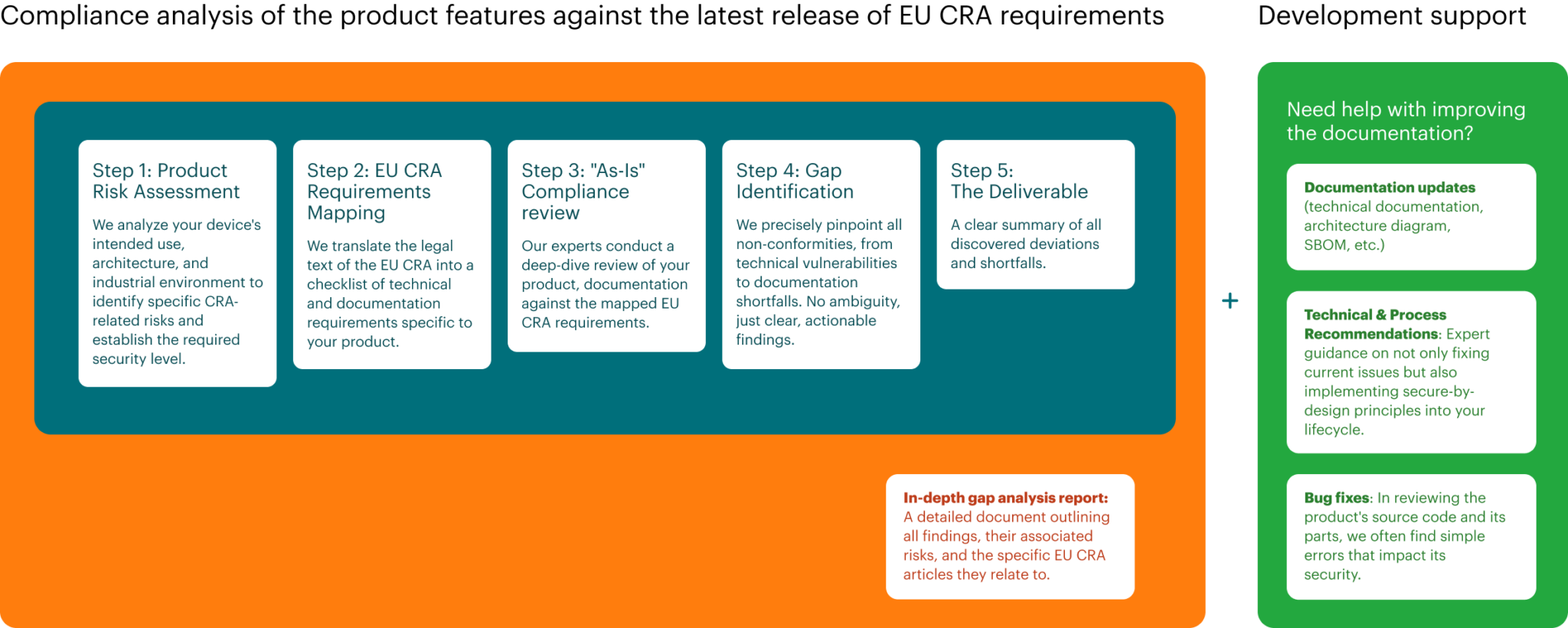
When we talk about EU CRA and IEC 62443 compliance analysis, we mean a set of practical activities that can be used independently or combined, depending on the state of your products and organization: · Gap analysis – Mapping your products, architecture, and development practices against EU CRA and IEC 62443 requirements, to establish where you stand and which gaps matter.

  • Cybersecurity risk assessment – prioritizing those gaps based on realistic risk to the business and to end users, rather than treating all findings as equal checklist items.
  • Documentation and traceability – establishing or repairing the link between requirements, design decisions, implementation, and test evidence, so auditors can clearly see what was done and why.
  • Remediation planning – defining a realistic roadmap: what needs to be fixed now, what can wait, and what can be handled through documentation, compensating controls, or formal risk acceptance instead of costly rework.

Engagements are typically project-based (e.g. 2–4 months for a first gap analysis and roadmap), with the option to continue with focused support as you implement. We work on your side: in your docs, your repo where it makes sense, and in workshops with your R&D, IT, and product people – so the output is something your team can own and maintain.

How we fit with your existing setup

We do not replace your certification body or your internal quality and security teams. We complement them by helping you reach a state where gaps, priorities, evidence, and documentation are clear and defensible.

What we deliver – gap reports, risk assessments, traceability structures, and remediation plans – is structured so your own teams or your chosen certification partner can use it directly during audit and certification. Our role is to close the gap between knowing compliance is required and being able to demonstrate it clearly to an auditor.

What to bring when we start

You do not need a perfect dossier on day one. To make the initial sessions productive, bring whatever you already have: a product or portfolio list showing what is in scope for CRA or IEC 62443, a high-level system or architecture overview, and any existing security, quality, or process documentation.

We work from that baseline and identify what is missing or needs clarification, so time in the first workshops is spent on real gaps rather than on assembling paperwork.

Let’s talk – and make progress from day one

If you’re wrestling with responsibility boundaries, questions about long-lived flagship products, or seeing cybersecurity risk and compliance costs balloon without results, let’s talk.

Bring your working docs, technical headaches, or open questions to Embedded World 2026. We’ll talk them through and help you identify concrete next steps – not just theory.

Meet Proekspert at Embedded World 2026: mission-critical software for security, compliance, and connected products

10–12 March 2026, Nuremberg – Hall 5, Booth 5-189b

Proekspert delivers mission-critical software for manufacturers of automation systems, HVAC, and complex industrial equipment. We help companies tackle key challenges in security, compliance, and connected product operations while supporting long product lifecycles.

At Embedded World 2026, our team will share insights from real projects and explore opportunities for strategic collaboration with your organization.

What you’ll gain at our booth

At our booth, you’ll discover how Proekspert’s mission-critical software solutions help you overcome challenges in security, compliance, connected operations, and product lifecycle management:

  • Keep your products secure, compliant, and connected with Proekspert’s solutions
  • Gain practical guidance on EU Cyber Resilience Act (CRA) and IEC 62443 compliance
  • Ensure reliable firmware updates, device identity management, and managed device fleets
  • Boost efficiency across product development, testing, field operations, and service with AI and automation
  • Accelerate product releases with confidence through R&D and testing support

Who you’ll meet

Our Proekspert experts at Embedded World 2026 include:

Oskar Haavel – Principal Consultant & Partner
Focus: mission-critical software, strategy, compliance guidance

Tiina Kalju – IoT-Cloud Integration and Applications Lead
Focus: IoT device connectivity, fleet management, and technician/end-user apps

Jukka Antero Halttunen – Embedded Software and Systems Lead
Focus: embedded software, system architecture, secure firmware

Terry London – Product Manager & Partner
Focus: EU Cyber Resilience Act (CRA), cybersecurity, compliance strategy

Carlos Lopes – AI‑Powered Digital Services Lead
Focus: AI agents for industrial field service, maintenance, inspections, and operational workflows – built around existing systems and trusted data

They’ll be available to discuss challenges in security, compliance, connected products, AI, and data management, and explore opportunities for strategic collaboration.

For pre-event meetings, schedule a 15-min session via our Calendly link or contact info@proekspert.com.

Schedule a focused 15-min discussion

Meet our experts at Embedded World 2026 for a short, high-value session to explore your challenges in mission-critical software, security, compliance, connected products, AI, and data management.

This discussion is designed to provide immediate insights and identify whether a follow-up collaboration makes sense.

Schedule your session →

Limited slots are available – secure your time with our team today.
Questions? Contact us at info@proekspert.com

Free ticket voucher

We’re offering complimentary tickets to Embedded World 2026.

Contact us at info@proekspert.com to request your personal entry code – first come, first served.

Ministry of Culture honors Proekspert for Arvo Pärt Centre archive upgrade

We’re proud to share that Proekspert has been recognized as a Culture Friend by the Estonian Ministry of Culture for our work with the Arvo Pärt Centre.

Together with the Centre, we upgraded and migrated APIS, their archive information system that’s supported their digital collections for over a decade. The new platform manages almost 11,000 unique materials, making the archive more accessible and secure for researchers, musicians, educators, and historians both in Estonia and internationally.

The modernization focused on carefully preserving existing archival logic and relationships while moving the system to a stable, fully supported technology foundation – minimizing risk while ensuring long-term sustainability.

AI assisted analysis supported the work by helping engineers understand and translate a complex legacy codebase more efficiently, without altering the archive’s underlying structure.

The award was presented at Vabamu in Tallinn. Minister of Culture Heidy Purga handed the diploma to our CEO, Marco Spielmann.

We’re grateful for the trust and collaboration from the Arvo Pärt Centre team and appreciate the Ministry’s recognition. Preserving cultural heritage depends on systems that actually work for the people who need them – this project is proof of that.

Is your IoT all alone on the dance floor? Time to make it move as one. 

Tiina Kalju shows why many industrial IoT projects never move past basic connectivity and explains how manufacturers can turn connected products into systems that drive service, new revenue, and long-term customer relationships.

Why do so many connected products still feel disconnected? 

This summer, I watched Estonia’s famous dance festival. Thousands of dancers, each with years of practice back at home in their local groups, come together every few years for one orchestrated performance, moving exactly the same way. That image sticks with me – it’s a living system, distant from each other but still well coordinated and thought through. 

Tantsupidu at Kalevi Stadium in Tallinn, Estonia: thousands of dancers, each trained apart for years, come together to form coordinated patterns – proving that powerful results only happen when every part connects and moves as one system. Photo: Kaupo Kalda

That same coordination should be the goal in industrial IoT. I often see fleets of smart products, remotely accessible, but still moving as soloists. The most important question isn’t “How many things can we connect?” It’s “How does it add real value – for the business, and for the customer?” 

The business model flip: Are you still selling products, or building lifelong relationships? 

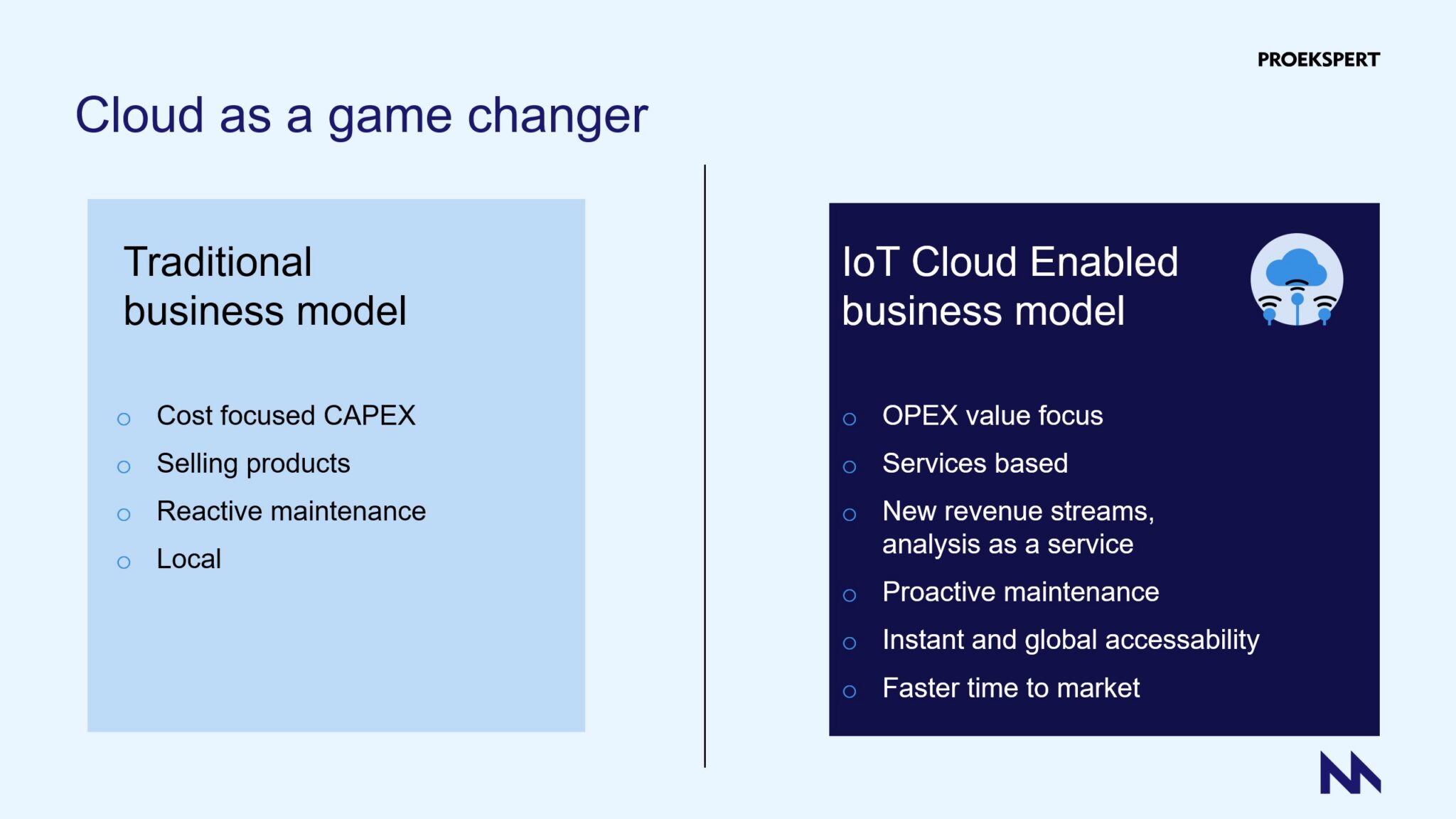
Traditionally, manufacturers sold products; service was reactive, relationships were distant, and once a device left the factory, it was out of sight. Today, IoT and cloud have changed the story for those ready to act. 

Now, forward-thinking organizations: 

  • Shift to service-centric models: proactive maintenance, reliable uptime, real-time support, and remote upgrades 
  • Stay close to customers, respond faster, and keep feedback loops open – from any corner of the globe 
  • Experiment and launch new offerings quickly, based on real-world operational data 
  • Turn data into actionable business opportunities, like uptime guarantees or tailored remote support packages 

Customer relationships become ongoing partnerships, not one-off transactions. That’s a strategic opportunity to build loyalty and open new sources of value. 

What’s getting in the way? 

A few patterns come up time and again: 

  • Organizational habits run deep. True progress requires alignment across service, support, product management, and R&D – not just leadership buy-in. 
  • Many organizations aren’t sure how – or when – to introduce payment for new digital services, so change stays slow and impact is limited. 
  • The technical potential of IoT-cloud is lost when the business model doesn’t evolve alongside. IT investment alone can’t deliver returns. 

These observations come from working directly with clients who know their realities best and move at the right pace for their business. 

Data and AI – powerful, but only with purpose 

The flood of operational and usage data in industrial IoT systems is only the beginning. What matters is how it’s used to deliver real outcomes: 

  • See your whole connected system in real time and act on what matters – for maintenance, upgrades, and support 
  • Use AI not just for analytics, but to anticipate problems, automate updates, and serve clients before they call for help 
  • Transform insights into business models previously out of reach – selling uptime, offering performance-based pricing, or enabling predictive support 

AI and cloud make the team more efficient, proactive, and customer focused. The real value comes when insights are connected to action.

IoT value: more than a technical project 

It’s easy for IoT projects to become about the technical corridor – developing connectivity, setting up cloud, integrating devices, implementing secure remote access, launching portals, features, and dashboards. But real impact happens when these capabilities become the engine for better customer relationships, new service revenue, and operational improvement. 

What sets apart those leading the way: 

  • They treat IoT-cloud platforms as foundational, using secure remote control, 24/7 monitoring, and cloud-based device management to deliver smarter, faster services. 
  • They build systems where every cloud-connected interaction – alerts, updates, diagnostics – is woven into the bigger picture: service, sales, and product evolution. 

Without that bigger picture, even the best systems add limited value. 

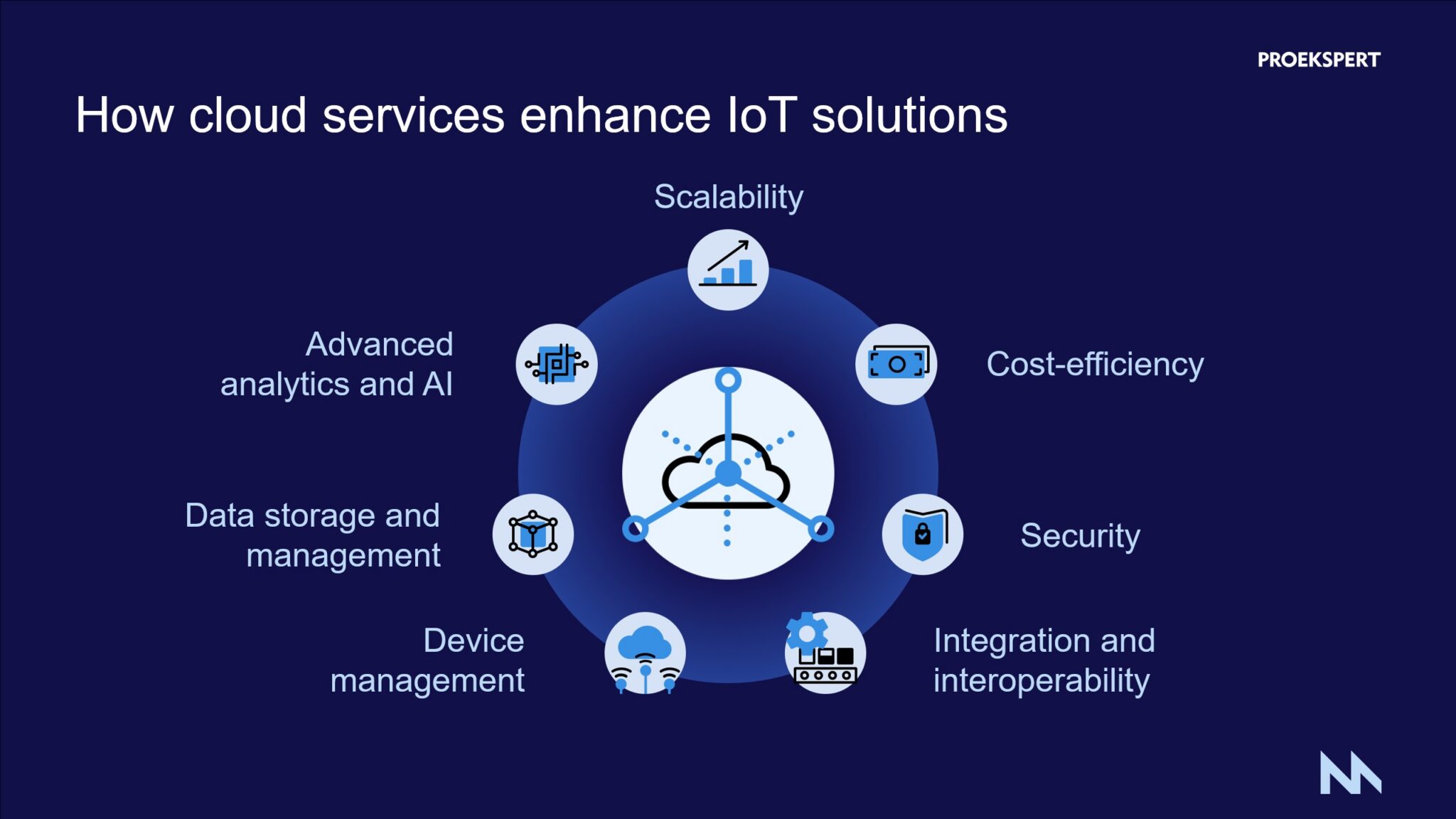
What cloud actually does for your IoT 

Cloud connectivity isn’t just about storage or convenience. It’s the platform that enables thousands – or hundreds of thousands – of devices to sync, share, and build collective intelligence. 

Here’s what really matters: 

  • Aggregating operational data with purpose – not just for graphs, but for decision-making 
  • Delivering real-time analytics, access control, diagnostics, and predictive maintenance at scale. Mass data creates collective intelligence, showing how devices behave in the real world and enabling improvements based on actual use – not just lab testing. 
  • Supporting applications for remote management, continuous improvement, instant support, and proactive care – so every product stays connected to the maker, and to the user 

A well-architected cloud makes these moves possible, not just more technical complexity.

The uncomfortable truth – and the opportunity 

Business and technology often operate in parallel. The tools and know-how are there, but the big picture must come together for real innovation. If success is still measured by devices connected or dashboards launched – not by new services delivered, downtime avoided, or revenue gained – your IoT isn’t moving as a system. It’s just dancing alone. 

Make your system perform – don’t let it dance alone 

IoT and cloud need to be more than a showcase or technical milestone – they need to drive practical value, new ways of working, and better customer outcomes. 

Don’t let your connected products keep dancing solo. Bring business, R&D, sales, support, and every customer touchpoint on stage together. Like a great dance performance, every role matters – and true impact only happens when all the parts move as one. That’s when the system truly performs, and when transformation is real. 

Proekspert connects your products to the cloud, streamlines remote management, and helps you turn IoT into real business value. See our IoT-cloud solutions, or contact Tiina at tiina.kalju@proekspert.com and let’s talk about your business needs. 

Shared success: Stiebel Eltron’s MyStiebel app recognized for digital excellence

Proekspert’s work on the MyStiebel app for Stiebel Eltron has been independently recognized by Stiftung Warentest – the German consumer authority – for setting new standards in digital excellence and product trust.

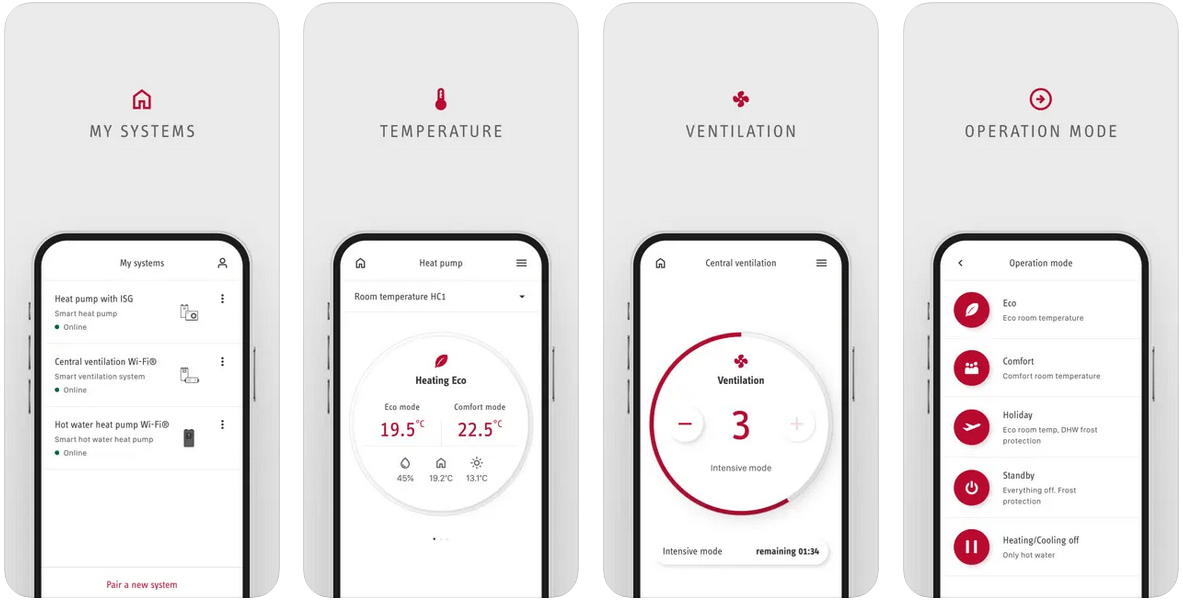
The Stiebel Eltron WPL-A 10.2 Plus HK 400 heat pump system was recently recognized by Stiftung Warentest – earning a top “GUT (2,2)” rating and second place overall. Within this comprehensive evaluation, the MyStiebel app and backend, developed by Proekspert, received the highest possible grade for privacy, security, and usability in the digital services category. 

A win built on true collaboration 

This achievement highlights more than technical expertise – it speaks to the deep, ongoing partnership between Stiebel Eltron and Proekspert. Together, we’ve delivered a solution that empowers homeowners with secure, intuitive remote control for heating and hot water – making everyday life easier. 

Delivering value for homeowners and industry 

Every aspect of the MyStiebel solution – from cloud architecture to mobile user experience – was crafted to empower Stiebel Eltron homeowners with reliable, remote control of their heat pumps, cooling, and hot water. And thanks to our deep partnership, every rollout is built to scale for tomorrow’s needs. 

“Working alongside Stiebel Eltron, we set out to prove that industrial apps can be both cutting-edge and user-friendly. Independent validation by Stiftung Warentest shows what’s possible when you combine ambitious engineering, business vision, and true partnership. Every great product win starts with shared goals and trust.”

Tiina Kalju, IoT-Cloud Integration and Applications Lead, Proekspert 

Curious how we did it? 

Read the full case study to explore the strategy, technical challenges, and business results behind this award-winning solution. 

Looking for industrial mobile app expertise for your next product? 
See how Proekspert delivers scalable, secure remote device solutions.