Agentic AI is moving from CEO discussions into real-world operations – and that’s where risk begins



Agentic AI has reached the CEO agenda
In late 2025, something shifted.
The Boston Consulting Group (BCG) CEO Data Point Interactive analyzes around 6,500 quarterly earnings calls across more than 2,000 keywords. The Q1 2026 picture is telling: agentic AI, AI agents, AI tools, and AI adoption have all settled into the established AI conversation alongside data centers and AI infrastructure. Mentions are no longer surging – they have stabilized at the level of expectation. The new wave of rising mentions belongs to physical AI and AI-native architectures, particularly in industrial contexts. Across all of them, the conversation has moved beyond tech companies into industrial and non-digital sectors. (Source: BCG CEO Data Point Interactive)
What was once a topic for innovation teams is now appearing in conversations about growth, cost discipline, and operational resilience.
That matters.
Because once a topic reaches earnings calls, it stops being optional. It becomes an expectation.
And expectations travel fast – from strategy decks to product roadmaps to engineering teams who are expected to deliver, safely and on time.
From strategic intent to operational reality
Agentic AI is no longer discussed as a lab experiment or decision support tool. It is increasingly framed as a way to:
- orchestrate operations
- improve execution efficiency
- reduce cost and risk through autonomy
In industrial contexts, that means agentic systems touching:
- planning and production workflows
- maintenance and field service execution
- compliance-relevant processes and documentation
This is where the conversation changes.
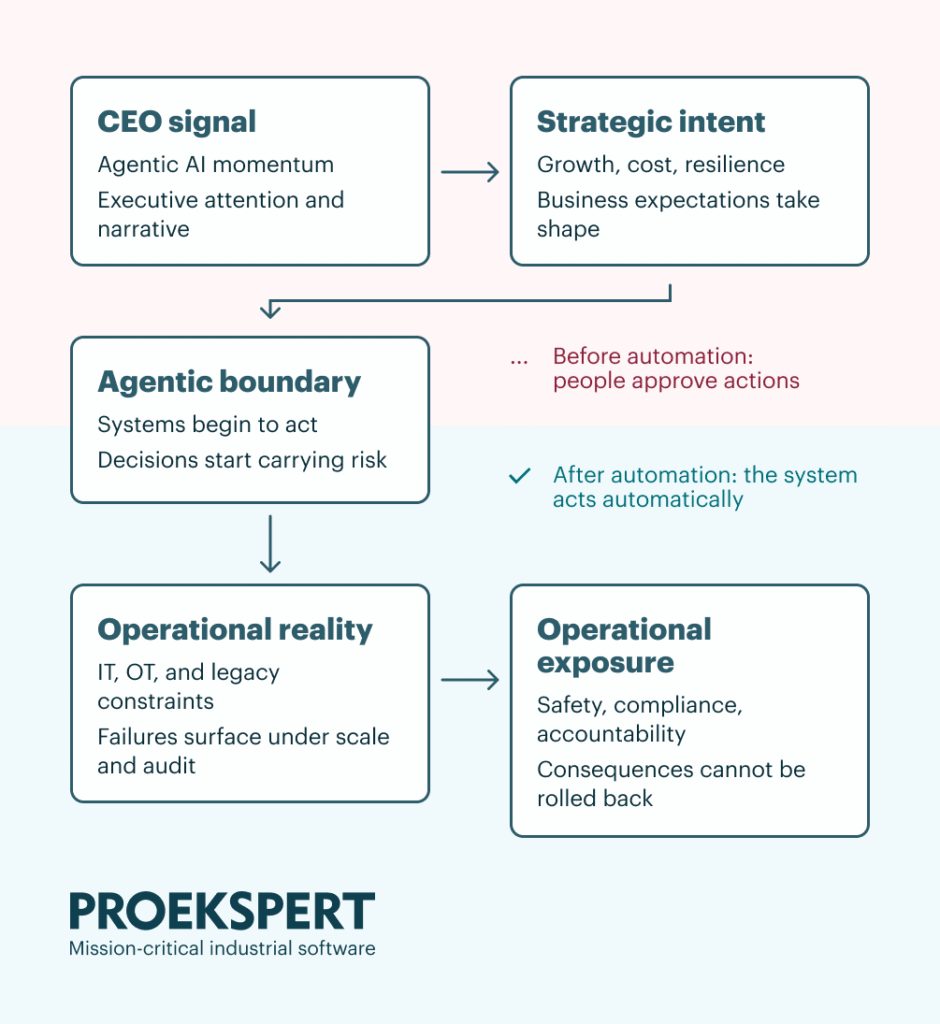
Because when AI starts acting inside core operations, failure modes are no longer theoretical.
The risk loads at the agentic boundary – the moment decisions stop waiting for human approval and start carrying consequences directly.
“In production” doesn’t mean “ready”
Many organizations now report AI agents running in production environments. At the same time, far fewer can claim those systems are:
- trusted under audit
- resilient under failure
- accountable when something goes wrong
This gap is not surprising.
Most early agentic AI deployments in manufacturing stall because:
- data is fragmented across legacy systems
- ownership and permissions are unclear
- pilots work in isolation but fail under scale, integration, or regulatory scrutiny
Pilots are easy.
Production – in regulated industrial environments – is where initiatives quietly break.
Agentic AI raises the stakes – not just the upside
Agentic AI is fundamentally different from analytics or copilots.
Agents:
- coordinate across systems
- make decisions with downstream consequences
- execute actions, not just recommendations
In practice, this means influencing:
- maintenance schedules
- safety and compliance logs
- procurement and supply chain decisions
- field service execution
Errors are no longer “bad insights.”
They become operational events.
This is why agentic AI in industrial operations exposes weaknesses that many organizations have lived with for years – legacy systems, unclear boundaries, and manual workarounds that never had to face autonomy.
Where industrial companies see value first
Despite the hype, early value from AI agents in manufacturing is pragmatic. One example from our delivery work: at a leading industrial manufacturer, an AI agent now processes every approved competitor manual automatically – replacing manual review that previously covered only 20% of the market. Extraction accuracy is up 20%, and analysis time has dropped from days to minutes.
Maintenance and field service
Field operations are often the safest place to introduce agentic systems because:
- workflows are well defined
- compliance requirements are explicit
- outcomes are measurable
This is why many manufacturers start with voice-enabled field AI agents – guiding technicians step by step, capturing structured data automatically, generating audit-ready records, and lifting first-time fix rates by transferring veteran knowledge to newer field staff in the flow of work.
When implemented correctly, AI agents for field service operations reduce risk rather than increase it by making execution consistent, traceable, and defensible.
See how Proekspert supports this here:

Cross-functional workflows
Autonomous orchestration across planning, supply chain, and production promises larger gains – and far higher risk.
Here, success depends less on models and more on:
- disciplined integration
- clear data ownership
- permissions, logging, and human oversight designed from day one
The more autonomy an agent has, the more engineering discipline it requires.
This is where custom AI agents for industrial workflows become essential, because off-the-shelf approaches rarely survive real operational complexity.
Digital twins help – but they don’t replace delivery
Digital and virtual twins are increasingly used to test and validate autonomous decisions before they reach real operations. This is a critical enabler for safe agentic AI deployment.
But they are not a safety net.
A digital twin amplifies reality:
- good data becomes powerful
- poor governance becomes dangerous
Autonomy still lives or dies by architecture, integration, and accountability.
Why most agentic AI initiatives stall after the pilot
From real industrial delivery experience, scalable agentic AI succeeds only when teams:
- start with one painful, high-value workflow
- fix data access before adding intelligence
- integrate incrementally, never all at once
- design permissions, traceability, and fallback paths upfront
- prove value under real operating conditions before scaling
This is engineering work.
Same discipline that ships any mission-critical industrial system – applied to AI.
For many organizations, an AI readiness assessment is the fastest way to surface delivery and compliance risks before autonomy expands further.
Proekspert’s AI assessment and innovation workshops:

Autonomy is inevitable. Surprises are optional.
Agentic AI is now firmly on CEO agendas. That means delivery pressure will only increase across manufacturing and industrial organizations.
The real choice is not whether agentic AI in manufacturing arrives – but whether it arrives safely, compliantly, and under control.
Organizations that treat agentic AI as a delivery discipline – grounded in real assets, real data, and real accountability – will move faster in the long run than those chasing impressive demos.
At Proekspert, we’ve learned this in environments where failure is not an option: intelligence must earn trust before it earns autonomy.
For three decades we’ve helped industrial companies embrace new technologies with a focus on real value. Now we’re helping them do the same with AI.
About the author
Carlos Lopes is AI-Powered Digital Services Lead at Proekspert. He works with industrial and manufacturing companies to design and deliver agentic AI and digital solutions that operate reliably under real-world constraints – from field service and maintenance to compliance-critical workflows.
About Proekspert
Proekspert is a European industrial software engineering partner with over 30 years of experience building mission-critical systems for manufacturers and OEMs. We modernize legacy systems, develop secure connected products, and deliver cybersecurity compliance — including IEC 62443 and the EU Cyber Resilience Act. Our expertise spans embedded software, device-to-cloud integration, industrial AI, and cybersecurity for regulated sectors.