Augmenting Data Scientists

Data technologies are in the early stages of their life cycle, so diffusion is not yet prevalent, opening space for innovation in data science tools. We estimate that a great data science tool focusing on the core activities saves at least 50% of calendar time spent on developing models.
– André Karpištšenko

The Right Timing for Data Science

Most companies are awash in data and an increasing number are creating products that combine data with analytical capabilities. Figuring out how to derive a profit from data is the job tackled by businesses together with data scientists. The impact of the data economy on GDP is expected to be considerable: for example two to four percent of the EU economy will be impacted by 2020 thanks to the data economy.

The number of highly-skilled data workers is forecasted to grow through 2020 in most economic scenarios, and there will continue to be a shortage of professional data scientists globally.

Augment Impact Through Better Tools in Data Science

Better tools that automate data scientists’ work can increase supply. Data technologies are in the early stages of their life cycle, so diffusion is not yet prevalent, opening space for innovation in data science tools.

IDC, the global markets intelligence firm, has forecasted $46 billion in corporate revenues associated with cognitive and artificial intelligence systems in 2020, a compound annual growth rate of 54.4%. As data scientists become more productive, the number of scientists does not need to increase proportionally with the increase in technology investments.

Focus on Automation of Data Science

Productive high-performance data scientists are a competitive edge for leading companies.

Preprocessing takes 80% of their time and is domain specific and hard to automate. Tamr and Trifacta provide tools for easing the workload in this area. Furthermore, data syndication and publishing services, such as Xignite, Planet OS, Enigma and Qlik, provide clean and curated data in some industries. Building upon data exchanges and preprocessing related technologies is a good use of data science resources.

The remaining 20% is the core of the data scientist’s activity – building, training, visualizing and deploying predictive models for services and products. By automating this part, we can significantly reduce the feedback loop duration and enable faster turnaround time from ideas to results. Automated scaling of experiments has a similar impact, as it allows the search space for the best performing model to be extended. Together with reduced errors from manual activities, we estimate that a great data science tool focusing on the core activities saves at least 50% of calendar time spent on developing models.

Experience the Impact in Data Science

At Proekspert, we are investing in the development of tools to boost productivity and automate these core activities. The first-hand experience of our data scientists is very encouraging. Contact us to talk about the approach.

How Mixed Reality Will Change Your Business

If mixed reality technology is truly on the horizon, how will it actually be incorporated into our lives and dominant industries? Let’s look at specific industries that may be the first to incorporate mixed reality into their work flows and beyond.
– Kunnar Kukk

Reimagining retail

The rise of the internet and online shopping put brick and mortar businesses at risk, ultimately reshaping the retail industry in its entirety. Mixed reality has the potential to affect the industry to a similar extent.

Imagine virtual dressing rooms that avoid the claustrophobic and time-consuming process of trying on clothes. An augmented reality app will enable you to visualize any item of clothing or outfit. Put on your Hololens, look into a mirror, and voilà, any outfit you desire is projected onto your reality. You can even view yourself in 3D to see how an outfit looks on you from any angle. In the comfort of your own home, you would have access to every fashion and trend, and enjoy a hassle-free shopping experience.

Clothing is not the only product that can be experienced through mixed reality. With a headset like Hololens you could drag an item of furniture from an online store into your living room, and move it around to see where it fits best. Mixed reality could transform online shopping so that the experience would no longer necessitate a leap of faith–every product could be tested and visualized in a real space before purchase. To gain a sense of the mixed reality shopping experience check out what Volvo is working on.

Stepping into the design process

Mixed reality technology could also totally transform interior design and even architecture. Designers could assemble whole rooms, inviting clients to experience them as if they were there in the actual space. The same technology might be used to conceptualize fairs, exhibitions, and even operating rooms. See a great demo:

Amazingly, some architecture firms (see IrisVR) are already utilizing virtual reality in order to give their customers the experience of architectural designs from the inside. Mixed reality could even enhance the experience of buying real estate, allowing developers to demonstrate site potential to customers by projecting future buildings and real objects in a space.

Manufacturing in mixed reality—building efficient teams

The manufacturing industry is an ever-evolving one. Do we ever not see headlines about manufacturing in the news?

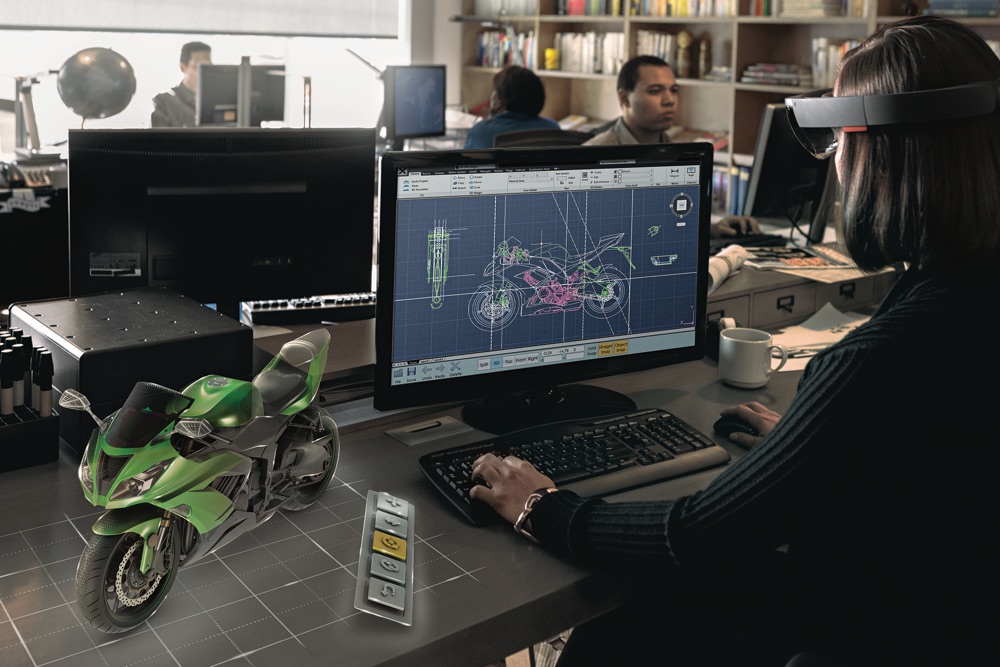
As much as manufacturing is full of innovations, mixed reality can bring even more novelty and efficiency into the work process. Mixed reality solutions across the entire product development process could enable engineers and designers to iterate together in real time. Bringing in new visualization, design and production tools, mixed reality could mean faster prototyping, more confident decision making, and more efficient cooperation between teams.

Breaking barriers in education

Technology has already become a catalyst for change in education. Classrooms are now often equipped with laptops and tablets that give students access to a plethora of resources. Major universities like Stanford and Yale offer online lectures that are accessible to anyone in the world.

One of the first projected use cases for virtual reality is in fact education. Developers are excited about the idea of setting up virtual classrooms where students from all over the world can interact with professors in an immersive digital environment. Mixed reality would take this virtual classroom to the next step, bringing the classroom into the home of each individual user. Hololens’ holoportation function could make online tutoring feel like a genuine in-person experience. And educational materials would become immersive too: imagine flat illustrations transformed into interactive 3D models that students can explore, alter, and examine from every angle.

Whether it be retail, architecture or education, mixed reality could change the real world that we experience by adding layers of creativity and information on top of our everyday reality.

For a comprehensive breakdown of the mixed reality industry—including an introduction to VR and AR—check out part one of this series: Is it finally time to invest in mixed reality?

Contact Us

If you would like to discuss it further, contact us or join our newsletter.

Radical Organizational Change (in Five Intense Days)

Kaja Kruus on what she wishes she’d known before Proekspert made its transformation to a bossless culture.

Companies are facing stiff competition more than ever before. Sometimes accompanying this competition is the feeling that everything has been done before, everything is digitalized, and the startup world is attracting all the talent. You know innovation is needed. But how to innovate? What if the key to the answer resides in this very question: How?

So how do you not fall into the traps of over-specification and feature creep? How do you reach a common understanding of exactly what to build? A problem described as a question quite often repeats a pattern which I have witnessed over recent years. And I have understood that everything begins from the mindset of an enterprise. The days when a brand could woo consumers with just beautiful words are gone. If your service or product is inferior, then word spreads faster than wildfire. Perhaps your people are a reflection of your product or service, and it’s therefore necessary to begin with the question of how do we do it, rather than what we do.

A start-up mindset

Around four years ago Proekspert began its journey to becoming a boss-less company. In the beginning the major problem was people talking past each other — what does something mean exactly and how complicated is it to understand how we’re now going to do things. Maybe somewhere we still have some hidden management. Looking back with 20/20 hindsight I would have advised the Proekspert team to use one method which will extricate you from complicated situations, facilitate a better understanding of one another, and help you listen to ideas which you then bring to life. Instead of talking about a boss-less company, practicing it and changing the mindset by doing. Because in the process of change it is extremely easy to return to the beaten path and say, “Well, it didn’t work.”

Startups are characterized by speed and boldness. They don’t have the luxury of greasing the slide with old fat, to use my grandmother’s expression, and they’re forced to step out of their comfort zones every single day. All the questions that I posed before must be answered quickly and effectively in the startup world.

The answer is sprint. Design sprint.

GV (formerly Google Ventures) created a method for just that. It is called the design sprint. Design meaning creativity and sprint means results in just five days. It’s a combination of design thinking, Agile and lean. It’s a wonderful train wreck of creativity, a human-centered approach, flexibility, and amazing speed.

While the preparation for a sprint is extremely important, for this article I want to concentrate on the value and end result, and will therefore focus on the five-day action plan.
Day 1: Understand the problem at hand, map the flow to your goal.
Day 2: Explore ideas.
Day 3: Choose the best ideas and go into detail.
Day 4: Create a prototype.
Day 5: Test your prototype on real human beings and get feedback.

You know the “fail fast” idea? Well, the best part about the design sprint is that it never fails! When your prototype gets negative feedback you have won, because you just spent a week to find out that your ideas suck, and you’ve spent not a dime on development.

An example, please!

Imagine that you are running an online health and fitness business. You want to expand and get more subscribers. Your marketing partner says that the best way is to order a Facebook campaign from them. Your technical manager says you should add more features. Your financial manager says you should add a new, more expensive package to your offerings. You have a lot of ideas, but you don’t know what to do. You run a design sprint where you describe the goal, draw a map how to get there, interview experts, sketch a lot of ideas, choose the best one(s), create prototypes, and test them on real customers. And the result is that none of the ideas you considered in the beginning are among the chosen ones.

There’s another example how the design sprint methodology helped a very large venture move to the next level. The environment where we live and where our kids grow up matters to almost every one of us. In Estonia, there is a group of people who not only think about the topic but also take action. In 2018, a world cleanup day called Let’s Do It World will take place, where a digital solution plays an important role. Expectations for technical solutions were very high. With the help of design sprint, it became clearer how many topics are on the table and how and where to progress. Endo Viires, an advisor for Let´s Do It World and Services Manager at Telia Estonia says, “Proekspert´s approach helped us bring out the important questions that are difficult to discover without the help of an external partner. Too often, with standard ways of working, principles get pushed aside and it seems easier to solve things blindfolded. But that approach always ends up with huges costs and terrible headaches.”

And then the mindset changes

Design Sprint has hidden values as well. You know how hard it is to put a bunch of people in one room and get them to work as a team? And how hard it is to find time to really listen to people and get to know them? The sprint will be full of activities and it can be quite intense. But during that time you will learn to know each other – your weaknesses and strengths. You learn to listen. You learn to pitch your ideas, evaluate them, and turn them into a working prototype.”

This is how you change the mindset that will start a change in the organization. And this is what Tony Robbins means with his famous quote “If you do what you’ve always done, you’ll get what you’ve always gotten.” And you do want new results, don’t you?

Contact Us

If you would like to discuss it further, contact us or join our newsletter.

Proekspert Wins German-Estonian Economics Prize

Proekspert won this year’s German-Estonian economics prize, awarded by the German-Baltic Chamber of Commerce. Held for the seventh time, the theme of the competition was “The advances of the digital age – Industrie 4.0”. All Estonian companies involved in the digitization of the manufacturing processes, or providing relevant solutions for industrial enterprises, were invited to participate in the competition.

“Congratulations to this year’s winner! The competition was tough, but Proekspert was successful,” said Thomas Schöllkopf, President of the German-Baltic Chamber of Commerce. “We will continue to support innovative companies like our finalists and winner.”

Proekspert took part in the German-Estonian economics award competition because we wanted to introduce our product development projects to a wider audience. These projects focus on smart devices, digitization, and solutions related to Industry 4.0, the internet, AI, machine learning, and other similar topics.

When asked for the competition to articulate why we deserved to win, we responded:
• Proekspert has been involved in connecting devices for almost 25 years. So digitization has been our strength for a long time before someone came up with the idea of Industry 4.0.
• At Proekspert’s core, our soul is engineering and everything we do revolves around that. We’re not a marketing company wearing a technical mask.
• We are already operating in the German market, and our experience so far confirms that we can add value in several sectors of the German economy.

The solution presented at the competition was simFactory – created for smart factories, and based on collecting data from shop-floor devices and business systems, simFactory processes and harmonizes data and analytics to improve decision-making. The uniqueness of the solution lies in the new way it presents analytics from observing the manufacturing process and the variety of functions it performs in the factory. The implementation of this solution makes manufacturing processes easier to monitor and more transparent, facilitating better business decisions. The solution takes advantage of data analysis to use production-related resources (equipment, people) as efficiently as possible, improve product quality, and reduce production costs.

The jury for the award included economic opinion leaders from Germany and Estonia.

The previous winners of this prize are Enics Eesti (2016), GlasStress OÜ (2015), Meiren Engineering OÜ (2014), Bole OÜ (2013), Suwem AS (2011) and Asper Biotech AS (2009).

Natural Selection in the Manufacturing Industry

The most critical factor separating a manufacturer from Industry 4.0 is not any issue inherent to the shop floor. It is stagnation and the unwillingness to change.
– Kadri-Liis Kusmin

IoT 4.0 and digitization of factories

Industry 4.0 is the new buzzword of the manufacturing industry, a sequent wave of distinct industrial advancements that takes the digitization of factories even further. By making use of today’s novel technologies including high-speed network communications, big-data and cloud computing, today’s factories will evolve into smart lights-out factories, where intelligent machines take over the more repetitive tasks and human workers can focus on the more innovative challenges. The clear course of Industry 4.0 has not been defined yet and its success or failure greatly depends on actions taken today.

We at Proekspert / simFactory believe Industry 4.0 will be what we make of it, and thus we put our effort into building a better future with our industry partners. We have visited many manufacturing plants, and even though each of them has its own nuances, the bulk of issues overlap and most can be solved through the application of ICT. Thus, the most critical factor separating a manufacturer from Industry 4.0 is not any issue inherent to the shop floor. It is stagnation and the unwillingness to change.

Today’s factories / future smart factories

Our industry partners are determined to use ICT to its full potential, and working together we have developed solutions to integrate shop-floor machinery to visualize real-time data, reduce the time operators spend on manual bureaucracy, and promote the competencies of the future workforce. Regarding the readiness for Industry 4.0, today’s factories can roughly be categorized into two groups: process-driven factories and impulse-driven factories.

Process-driven factories have maximally optimized their processes, everything is planned, and work usually goes according to plan. The main issues derive from the factors that cannot be planned: machinery incidents, unexpected maintenance, or issues with the workforce. The problem is that the company wants to grow but the processes cannot be optimized further. This means they need to find other improvement areas, for example digitization. However, moving from a process-driven mindset to a data-driven mindset can be very hard, especially if there are no major issues. The factory works just fine, especially compared to less-advanced competitors, so they don’t really have an incentive to look for more advanced production methods.

Impulse-driven factories also rely on processes, but they are not optimized, which causes some struggle. When orders come in, it is not easy to estimate production capacity and provide dates for clients. Production processes aren’t very well planned because the company lacks objective data. This results in non-transparent production that can often generate a culture of blame: if something happens (or even worse – does not happen), the first action is to look for the responsible party, instead of improving the process. These factories often understand that they’re struggling and thus they are more motivated to find help from new developments in IT.

Data-driven factories

Either of these factories could make investments into digitization and the widespread application of ICT to become a data-driven factory. In a data-driven factory, production systems are integrated throughout the value chain, enabling the factory to make use of big data and cloud computing. From this data, patterns emerge, that assist in decision making and estimation. Advanced analytics, predictive maintenance, and data-driven simulations help avoid machinery failures, and assist in planning maintenance and shop floor changes. Progressive cyber-physical systems control and monitor the processes, and manufacturing is based on facts instead of being reliant on micro-level planning. To control these processes, the human workforce is supplied with state-of-the-art ICT tools that make use of advancements in augmented reality and intelligent robotics. This frees the human workforce from more repetitive tasks and allows them to focus on more challenging ones, including R&D and innovation. Naturally, work life will improve: employees have greater autonomy in making decisions, they are more engaged in product and process development, and are free to regulate their own workload. The work can be done over a network, balancing work and private lives.

Transparent real-time date brings the customers closer, both virtually and physically. Thanks to virtual design processes and self-service portals, individual customers are able to supply their own designs and provide stronger input for the general production process. Having largely automated the physical production processes of the factory, the company has chosen to bring the factory physically closer to the customer to shorten the logistics chain and delivery time. Hence, the application of the Industry 4.0 concept improves the lives of each human group in the manufacturing ecosystem: business people, shop floor workers, and customers.

Rudimentary factories

If manufacturers refuse to evolve, they may soon find themselves in the interchangeable and easily replaceable role of mere suppliers. They’re unable to compete on anything other than price, whereas their competitors have moved on to novel, service-based business models which attract customers with new possibilities like rapid prototyping and mass customization. While rivals attract human workers with challenging and innovative tasks, a flexible workplace, targeted development options, and state-of-the-art tools, competing in the labor market will get ever more difficult and may result in massive recruitment challenges and talent shortage. Proprietary data and communication protocols hinder the use of novel technologies by limiting compatibility of products from other companies or regions, and this increases integration costs.

These are only a few example cases that could result from inactivity or responding to changes too late. Additional challenges include safety and security, legal issues, concerns regarding intellectual property, and standardization. None of these issues are insoluble, but they need to be considered well in advance and in cooperation with all of the stakeholders.

Success through symbiosis

Even if manufacturers cannot yet visualize themselves as futuristic data-driven factories, there are no arguments against digitization and the application of ICT. It is not obligatory to transform the whole factory, but instead existing issues can be solved with the future in mind. Although the concept of Industry 4.0 is not yet widespread, there is great potential that it will penetrate and improve many aspects of human life and today’s manufacturing. To achieve this, all stakeholders need to work together. After all, there is no path set for Industry 4.0 – it will be what we make of it.

Connect with us!

We’re open to cooperation with electronics manufacturers who face similar challenges. Contact us by signing up for the demo on our website to receive more information about simFactory.

Your cyborg implant? Interview with Robert Filic

How does an electrical engineer from Ljubljana wind up in Estonia?
My wife impressed a Finnish businessperson who invited her to co-found a healthy snacks company in the Nordics. Tallinn is quite close to their first market of Finland, and it offers challenges for me as a tech enthusiast. She said “Pack your bags, we’re moving to Tallinn.” And so we did.

You’ve been in the country almost a year now. How are you adjusting?
Estonia and Slovenia have many similarities (weather excepted). Both are small, clean, and green. Yet they’re quite different, too. While Estonia has developed a very strong service sector, Slovenia is strong in engineering and production. Estonia has an entrepreneurial and innovation vibe. Combining both country’s knowledge is like putting hardware and software together.

How’d you find Proekspert?
I worked six years in an engineering, development and production company, helping the automotive industry to get greener and household appliances to get more efficient. I like technology and am always looking for the “next big thing.” So when I arrived in Estonia I found an ML [machine learning] meetup and discovered Proekspert was the organizer. Since we share the same values – letting machines improve human lives – it was a natural fit.

AI, PA, ML? These terms get used a lot. Which ones should we be using?
Artificial intelligence (AI) is a huge concept which contains both predictive analytics (PA) and machine learning (ML). What’s important is that we’re consistent in how we use them. For a longer explanation, I think this blog post by Michael Copeland does a particularly good job.

Let’s call it AI. How’s Estonia stack up against the rest of the world in AI?
If I had to rank them I’d say Silicon Valley is number one. The UK is second. Maybe Switzerland in there in third or fourth. After that it’s a question mark. Estonia has to carve out a niche in AI. Autonomous driving is popular now, but it wouldn’t be wise to jump into the automotive industry. But one Estonian startup, Starship, made a delivery robot. That’s a good niche because they don’t have to compete with OEMs with their huge budgets and well-known brands. It’s a good example of how smaller players can find a niche.

Starship Technologies

What are the AI breakthroughs we’ll see in the nearest future—outside the automotive industry?
First, lots of smart objects for the home. We’ll have smart HVAC systems, and the entire supply chain from the producer to end consumer will be smart. This will decrease the consumption of energy, decrease pollution by the energy distributor, and create a cozier home for the end user. Second, in production it will be predictive maintenance. Production companies with high utilization rates (24/7 factory operation) suffer high costs when there’s a work stoppage. Predictive maintenance will replace planned and reactive maintenance by using data to predict when a breakdown is expected and do service before it happens.

We discussed a harbour crane losing pressure in a tire, for example, and a worker filling the tire before a flat causes a work stoppage?
There’s an important difference between “connected” and “smart.” The harbor crane tire is an example of connected and remote access, but not smart. You find out about the loss in tire pressure when it starts to happen. But “smart” means it can analyze information, make decisions, and take action. With “smart,” we’d know about the tire before it happens.

What’s a better example?
The most prominent example today is Google, which is already running predictive maintenance on its servers. They take data into account and know when a breakdown is expected. But what’s important is that we can do the very same on any machine.

What company ought to be using PA that isn’t?
Pretty much every business which employs decision making based on data should apply predictive analytics. Humans are reasonably good at making decisions based on limited amount of data, but we are not able to consume large sets of data. When the performance of a computer is as good as a human’s performance, then we consider the problem “solved”. There are massive applications for PA in the healthcare sector. Machines are much better than humans at recognizing differences on photos or scans. Computer vision should be used as a first filter and suggestion or confirmation tool for a doctor’s diagnostics.

Should we fear losing our jobs to robots? Or has this been happening for years now?
It’s hard to say how far this will go. More than tech barriers there are social barriers. Robots started taking our jobs at the turn of the 20th century. As workers we had to update our skill set. Of course, not everyone can update a skill set, so it’s very important how society reacts and how our system adjusts to it. Finland, for example, is already running a basic income pilot project.

So robotization is a fait accompli?
When Elon Musk started Tesla he did it in Silicon Valley, where there’s an extremely high cost of labor. He noted that robotization is already so far advanced that labor is not the most important cost in the Tesla equation. So we’ve already crossed the Rubicon on automatization.

So our fears are unfounded?
If you’re looking to be frightened then you should explore genetics! I understand that the technology is now available so that you could theoretically select your child’s eye color and hair color.

So when it comes to AI, PA, or ML, what do you advise your clients? What do you tell them they ought to be doing?
For me, the question is not what they should do, but the question is what they shouldn’t be doing. Which activities do they dislike? Which are not optimal? Which generate a lot of waste? Let’s look there to apply technology. My view on technology, in general, is that it should make our lives better. Current advancements in technology allow machines to see and hear. There are some companies working on recognizing taste as well. That’s the human head, isn’t it? Sensors allow us to feel the external environment. The hands and the legs, right? Combine these capabilities, apply an AI “brain,” and we’ve basically got a human-equivalent, “who” can get rid of many unpleasant activities and let us focus on what we are good at and what we enjoy.

Robert Filic is Proekspert’s Predictive Analytics Lead. Contact him at robert.filic@proekspert.ee and join our newsletter.

Use of Graphics Processing Units on the Rise

An overview of this year’s GPU Technology Conference (GTC) is about the world of GPU-driven deep learning and real-world applications of AI.
– André Karpištšenko

GPUs are the present in accelerated computing for analytics and engineering.

Proekspert has been at the cutting edge of smart machines and software for 24 years and is actively investing in data science software and infrastructure. In the spirit of genchi genbutsu (“go to the source and see it for yourself”), we visited this year’s GTC. Here is a recap of the zeitgeist at the event

While the CPU outperforms the GPU in latency and energy efficiency, the GPU is the way forward for high-throughput massively parallel computing (growing 1.5 times year over year), matching the pace of data growth and reducing the compute gap of the CPUs. John Hennessy from Stanford University has claimed the start of a new era for computing in 2017. The underlying core concept is CUDA (Compute Unified Device Architecture), a decades old parallel computing platform and programming model suitable for accelerating common tensor operations (matrix multiplication and summation), for example in deep learning. With CUDA 9, synchronizing across multiple GPUs enables any scale of computing, a step towards an operating system for accelerated computing. The GPU Open Analytics Initiative is working towards pushing the entire stack of data science into GPUs, with Anaconda data science distribution, the H2O data science platform and MapD database providing the basis.

One of the fields taking the most out of this trend is narrow AI and its applications. At GTC, deep learning and AI made up well over half of the content.

Deep Learning in GPUs

The time when more software will be written by software than humans is no longer so distant. At the forefront of this direction are five tribes of machine learning, a subfield of AI: symbolists, Bayesians, analogizers, evolutionaries, and most prominently connectionists — called deep learning in the mainstream.

Deep Learning Frameworks supporting the most advanced GPUs

Deep learning frameworks

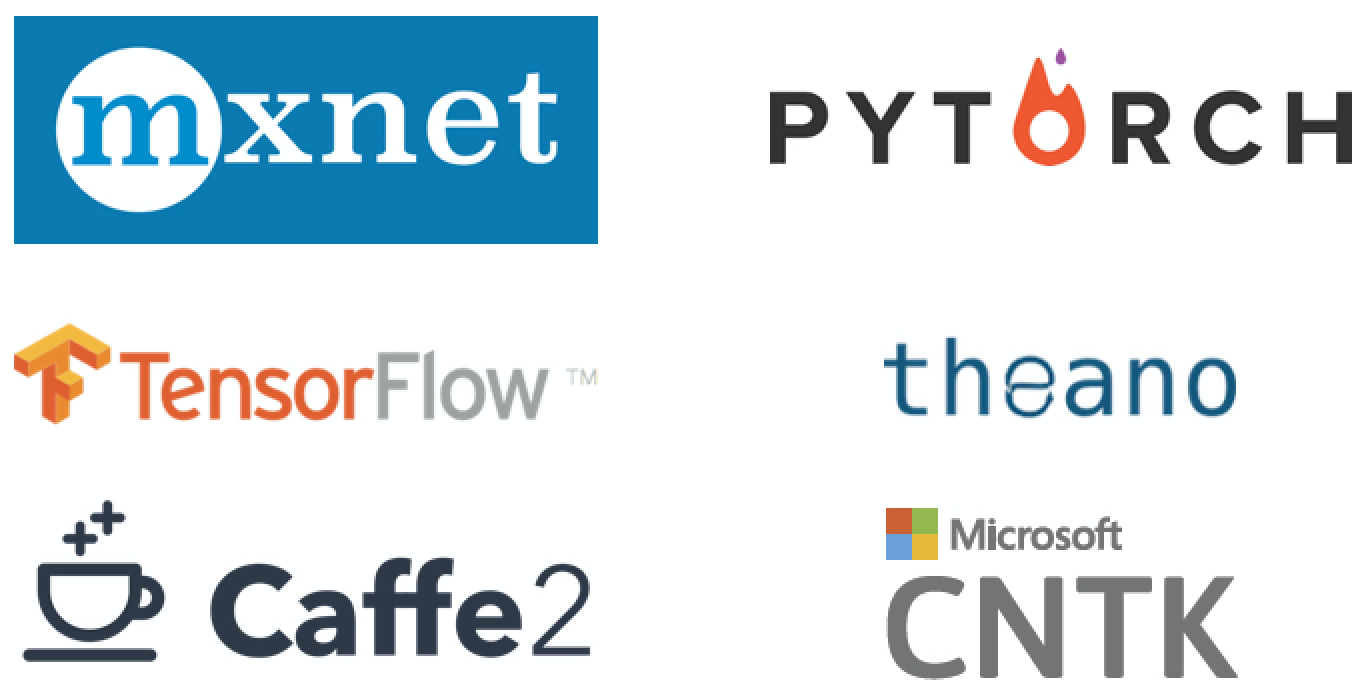
For high-end development of deep learning models, numerous frameworks support the most advanced data center GPUs. If you are an engineer making decisions about your technology stack, there is ample choice. Microsoft Cognitive Toolkit (CNTK), which focuses on scalability and performance, Facebook’s highly customizable PyTorch, the production-ready Caffe2, Google’s popular TensorFlow, academic Theano, and the collaborative endeavor MXNet, provide the basis for adding intelligent features related to computer vision, text, speech, images, videos, time-series and more. Symbolic loops over sequences with dynamic scheduling, turning graphs into parallel programs through mini-batching, reduced communication overhead, are but a few of the exemplary features available at production quality. For example, building a leading image classification ResNet that performs better than humans at a 3.5 percent error rate, is estimated to be a 30-minute task with the new frameworks. Deep learning has turned into a popular choice with its Lego-like building blocks that can be rearranged into specialized network architectures. There are many use cases for the method.

As a specific example of networks inspired by game theory, generative adversarial networks are starting to find new applications. Some examples: for simulating data, working with missing data, realistic generation tasks, image-to-image translation (from day to night, for example), simulation by prediction for particle physics, learning useful embeddings in images, and others. Networks are strong for perceiving and learning, but not for abstracting and reasoning. This is being solved by the new wave of AI for contextual adaptation that combines the statistical learning approach with handcrafted knowledge. The need for samples is decreasing considerably both for networks and for the new wave of models. For example, the new models can be trained with tens of labels in a handwritten dataset instead of the previous 60k.

Autonomous Vehicles

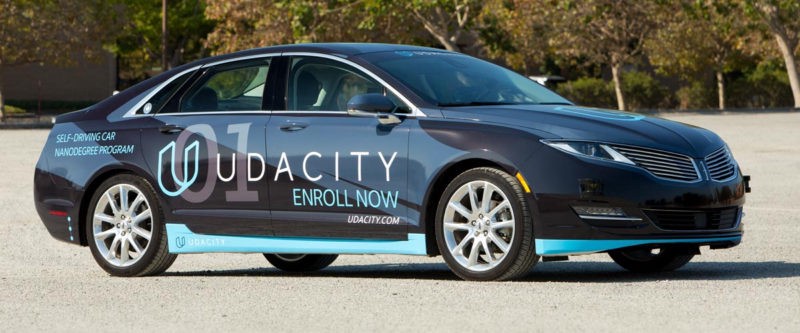
Udacity is democratizing development skills and knowledge for building autonomous cars

Not limited to deep learning, the rising professional application of GPUs is narrow AI. A prominent field here is autonomous cars, where custom L3/L4 autonomy for cars can be bought without having to build the physical infra. Nvidia PX2, and modular and scalable Driveworks SDKs, make advanced tasks like calibration, sensor fusion, free space detection, lane detection, object detection (cars, trucks, traffic signs, cycles, pedestrians, etc.) and localization fast and easy. Developers of autonomous vehicles can focus on their applications instead of the highly complex development of the base components.

AR/VR

Virtual Reality and Augmented Reality are finding its first scalable business cases

Moving closer to the roots of GPUs, namely computer graphics, there was another maturing trend well present at GTC. The devices for AR and VR have matured considerably in the decades since their inception. Novel directions like AI in VR are explored for interactive speech interfaces, visual recognition, data analysis and collaborative sharing. Corporate R&D teams are working on concepts for the metaverse native generations that are in the early stages. A step in this direction is Nvidia’s Holodeck, which is a photorealistic, collaborative virtual reality environment that incorporates the feeling of real-world presence through sight, sound and haptics. The state of the art can handle products as complex as the new electric Koeningsegg car design. By fitting the entire dataset into the GPU, multi-caching technologies enable interactive slice and dice queries and visualizations of fairly large datasets (384GB as of May 2017) in milliseconds.

Looking Forward in deep learning trend of GPUs

Many industries are affected by the rising trend of GPUs; for example, companies focused on healthcare, materials, agriculture, maritime, retail, the elderly, mapping, localization, self-driving, graphics, analytics, games and music are discovering and inventing new ways of interacting with the new era of abundant computing power. While I/O is still the bottleneck, we are entering a new era of craftsmanship focused work at the intersection of art, science and engineering. This is evident from the 11-fold rise in GPU developers during the past five years.

The frontier is about finding better ways to manage the model and experiment complexity explosion. For example, in 2017 Google NMT runs at 105 exaFLOPS with 8.7B parameters; in 2016 20 exaFLOPS and 300M parameters were needed for Baidu Deep Speech 2, and in 2015 Microsoft ResNet required 7 exaFLOPS with 60M parameters. One exaFLOPS is equivalent to running all the supercomputers in the world for one second in May 2017. Proekspert is evaluating how this trend is impacting data scientists generally, and what tools a data scientist needs to achieve and maintain high performance and productivity in the new era.

Protecting Revenue with Predictive Analytics

From common sense baby steps to sophisticated data science: how to protect revenue by avoiding customer churn.

Data means revenue

Two-thirds of “very successful” companies use marketing automation (MA) systems extensively, according to a recent study. That is perhaps to be expected. But here’s a surprise: More than a third (37%) of companies achieved best-in-class status with just limited use of MA.

Marketing automation systems

But despite MA being an obvious tool, and despite research to show that a higher percentage of companies in high revenue tiers use MA, less than half of companies are actually using it.

Sometimes using data is difficult. Companies have massive amounts of data from a variety of sources and platforms. Also, the bigger the company the greater the likelihood it may have inherited IT systems from mergers. The good news is that, despite difficulties, baby steps will pay off.

Lowering customer churn with predictive analytics

The two main barriers, according to research, to getting started are lack of an effective strategy and system complexity. But one doesn’t need a massive amount of resources and planning to begin to pick the low-hanging fruit using predictive analytics (PA) in subscription-based services.

Customer churn is an area in many businesses where PA can be applied for quick benefit. Take telecommunications companies, for example.

Telcos collect a lot of data related to customer usage of services and their networks. They also track customer preferences and buying habits. They store and manage vast amounts of data on a daily basis. This data can be used to analyze customer behavior, uncover drivers of churn, and identify potential churners before they leave.

Predictive models

Predictive models can be built, too, which estimate probabilities for any customer leaving. Factors can be identified (4G, data usage, mobile plans, incoming messages) that affect churn. And it can also be predicted to which new network a customer will go.

Ad hoc methods can be disposed of and actions can be automated to allow targeting based on objective customer characteristics. For example, specialized offers can be made at a point before churn becomes a danger.

CRM efficacy strategies can be measured via data on response rates, designing experiments, and analyzing the treatment effects of various methods. Know if a personal email is sufficient to reduce churn, or whether a gift is required. In the case of a gift, know for sure whether the monetary gain from customer retention will outweigh the cost of the gift.

Common PA practices in the telco industry

In the experience of Proekspert employees, we have noticed these particular patterns in the telecommunications business:

If a single customer departs for another company, odds are high his friends will carefully consider doing so, as well. Data can be used to identify friends and make offers if necessary.
Family changes are easy to monitor and make appropriate offers. While some life changes are beyond control (perhaps someone marries and switches to the spouse’s company), but others, like a school-age child are easy to handle, with offers of an additional number at a favorable price.
Regional peculiarities are also identified by using PA. Some regions will churn at much higher rates than others, enabling a much more effective spend of advertising budgets.
Behavior monitoring is also possible to a certain extent. A change in television viewing patters often indicate that service quality has deteriorated. This information enables proactive change.
Cultural churn can also be predicted and monitored. In countries where many cultures are present, churn characteristics and rates can be distinctly different for different language groups.
Text analysis is another available tool. For example, words like “temporary” used by the customer in email or chat channels often signal that the odds of churn have increased.

Beyond common sense

But common sense, despite it being not so common (as Jefferson apparently remarked), can sometimes be misleading. Common-sense metrics like age, marriage status, sex, etc., are often non-behavioral and therefore not optimal for segmenting customers. But a fully-reactive digital overview of a customer base, combined with AI-assisted suggestions of actions to take, can generate some amazing results like these.

Life-time values of individual customers can be estimated by aggregating average revenue per user (ARPU) data. This allows you to know how much a customer is worth at the beginning of a contract, or a few months or few years into a contract. With accurate cost-benefit calculations, you know which customers are worth more to keep and you can spend accordingly.

By clustering customers into data-driven segments, easy-to-use dashboards can be created for optimal CRM. Query the entire 360-degree customer profile (e.g. most recent call center interaction information) and summary statistics, going well beyond just churn indicators.

How data scientists can help your company

The importance of PA and MA cannot be underestimated. In 2017, CMOs are on track to spend more on technology than even CIOs. The big budgets of marketing must now stretch to important investments in marketing technology, including infrastructure, talent, and paid media. According to a Gartner CMO spending survey, marketing chiefs are spending more than a quarter of their budgets on technology and the marketing department’s tech budget generally rivals that of the CIO’s entire IT budget.

MA is also connected directly to customer experience, since frustrated customers lead directly to churn. Gartner further predicts that by 2018 more than half of organizations will redirect investment toward improved customer experience. Research shows that among unhappy customers, 13 percent will tell 15 or more people that they are unhappy. Interestingly, customers generally do not direct their complaints to the company who could help them — 67 percent cite bad experiences as a reason for churn, yet only one in 26 (ca 3,9%) actually lodge a complaint before leaving.

Proekspert data scientists can help you take PA to the next level, with complex algorithms specifically designed to account for individual aspects in every customer segment. Accurate churn predictions enable planned customer engagement before the risk of churn becomes critical — and a healthier bottom line thanks to stable revenue.

If you are interested in what data scientists can do for your company, contact: Proekspert Data Science Business Development Robert Filic robert.filic@proekspert.ee

Is it finally time to invest in mixed reality?

The must-knows of mixed reality and Microsoft’s game-changing HoloLens
For some years now there has been a lot of talk about virtual reality in the tech world. VR headsets finally hit the market en masse last year, and nearly every major media outlet has run some feature on the futuristic implications of virtual content. This VR hype is all fine and good, but we at Proekspert believe that the real game changer is going to be mixed reality — the merging of the virtual with the real.

Could it be more innovative technology than virtual reality?

Arguably a more practical and innovative technology than VR, mixed reality could be the new medium that completely reimagines the basic tasks and workflows that govern our daily lives. In this first post of a two part series, we will dive into a little background and think about the potential impact of mixed reality. It’s all very exciting, so let’s get right to it!

Why mixed reality is so much cooler than virtual reality

Believe it or not, virtual reality is a much older technology than most people acknowledge — it dates back almost 35 years! Admittedly, the technology has come a long way since then. Now we have advanced headsets like the Oculus Rift, Samsung Gear VR, and PlayStation VR, all of which took the world by storm with overlapping releases just last year. Each of these devices is in the business of creating the illusion of being inside a videogame or film. The content of VR is mainly that of fantasy. Users are transported into software generated environments that are completely separate from the real world. Even the New York Times’s heartbreaking VR news reports involve a total transformation of one’s surroundings, a temporary disconnection from the reality of one’s life.

Difference of mixed reality

Mixed reality is different. Rather than simulating a whole other world, it simply constructs new layers on top of your existing reality. Using your base environment as a canvas, mixed reality merges the people, places and objects of the real world with virtual additions. So instead of appearing in a virtual jungle, you can stay seated in your own living room and pet a baby dinosaur that has just appeared by the coffee table. More practically, you can stay seated on your couch and have your friend on another continent sit right next to you as a virtual, real-time rendering. With mixed reality there are endless possibilities for reimagining the everyday reality of life.

It’s not a technology for escapism, but rather for reinvention. Whether it be commerce, construction, education, or design — by applying our imaginative thoughts to the real world around us, we can achieve some truly spectacular results.

See for yourself:

All the fancy terms in a nutshell: VR, AR and mixed reality

Virtual reality — In VR your surroundings are 100% virtual, a complete simulation of some environment. VR also requires that you completely disengage from the real world around you, so instead of being in your living room, you might be transported to Middle Earth or the Millennium Falcon.

Augmented virtuality — In this scenario you enter a virtual environment accompanied by some other real world objects. For example, might venture into Middle Earth with your friend who is also immersed in VR via a head-mounted display.

Augmented reality — AR builds virtual layers on top of the real world. You might look out your window and see the weather predictions for the day materialize in front of the view as an augmented layer. AR is how the Terminator saw humans.

Mixed reality — This is a wide and flexible term, and is often referred to as a scale of virtuality and reality. Mixed reality is different from augmented reality in that it adds more than just layers of information, but also virtual objects in real space.

So this all sounds great, but is anyone actually working on it?

Yes, people are working on it! (And hopefully we don’t have to wait another 35 years to see mixed reality tech in retail.)

Arguably Google was the first company to give mixed reality a genuine try. Remember Google Glass? Besides making people look kind of pretentious and silly, Google Glass was the first augmented reality gadget to hit the market. And even though it failed spectacularly, it did mark the beginning of a powerful new technology that is now finally coming into its own. Picking up Google’s dropped torch, Microsoft is the new leader in augmented reality, and its bright new hope is the wondrous device called Hololens.

Have you ever watched Star Wars or Star Trek and thought — wow, those holoportation devices are pretty freaking cool! Well, if so, then you had better hold your breath because Microsoft is currently developing a form of virtual 3D teleportation that works in real-time. Hololens, the “first self-contained, holographic computer,” was released in its pre-production version just last year, and might hit the consumer market sooner than later — the main obstacle for the headset’s release is cost, Hololens would currently sell for roughly 3K a pop, which is just too much for the average consumer.

Besides Microsoft’s Hololens there is also Magic Leap, a secretive startup that has received investment from the likes of Google. Magic Leap has revealed relatively little about its work; the company’s website offers a lot of buzz words and pretty pictures but not much actual substance. However, it is generally known that Magic Leap is also developing a head mounteddevice for mixed reality. What this device will look like and how it might compete with Hololens is still to be determined, but we can be sure that mixed reality is no longer a technology of science fiction, it’s becoming very real — as Magic Leap promises, “magic is right around the corner.”

But maybe mixed reality is just overrated hype… Should we invest or should we wait?

When talking about new technology, it is important to remember that sometimes even the most remarkable inventions can really flop once they hit the market. Google Glass is one such example. It’s true that the Glass was reported by early adopters to have some serious technical problems, but that wasn’t really the reason why the gadget failed. What really drove Glass to the ground was a complicated set of security problems, privacy issues and simply the fact that the public wasn’t ready . Perhaps we weren’t as married to our devices as we are now, and ultimately the look of Google Glass was just too far out for its time.

Of course we must also remember that HoloLens 1.0 has its own set of problems. It is far too heavy (imagine walking around all day wearing glasses that weigh more than half a kg); the field of view is actually much more narrow than you could imagine based on the demo videos; the response to hand gestures is clumsy; HoloLens’s understanding of space is also at a supremely beta level: objects go through walls etc.; and its battery life is only about 3 hours.

Hope for mixed reality

Yet there is hope for mixed reality. Forecasts show that by 2020, virtual and augmented reality will do quite well in the market, ultimately driving the cost of headsets down. In fact, we are seeing this already. Just a few weeks ago Facebook lowered the price of the Oculus Rift by one hundred dollars, hoping that the device would sell better on the market. If reports are correct, then in 2020 alone more than 25 million VR headsets will be sold to consumers, meaning that VR and AR headsets will be in 1% of households worldwide in just a matter of years.

Evidently, despite its tumultuous start, VR is here to stay and mixed reality won’t be too far behind. It’s nearly impossible to think how this technology might reimagine every major sphere of our lives. Ultimately, as Magic Leap puts it on their website, mixed reality is trying to “rethink the relationship technology has with people.” It’s the beginning of a completely new interface, one that will release us from the boxy confinement of devices. But more on that in our next post!

If you want to know what about business opportunities with HoloLens, sign up for our newsletter!

The Challenges of Electronics Manufacturing Services

“Last week I attended the IPEC 2017 and gave a speech about our vision of the future of electronics manufacturing and the challenges we need to first overcome to start moving towards it. Here are part of my thoughts to share in written form.
– Terry London

The Future of Electronics Manufacturing

Like everything in this world, electronics manufacturing is in constant change. In all likelihood, the methods in electronics manufacturing management in the future will be drastically different compared to today.

Automated factories

We already see a movement towards fully automated “lights out” factories, where a major share of manual workplaces are automated and human workers replaced by robots. Complex manufacturing environments themselves are turning into enormous autonomous machines. And operating this kind of a shop floor will be as simple as operating a dedicated machine where we just have to focus on inputs and outputs – not how the insides are operating.

Therefore when looking at a global network of manufacturing, shop floors may be viewed as a network of huge production points, some, like machines on a shop floor, as logically linked as a daisy chain – and all virtually connected to each other.

Electronics production management and virtual factories

We see the future of electronics production management as virtual factories – located in economically reasonable locations, their production can be managed from virtually anywhere via the Internet. As a company or private user you can host or rent a virtual manufacturing service and manage it despite the distance between you and the physical entity.

What about electronics manufacturing services?

Lights out manufacturing expects that the environment rarely needs any major re-configuration or setup change. This is the exact opposite of how EMS (electronics manufacturing service) works.

Electronics manufacturing services companies must get by with a very high mix of products that are mostly produced in minimal amounts. For example, bigger tier 2 EMS companies may produce 50,000 different product designs and 50 million products a year (so the average lot size is around 1,000 pieces) by using 5 billion components globally.

This is a huge picture with many details to focus on, especially when production is shared between tens of globally distributed manufacturing plants, and those, in turn, consist of multiple shop floors and hundreds of machines that have to work perfectly.
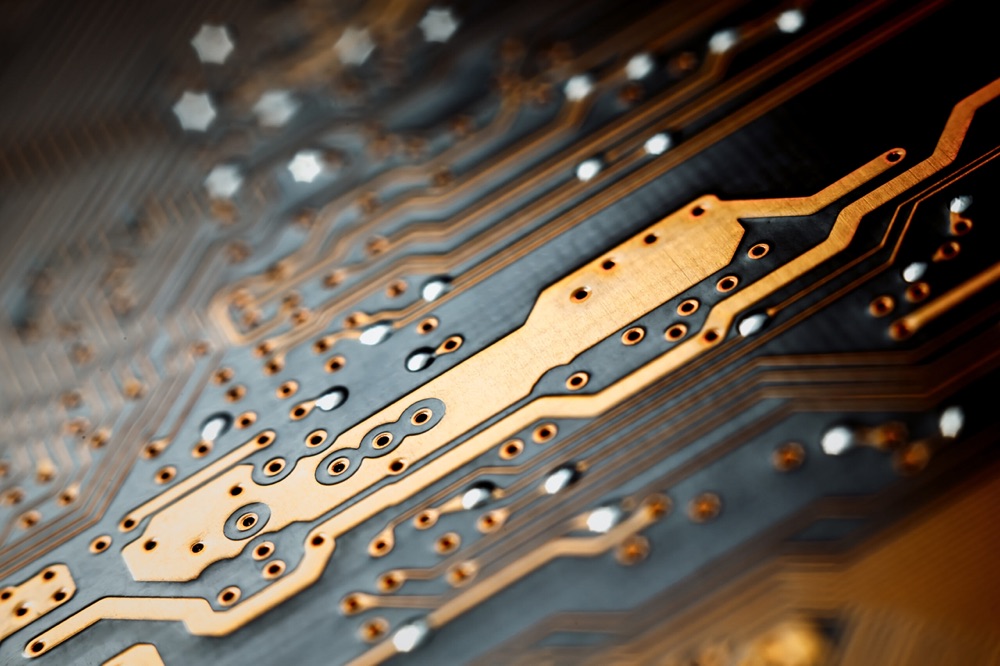
Electronics manufacturing is a complex process. You must focus on big picture and the production line and even machine-level details, all at the same time. But the reality is that those two perspectives are rarely aligned at the same moment in time.

The challenges of electronics manufacturing services

So why is it so hard to keep an eye on the big picture and focus on details at the same time? What separates us from a future of full automation and virtual manufacturing? There are many reasons, but everything starts with simple yet complex challenges.

We have identified two main “pain points” that almost every electronics manufacturer faces today:
• Data collected inconsistently
• Fragmented visibility of analytic data

Interviews we conducted with electronics manufacturers have revealed two key numbers:
• 19 out of 20 companies admit that they possess data but feel that they are rarely using it to learn
• 18 of 20 companies feel they cannot view the big picture fast enough, and have to rely on outdated data

Causes and Amplifiers for challenges in electronics manufacturing services

The reasons why we face these challenges are simple – there is no standard way to collect data from machines. There are locally-generated log files, a variety of databases, and limited connectivity due to the lack of options or proprietary protocols, etc. This causes lots of manual work and micro-management with Excel sheets to prepare the collected data for analysis. The analytics exist but how you see it is scattered – like comparing 10 different Excel sheets from different departments, because each one has their own format for reporting the status.

Most machines in a production line are already digitized; they produce tons of numbers every second. Huge amounts of data are generated by a production line every day. But as the data are not unified it’s very difficult to get real-time value out of it – all because we must use time wasting, semi-automatic methods to see details in the bigger picture.

Also, the methods we use for data visualization are relatively static. When we look at our production management dashboards, we see dry KPIs that are more oriented toward showing what happened yesterday, rather than attempting to project what will happen today. For example, OEE: it is good to know it and understand what’s behind it, but learning from this KPI takes just too much time, especially in environments where mistakes on the shop floor may cost thousands of euros per second.

There are also amplifiers for the challenges. When there are only one or two lines with less than 100 workers in a manufacturing plant, it is easier to handle both the big picture and those pesky technical details, because the production manager can ask for updates from shop-floor operators and engineers whenever needed. But when production grows by a number of different products, the management process becomes exponentially more complex.

The trend is that the mix gets higher and volumes much lower. The more technologies advance the more they support mass customization. This, in turn, demands much higher scaling capability, plus greater flexibility, as there is a larger variety of products to manufacture at the same time. Issues that may be solvable by simple communication between people are no more – because it just takes too much time and is not accurate enough for the company’s growing needs.

A shop floor is like the kitchen in a restaurant. If you have seen the reality show “My Kitchen Rules,” you probably know that precise planning and domain experience are crucial to succeed, but in the kitchen there is time pressure. Things don’t go the way they’re expected, and if the customer is not served well he may go to another place. It’s a great example of focusing on the big picture and keeping track of the details at the same time.

You want to be aware of what’s going on and see multiple steps ahead at the same time. It’s easy when you have prepared and everything goes as planned. But conditions tend to change at the most inconvenient moments.

Data-driven approach in electronics manufacturing services

We want to solve these challenges and make shop-floor management much more transparent and forward-looking than it is today. As the two main challenges are basically lack of data at a given moment in time, we focus on data.

The first mission is to make use of existing data. In most cases the data exists, but managers or other responsible parties cannot view it the moment they need it. In some cases there are no real time views – only reports from the previous day or week. We want to change it by taking the data and visualizing it for you.
As the machines in production lines produce a huge amount of data, we only have to collect it and use it as wisely as possible. Our point is not to put too much effort into improving KPIs, but rather focus on what actually happens on the shop floor.

By combining the activities of different parts of the shop floor, we create a virtual shop floor out of connected machines and production points. This is a purely data-driven approach and will likely change how we see shop floor management in the near future – as it has changed how we see information technology today, compared to 10 years ago.

Electronics manufacturing and information technology

When joining electronics manufacturing and information technology, we see electronics factories as our development partners and advisors.

In essence, electronics manufacturing service is a global business. Connected factories are located in a variety of countries around the world so that the meaning of a single manufacturing plant has diminished slightly. Therefore, the approach to problem solving must also be global. As different regions have their own perspectives on production, to solve challenges is possible only with a cross-border knowledge exchange.

Our solution is a cloud service that connects factories around the world within one virtual environment. It functions as one central service, but at the same time each factory can be individually managed.

It is important to understand that the digital transformation of a production environment is an iterative process – there is no silver bullet. Solutions come only with deep cooperation between IT and manufacturing disciplines.

Connect with us!

We’re open to cooperation with electronics manufacturers who face similar challenges. Contact us by signing up for the demo on our website to receive more information about simFactory.