Explore Estonia

Healthy living is important. In Estonia we live closely with nature, we understand the benefits of taking time to relax and be at one with our surroundings.

We would like to take you on a small journey and introduce you to 10 of our absolute favourite hiking trails that you can enjoy in 2018.

You’ll also find our offices on the map. You’re always welcome to drop by, say hello and have a friendly chat if you’re in the area.

1. Kakerdaja Fen hiking trail

A fen is a type of wetland mire. Kakerdaja is one of the largest fens in Kõrvemaa. It covers an area of approximately 1000 hectares. The most unique feature of this picturesque fen is that it has two levels of different height. Thousands of water birds stop on the fen in spring and autumn. Lake Kakerdaja can be found right in the middle of the fen.

Read more

2. Viru Bog trail

Viru Bog is one of the most accessible bogs in Estonia. Complete with a 3.5-kilometre trail marked with signposts, it passes through the forest and marsh landscapes typical of Lahemaa National Park.

Read more

3. Keila-Joa Park nature trail

This 3 km long round-shaped nature trail in Keila-Joa Park runs along the banks of the River Keila and through the Keila-Joa Park.

Read more

4. Taevaskoda nature trail

Taevaskoda hiking trail is located in the Ahja River Landscape Reserve. The trail starts in the Saesaare car park and runs along both banks of the Ahja River, where the outcrops of Väike and Suur Taevaskoda, caves with springs and picturesque views catch your eye.

Read more

5. Alatskivi hiking trail

The trail starts at Alatskivi or by the Bed of Kalevipoeg. Alatskivi Castle and Castle Park, Hirveaed Garden, the Oak of Loyalty, Sheep Bridge, Bed of Kalevipoeg, Lake Veskijärv and Lake Lossijärv are all along the track. The track is 4.5 km long.

Read more

6. Oandu-Ikla hiking trail

The RMK hiking trail is the first hiking trail to pass through all of Estonia. Covering 370 km, the trail starts in Northern Estonian at Oandu in Lahemaa National Park and leads through the thick Kõrvemaa forests and then onto the Soomaa National Park—one of the most magnificent marshlands in Europe.

Read more

7. Beaver Trail

Starting from the Soomaa National Park Visitor Centre, the Beaver Trail takes you through forested woods to see a number of beaver lodges and dams.

Read more

8. Harilaiu hiking trails

Harilaiu Peninsula is the most beautiful and ancient part of Vilsandi National Park. It has been a protected area for fauna, flora and geology since 1924.

Read more

9. Panga Cliff trail

The Panga Cliff stands, stark in colour, at a maximum height of 21 m, and runs for about 2.5 km! A vast slate, as all cliffs of Saaremaa are, wall reaching straight up from the surrounding beach, the cliff impacts its environment in a interesting way.

Read more

10. Kiideva-Puise hiking trail

The trail is on the north coast of Matsalu Bay. The main part of the track is a 2.6-kilometre long section which starts near Kiideva and goes through the deciduous woodland and restored wooded meadow until it reaches Lõpre oak.

Read more

Source: www.visitestonia.com

Creating digital products from a shared vision of the future, through design, science and technology.

A company creating digital products for the future needs to approach the task with a completely new set of tools. It needs to break away from systems of the past, reliant on structured methods. It needs to embrace an attitude, a mentality for progression, or an ethos that captures the spirit of a shared vision for the world of tomorrow.

Today most of us have an idea of how the future may look, and some of us know when specific innovations might start changing the game. There are those that fear the inevitable progression and its consequences; there are those that immerse themselves deep into the infinite possibilities; but there are also some, who are clear about which of the many paths we’ll follow into the future. That path is one which is focused and has no room for technology’s ego, leading to a destination where Information Technology as we know it is nothing more than a foundation for design-led, science-driven solutions that each and every one of us will rely on.

Future digital products and services

We believe that future digital products and services are created by merging human-centric design, data science and technology. Creating the perfect blend with which to service the future of humankind, that thrive on the skills of multidisciplinary teams. Cross-functional collaborations lend themselves as a new way of working to our core ideology. The realisation of where we need to go as a creator of digital products, and more importantly where we shouldn’t even consider going, runs in line with some the world’s current innovators.

One of these innovators is Pedro Gomes, managing creative director of Pedro Gomes Designs (currently rebranding), board member at the National Association of Design in Portugal and lecturer at Porto Business School; he shares our way of thinking. Also involved with the Estonian Design Centre as senior design manager, Gomes has built his brand on the need to take a holistic approach to design. Heading up a team of 13-20 people at the forefront of radical design thinking, his mission is to redefine design as human-centric and driven by holistic values; a mission that we at Proekspert can relate to.

Holistic approach to digital services and digital product creation

To fully understand the direction of this thinking, a simple reference to the English dictionary can help. The definition of holistic is, ‘characterised by the belief that the parts of something are intimately interconnected and explicable only by reference to the whole.’ Something which is very often forgotten throughout design and problem-solving processes. The awareness that every aspect of something is as important as the next can influence the design process in a positive way.

When addressing a client’s needs we need to ask questions, it’s the fundamental basis of any project; we need to understand the problem completely. Holistic in the medical sense lends even greater relevance: ‘the treatment of the whole person, taking into account mental and social factors, rather than just the symptoms of a disease.’ That series of questions or initial workshops gives us the opportunity to understand the client, their issues and their goals. Through the use of data science, and with this deeper understanding of the task, we can build a technology-based solution that caters for the clients as a whole entity, as we might for an individual – a human-centred solution to what is inevitably a human issue within an organisation or team.

Gomes takes the same approach with his design projects, many of which are socially relevant. He explained to us his notion of ‘radical change’ in design, stating that it’s, “when design shifts from an aesthetic or functional exercise to a strategic creative process used as a tool for holistic business innovation, with measurable impact.” In short, he considers every aspect of the design. He draws upon research, data and client feedback; he considers the end user from the very start of each project, and he strives for both impact with social meaning and impact within an industry. This facilitates a leap forward in the areas his project is related, and critically, in areas that will indirectly benefit: the whole picture, the holistic approach.

The values we share don’t end there. Our commitment to immerse ourselves in the worlds of our clients has and always will be paramount, with a homogenised team in terms of both discipline and position free to blend into clients’ teams efficiently and without complications. Gomes also believes that you must become consumed by a project. Live it, breathe it; understand it on a whole new level. Only then can you provide a relevant and innocently human solution: “Live the journey, tell their story,“ says Gomes.

The future of digital product creation takes its cues from this way of thinking. Following a mindset rather than a methodology. A strategic approach led by the essence of the task, guided by data science and never forgetting that human focus. Remembering there’ll be someone just like us at the end of the process, relying on this solution to simply work. Technology is here for us to take away the monotony, to carry the burden of a task, to fade into the shadows unnoticed so that we can get on with the what’s really important: just being human.

Seamless payment solutions for public transport networks

Robert Filic
Data Science Lead

“Imagine having a convenient, transparent and secure way of getting around the cities of the world. Free of passes, tickets and coins. No wrangling with price lists and timetables. Well, there’s no need to imagine: the technology is already here!”

A seamless transport system needs a seamless payment solution – The technology is here, and according to leading figures in the city planning sphere, it needs to roll out fast! We take a look at the benefits of a contactless payment solution for users, municipalities and city infrastructures worldwide.

The commute is an essential part of our daily lives; city planners and transport strategists need to be thinking about how to make it not only easier and more bearable, but enjoyable too. Gilles Vesco, former Vice-Mayor of Lyon and VP of Grand City of Lyon, believes: “The goal is to rebalance the public space and create a city for people, [with] less pollution, less noise and less stress.” And it’s with this idea in mind that cities around the world are looking to the future.

Not just the traditional

When we think of getting around a city, most of us might naturally turn to the traditional transport infrastructure. The more tech savvy amongst us will consider taxi-on-demand services like Uber and Taxify, or apps that exist to facilitate car sharing. The more adventurous will often go under their own steam, either walking, cycling or using modern alternatives like the hoverboard, favoured by younger people.

The truth is however, that often the most convenient way to get around a large city is by using an already established public transport system, that’s why it’s still the most popular option. But is the experience as seamless and convenient as it could be? The simple answer is that it all depends on where you live.

Contactless makes sense in so many ways

Most developed cities in 2017 are developing their transport infrastructures around the ‘integrated multi-modal transportation system’. The foundation of this system being the ability to effortlessly move between key points of a city with minimal inconvenience and maximum speed. You land at the airport and can take a tram to the centre of the city, then the metro or bus to your home. The challenge for such systems is collecting payment. Many cities have reloadable travel cards, day tickets or good old-fashioned conductors.  These solutions all require one or more extra steps of effort, which in turn is perceived as inconvenience and actually more of a challenge for the user themselves.

A simple solution that’s tried and tested

London, England. During the 2012 Olympics Transport for London pioneered a system that many users of the network had wanted for years, but previously the tech hadn’t been up to speed. The system allowed users to pay for journeys with their contactless bank debit cards, and has now been permanently rolled out across the network and offered as one of TFL’s standard payment options. By using the same card each time commuters can take advantage of daily and weekly caps and offers. To date there have been 1.8 million journeys made using contactless payments, from over 100 countries which in total accounts for 40% of TFL’s total amount of trips made since the implementation of the system.

Enter Proekspert – Developing a contactless payment solution

Together with our partners at Ridango, we’re developing a contactless payment solution that can be integrated into an existing infrastructure, or installed from scratch as a standalone system. Integration and operational costs can be reduced for networks using older technology, with significant savings on wages for the oldest of all technology, the conductors and ticket sellers.

Benefits for both municipal operators and their users alike

No longer will a weary business traveller have to go on the hunt for a ticket office or machine when landing in a new city. They will simply pull out their contactless debit card and touch-in when boarding the train, tram or bus from the airport and throughout their multi-modal journey to their destination. The appropriate fee will be deducted immediately; the most effort needed may be a short registration form on the city’s transport app or website, but generally this would not be required*.

Speed is a benefit for both the user and operator, less than 500 milliseconds to make a transaction means fewer queues and a more efficient service. As the secure technology works as an offline data authentication solution there is no need to process transactions online in real time, and there is no requirement for the user to enter a PIN, both key to saving valuable time for all.

Technology implementation

From the point of view of the municipalities, costs are reduced and the need for large capital investments to implement the technology can be avoided by integrating into existing fare management smart card systems. Operational savings come from a reduction of activities, this relates mainly to the issuing of new smart cards as well as the maintenance of their infrastructure.  As users appreciate these small yet significant advancements – especially those that make the experience of using public transport more pleasant – operators that integrate this technology into their networks will see their reputation benefit exponentially.

Focus on making people’s lives better and you can’t go wrong

Cities are essentially collections of people. People working, living, loving and having fun. Any technology that takes away the barriers, that allows us to get on with just being, this is the tech that’s essential to us. They say it’s the technology you don’t notice that’s the most valuable, the tech that just works, and this has never been such a poignant observation. The moment technology puts an extra stage into an everyday routine is the moment it becomes irrelevant – something we here at Proekspert strive to remember.

Excited by the possibilities? If you would like to discuss how this technology can benefit your transport network, just get in touch. We’d love to have a chat and tell you more.

*This is currently an option for TFL London and results in access to offers of cheaper fares.

How to streamline manufacturing processes with data you already have

“Optimising manufacturing is an ongoing process with complex data analysis at its very heart. Modern manufacturing processes produce data at almost every stage, with information available from sensors, machinery management systems and business infrastructure systems; the inevitable need to analyse all this data efficiently can be extremely draining on resources. Processing terabytes of data with the aim of reducing costs, improving quality and increasing the overall efficiency of an operation will almost certainly require automation.”

Tähve Lõpp, Business Development

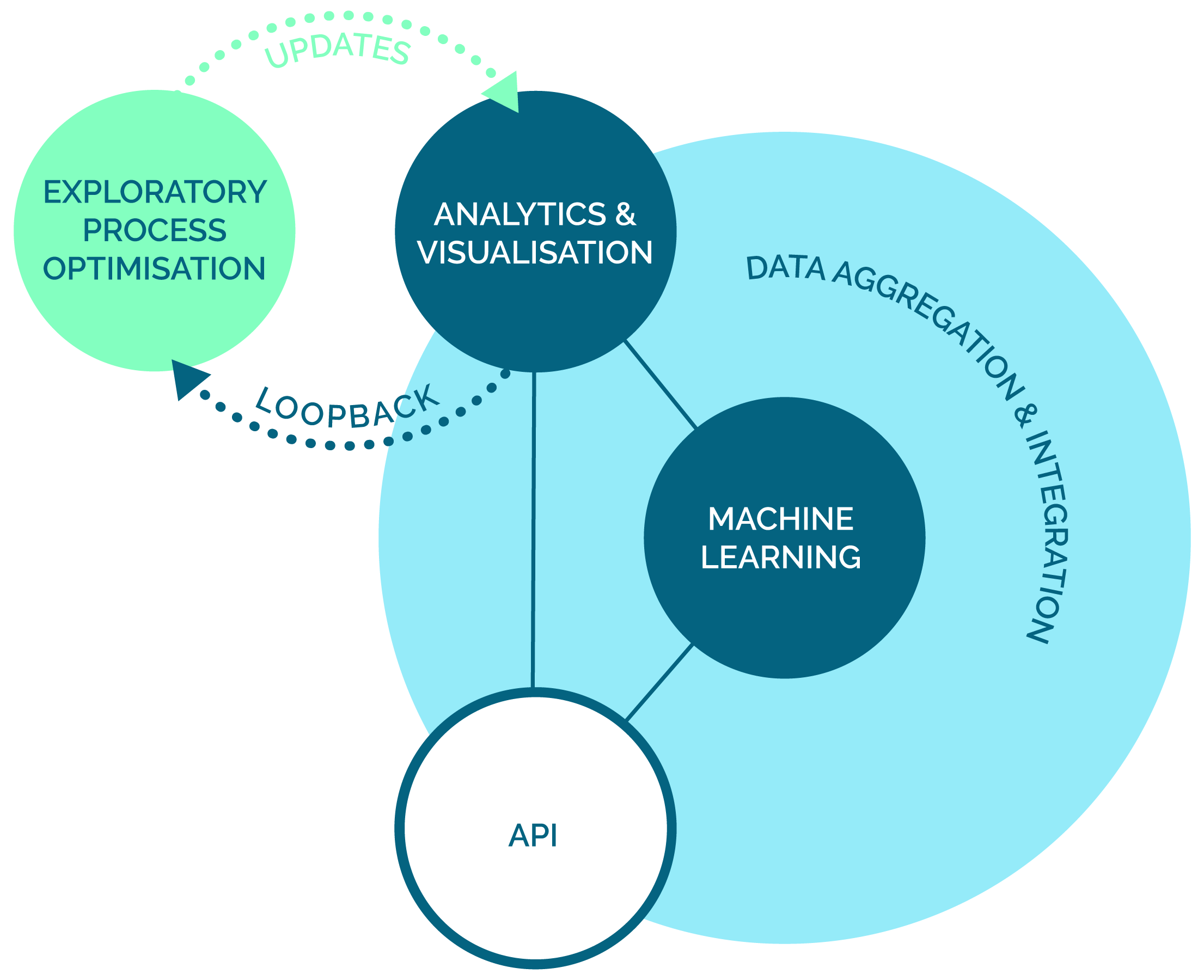
Proekspert believes the best approach for continuous optimisation in the IoT era, is automated learning from manufacturing data streams. Using state-of-art science and technology, we fuse the data that’s collected to build robust optimisation models tailored to specific business needs.

An effective analytics model

An effective analytics model will be built around a specific business question and have a reliable dataset as its foundation; to incorporate such a model into the manufacturing process will require integrations. Although the building and integrating of these models can be expensive, the cost is offset by the saving on not having to repeat large quantities of work upon the discovery of a new available dataset.

In response, we have created an analytics excellence deployment tool: simFactory. It addresses the complexity of analytics development and implementation by enabling a fast and efficient workflow to prototype and validate analytics models, all without the need for costly implementation and deployment.

Cloud based approach

We use a cloud based approach, because it allows us to visualise and continuously improve the models with ease. They can then be made available for the shop floor operators anytime, anywhere.

Here’s a brief overview describing the five-step sequence for defining the business question, developing and validating a meaningful analytics model and enabling a continuous optimisation process.

Defining the business question

Start agile, regardless of whether the digitalisation strategy in your company has been finalised – fast prototyping provides valuable input for strategy as well. We always use a ‘design thinking’ approach, starting with a simple workshop where urgentissues, bottlenecks, and the emerging business question can be shared.

The workshop is also an opportunity to define KPIs as well as evaluating expected impact, increases in efficiency and quality, or the reduction of costs. Of course, we’ll give meaningful input wherever possible. Through our focus on electronics manufacturing, we’ve already identified 95% of business questions we could solve using advanced analytics.

Defining dataset and integrations

After defining areas for improvement, it must be understood which dataset is required and which is available – or perhaps most importantly, accessible. Sensors, machinery and business systems will be listed, and the integration level will be defined. Initial problem discovery and analytics model prototyping is a relatively straightforward process, with often a limited dataset in .csv format being sufficient. Over a longer-term perspective however, permanent integrations need to be considered to meet the needs of real-time decision support. This could mean the acquisition of new solutions, machinery or lines. To maintain the capability of making swift changes to factory configuration, open API based integrations are essential.

Prototyping

Integrations and data collection without a purpose is a luxury. Therefore, it’s crucial to start working on data that already exists first, then decide how to move forward incrementally. Before we tackle complex integration developments – or even start data collection – we use available data for our analytic model prototypes.

During prototyping we structure and prepare the data, making it suitable for automatic processing; for the fusing of different data sources, and to develop initial models and visualisations that will assist us in seeking answers to the business questions. These models can be iterated and validated quickly with the business owner as many times as needed. Data quality, model accuracy and overall efficiency will be verified.

NB! Prototyped models are fully-functional; they can be used in daily operations within a month. Think of it as playing chess with the option to undo your previous moves!

Implementation

Having verified the models, further investments can then be decided on, with focus on which integrations are required and how the models might be used by operators. Their integrated datasets allow new models to be implemented within a matter of days.

During implementation, datasets will be integrated according to importance. New models that have passed the prototyping and testing phases will then have the necessary integrations carried out. It’s an agile method that helps customers implement models they’ll really benefit from, and control their investments.

Continuous improvement of streamlining manufacturing processes

Continuous optimisation is always taking place. When one bottleneck optimisation is done, another is appearing in a new location. So, production must be improved to meet the new demands of products, processes, customers, and technology.

Data modeling is evolving rapidly and there are many new methods and libraries available. Therefore, it’s crucial to avoid vendor locks, and to have an open platform that enables the implementation of newer and better models.

Our aim here at Proekspert is to simplify the process of adapting new analytics models. We want to enable greater benefits from available data and provide better visibility for the client with regards to what is actually going on during the production process.

We realise that digitalisation must be part of a company’s strategy to really see the effects from a data-driven approach. We also understand that successful digitalisation demands a complete mindset shift, and the most effective way to achieve it is by carrying out PoC, pilots, and by prototyping. We urge companies to start with digitalisation today – yesterday even! Quick wins can easily be transformed into daily routines.

Connect with us!

If you would like to discuss things further, contact us or join our newsletter. To receive more information about simFactory visit our site.

Proekspert and Danfoss: celebrating a 15-year working relationship that has strengthened over time

Proekspert recently celebrated a successful 15-year collaboration with Danfoss, one of the largest production companies in Denmark. Delegates from both companies were present at the celebration event which saw the shared values and aspirations – and some turbulence – of the past, present and future recognised.

Cooperating since 2003 and starting out producing embedded software tools for variable frequency converters, the relationship with Danfoss has developed. Now with full technical know-how of the Danfoss heating, ventilation and air conditioning business segment, Proekspert can call itself one of the development centres for Danfoss.

“More than 60 of Proekspert’s people have worked in Danfoss projects over the last 15 years, and 40 for the last 4 years, also 19 of their 25 shareholders have worked for us,” says Rui Martin Costa, account manager at Proekspert, speaking at the event, in an attempt to describe the impact of the collaboration on Proekspert´s culture and experiences.

It is also important that our outlooks and work ethics match and help to drive the joint operation forward harmoniously. However, as with all relationships, there have been highs and lows, and it hasn’t always been plain sailing:

“We were not always talking the same language. We used the same words, but sometimes didn’t mean the same thing; our communication has not been flawless all the time.  Now we’re so much better. We’re not stupid enough to make the same mistake twice. Things are working very well at present,” Soren E. Nielsen, VP of Danfoss Drives admits during his event address.

Through communication and perseverance, things started to turn around. Initially, some at Danfoss felt that their colleagues at Proekspert should be seen more as sub-contractors, but as Marko Sverdlik, CEO of Proekspert explains, this was a side effect of the worst times. “This marriage had its ups and downs, but things started to go uphill since Danfoss began listening to our opinions and ideas,” he went on to say: “We generated more value – growth was remarkable, and so were the challenges.”

Although a multitude of factors is behind the growing success of the partnership, it’s Proekspert’s values that are the foundation for that: “We decided to partner with Proekspert in 2003 because of your values”, Soren E. Nielsen tells the event’s guests. “In 2017 l can say that we have so many good people here in the Estonian office! The first experience proved to be a fantastic long-term cooperation.”

Proekspert has been a part of the Danfoss Group since 2003. In 2015 the Estonian minority shareholders of Proekspert and the representatives of Danfoss signed the purchase and sale agreement, the Estonians become the sole owners of Proekspert as a result.

As for the future of the partnership, Soren E. Nielsen declares: “When we talk about Proekspert, we talk about our colleagues. Together we have both the history and the experience. We see Proekspert as part of the Danfoss family. There has always been an informal and open dialogue, and that should continue.”

An intelligent person needs no management

I have a dream. A dream about the Estonian state as a flagship of state-of-the-art leadership and operations. A state where every citizen feels involved and significant. Where they feel a part of something bigger and more important in which they have their own role. A role that answers their calling. A role in which they are the best. In which they are trusted and honoured. In which they create useful things that contribute to progress in society.

Such a dream may seem quite distant and unattainable. It is indeed distant, but not unattainable. We needn’t change the whole system at once to make a considerable developmental leap. We can start from something “easier” that we all come into contact with in our daily lives: leadership. The leadership of people. I believe that no one who is intelligent needs anyone else in order to manage themselves. If they do, the problem lies somewhere else. It’s the task of leaders to identify and, if possible, remove the obstacles that prevent the person from reaching their full potential.

You may say that we already have a state-of-the-art IT state, a pioneer in e-Governance. Yes, that is true from the viewpoint of digital development. However, IT is not a goal; it’s a means of reaching a goal or solving a problem or challenge. An IT state cannot be a goal, only a solution. A solution to what? What goal do we want to achieve or what challenge or problem do we want to overcome through the IT state? The answer is laconic – to remove everything from a citizen’s path that is redundant and prevents them from dedicating themselves to that which is important, from being useful and creating value.

Unfortunately, the situation is not so good when it comes to focusing on citizens. The latest developments actually point to the opposite trend. The distance between the citizen and the state is growing. The citizen has an increasing number of useless obligations and duties while the value being created is shrinking. The state is being developed and built in the state’s own interests, which are often short-term and materialistic. Actions and speeches convey a clear message of distrust, control and restriction. Let alone blame and defamation. People are seen as lines in the budget, assets on a balance sheet and nameless cogwheels in the state’s aimless machinery. Compared to organisations that employ state-of-the-art leadership and operations in the world, we are clearly moving backwards.

What are state-of-the-art organisations doing differently? They shape and build organisations with a human focus, based on human needs – in every aspect – with respect to employees, clients, and the end users of their services and products. People with their wishes and needs come before goals, processes and money. Organisations are built on people’s trust and freedom of action, as well as initiative and eagerness. People are given a chance to decide and the freedom to manage their own activities. Dedication, willingness and creativity are received in return. These are the core components for making dreams come true and for making a targeted developmental leap.

The human-centred approach is much talked about, but quite often it means a client-centred approach where the client is king. All of us have heard about shaping the customer experience, or about designing the user experience. Little has been spoken about shaping the employee experience. Even less, or actually none at all, about shaping the citizen experience. The idea that the client is king tends to overshadow the idea that the employee is also human. A human whose welfare, involvement and dedication determine the success and development of the organisation. Companies that can create essential value for the users of their services and products involve and inspire their employees and also be more responsible as members of society are successful in the long run. The same applies to the state. States that have built their operations on the best possible citizen experience by providing useful, demand-driven services to the people who need them, can be successful in the long run. To make this happen, state agencies have to centre their functions around humans – in every aspect.

Luckily, we don’t have to look far to find practitioners of human-centred organisations. Internationally successful Estonian companies often employ highly innovative management styles, and this is no coincidence but clearly a cause and effect relationship. Fortunately, there are also state agencies that are taking steps toward a human focus. My confidence in our potential to be a leader in state-of-the-art leadership and operations is based, among other things, on personal experience in the application of the bossless ideology and a human-centred approach at Proekspert since 2013. We have deserved extensive international recognition as innovators of leadership thought and, even more importantly, we have built a strong and motivated team. Our employee and customer satisfaction have improved considerably. The organisation has become leaner in terms of both management levels and processes. This in turn translates into lower costs. We have become more productive and can be useful to a larger number of people in the same amount of time.

There are many ways to improve the quality of life in Estonia. One of the most tangible is the promotion of a leadership culture and principles through the implementation of a human-centred approach. This applies to the daily affairs of the state, its agencies and also businesses and other organizations. An intelligent person needs no management. Give them a chance to decide and the freedom to manage. In a team of like minds, services and products are designed and developed that are useful and matter to people.

Read more about bossless companies here. 

Thinking of joining us? See Proekspert open positions here.

A DevOps War Story

A small team of Proekspert devs was set loose in the world of DevOps. Here’s how they built something beautiful despite the odds against them.
A client actually said this to us: “What would you change in our current software architecture to make it better? Make a proposal and we’ll give you free hands to do it.” Many developers dream of such a task, but the opportunity rarely arises. So, it will come as no surprise that we were very excited.

What’s to blame?

Our customer is a major telecom operator in our region, and we are building a number of their customer-facing systems, such as self-service portals. Such software is plagued by the same problems as any other complex system. On one hand, we are looking to make new ideas reality as fast as possible. On the other, we have to be careful not to break things in the process. For example, an unresponsive or misconfigured background system might completely ruin the experience for many end customers. Ideally, these kinds of problems should be avoidable. But when they do happen, every second counts.

These were the main worries of our customer:
· How fast can we pinpoint a problem and fix it?
· How do we avoid such incidents in the first place?

We figured that these concerns stemmed from the lack of automation in testing, delivery, and monitoring of software – the very same problem that was making our lives as developers hard. We had been living in a world of a mysterious pre-configured bare metal infrastructure, with scary, manual late night releases and very involved incident investigation sessions. So, we set out to build a new architecture — an architecture that avoided many of such problems and made fixing them easier, an architecture that would enable us to release software faster. This is what DevOps is all about.

But the journey did not start without doubts or fears. First, we didn’t have the flexibility of a startup. We couldn’t just move to cloud, for example. Everything we required we would have to build ourselves on the infrastructure we already had, and we’d need to do it within the strict security confines of our system. It didn’t help that we were first and foremost developers with little previous experience in operations. Can you hope to succeed in building a modern system under these circumstances? This is our war story.

A fresh look

There are a variety of ways you can look at your infrastructure. You can see it as a set of carefully crafted machines that live and evolve with the system. Or you can take a colder attitude and see them as disposable machines necessary to run your apps, machines that can be destroyed and quickly rebuilt every time something goes wrong, or any time you just want to make a change. This notion can be described as immutable infrastructure and moving towards an immutable infrastructure was our first major decision. Configuring environments on the fly, even when using scripts, had proven to be a challenge time and again. Misconfiguration had been a source of numerous issues and confusion. Making our environments disposable gave us a way to make a lot more sense of the environments we were working with.

The right tools greatly reduced the effort needed to set up automated delivery of our software. Furthermore, we could have our whole environment in version control. This basically means we have a full description of our software system at any given point in time – a very valuable asset for tracking and rollbacks in case of trouble. What was left to do was to find the correct tools. Remember we were still dealing with a limited number of bare metal machines. In order to have the immutability we were seeking we opted for containers.

Tools of the trade

Containers gave us a way to package the necessary environment together with the application. Docker, being most popular of such container engines, has become insanely popular. But for us Docker was more of a means to an end. With Docker came our first reality check. We quickly ran into problems that could be described as leaky abstraction. That is, in order to put it to actual good use, we sometimes had to dig deeper into its inner workings than initially anticipated. For example, to debug a mysterious issue Docker had with the version of Linux we were running, we found ourselves knee deep in complexities of Docker’s storage drivers. But at the end of the day we still have great faith in the container technology.

Deploying a single containerized application is very convenient. But we were going to deploy lots of them. We needed some kind of orchestration. Also, we needed to balance the load among the applications and make sure applications could easily find each other. We researched several options and settled on Kubernetes. Kubernetes solved these problems and at the same time was still relatively focused in its feature set. We had grown wary of do-it-all solutions. Kubernetes provided its own opinionated model of building blocks of a software system. But we found these opinions to be very agreeable. Kubernetes also provided the dearly missed declarative way of describing the software system we were wishing to run. Having an orchestration tool such as Kubernetes really starts to pay off once the number of apps starts to grow. If you are planning to go for Microservices architecture it becomes absolutely essential.

Once we had the first applications running on the new stack we needed to monitor them. Without investing in monitoring solutions, a system can seem opaque. No single person has a clear overview what’s really going on under the hood. So, we set up a centralized solution to collect logs and metrics from all of the applications using Elasticsearch and InfluxDB. With Kibana and Grafana we had all the interesting data together on just two dashboards.

No pain, no gain

These are the tools we chose. But they did not come without cost. I already mentioned the gotchas we experienced with Docker. The difficulty with Kubernetes originates from its complexity, the same complexity that makes it extremely robust. Namely, it is made up of several smaller components, each with its own specific purpose. Each of them needs to be configured correctly to make the whole work seamlessly. This makes the set-up a non-trivial task. While there’s admirable effort being put into making it easier with installation scripts, we felt the need to fully understand each small part. After all, we were the ones who would maintain it later on. So we rolled up our sleeves and set up the Kubernetes from scratch.

Another hurdle was setting up the networking correctly. We were used to a lot simpler life where the routes between applications were well known and few in number. With the new approach, there was no knowing which application ended up on which physical host. The physical hosts didn’t matter anymore. This made the network topology considerably more complex and setting up firewalls more challenging. The strict security regulations made us doubt the feasibility of the new setup. We were moving in to an operations territory previously foreign to us. Take a crash course in networking and firewalls. In hindsight, we realized that fear has big eyes. As we gained more insight the picture cleared and the networking turned out to be a non-issue.

An ongoing task is onboarding new architecture. Of course, we didn’t tear down the old system altogether to replace it with new architecture. You don’t spit in the old well before the new one is ready. We set the new architecture alongside the old one and started migrating to it in small steps. The migration to the new system is of course a technical and social challenge in itself.

Time to count the chickens

So where are we today? Thanks to the new tools we are able to release software faster and avoid many problems originating from making too many big changes at once. More automation helps to improve testing of the software and hopefully we will see fewer bugs reach the end user. If things should start to go south, we want to know about it before the end customer. The logging and metrics tools now in place will be of aid there.

As a developer, I’m really happy with the outcome. This undertaking gave me lots of confidence and knowledge of new areas. And personally, I feel a lot of pieces that previously seemed out of place in software delivery, suddenly fell in place. Software delivery doesn’t seem like a chore anymore.

If you are building on a cloud platform today, these benefits are probably already at your disposal. But even if you’re stuck on a run-of-the-mill infrastructure, with a little effort you could still enjoy much of what modern technology has to offer. The benefits are real.

Contact Us

If you would like to discuss it further, contact us or join our newsletter.

Scrum is not a silver bullet

Agile Coach: Scrum is Not the Messiah

Scrum too often provides answers to the wrong question, says our agile coach Vaiko Hansson. If you want to be agile, set aside Scrum for a moment and consider the bigger picture.
– Vaiko Hansson

Since the Agile Manifesto was first published in 2001, companies have sought to become agile, and Scrum has become the most applied framework for agile software development. Over a thousand books have been published about Scrum, leading many to believe it’s the fast track to agile.

But Scrum is no silver bullet. Focusing too much on the processes can lead developers to create solutions to problems that never existed.

Understanding agile

When we build something, we always believe that we’re building the right solution to our problem. But environments where problems exist are always changing, and problems themselves are usually complex. Have we truly understood them? The only way to know is to constantly validate and update our understanding of the problem at hand.

To be certain of a solution, we need to take the solution to the end users as fast as possible. And here’s where agile comes in. Agile is a mindset and collection of practices to help you build something usable extremely fast so that you can test it in the real world. Only then the feedback loop is closed properly and some validated learning can happen.

Months not years

At its worst, too much Scrum can cause a minimum viable product to be drawn out years, when it should be brought to the market in weeks or months.

One organization I was a part of decided to force Scrum processes on everyone throughout the value chain. This meant simultaneous updates of everything from the core systems to the organization’s brand. It took a massive amount of time and was of no actual value to the users. Millions of euros were spent only to end up in a train wreck when the interests of investors collided with the reality of the product release (or the absence a product release). Key people hadn’t understood the true nature of the word Agile – fast. They started with the process, not the mindset.

A second company wanted to build a file sharing platform and used Scrum to construct it with the ultimate security features – something even Dr. Evil could not breach. The company was so sure they knew the problem inside out that they decided that little to no interaction with actual users was necessary. It took a year before it was tested on the end users, and only then was it discovered the customer’s problem was communication, not security. The team had a solution for a problem that didn’t really exist, and one entire year went down the drain.

The Scrum fallacy

Common misconception about Scrum is that you need to start developing as fast as possible and build it in small iterations. Instead we need to start offering value as soon as possible.

Say you’re building a car and getting fast from point A to point B is the goal. Scrum will make it iterative and spread development into small pieces. You might make the body, then add the chassis, wheels, and motor. But Scrum can lead you to the body alone, which by itself can’t get you to B.

What is really needed is to iteratively carry people from A to B. Don’t iterate the building. Instead, iterate the problem solving. In this example each iteration should carry humans from A to B a bit faster. With each iteration you’ll learn something new. Maybe you don’t need an engine – perhaps a chassis on wheels pulled by people will suffice. Or maybe you’ll learn people don’t even want to get to B.

Scrum advocates building as fast as possible in an iterative fashion. A popular criticism is that with Scrum you don’t know what you’re building. But this is simply a misunderstanding of agile. Agile doesn’t say “Don’t do pre-analysis” or “never have a product vision.” In fact, those statements are what agile is all about.

Don’t iterate how to build a car. If you’re doing that you’ve already failed on the business side. Iterate the solution of moving from A to B. The assumption that the problem is going from A to B, and that the solution is a car – all this gets crammed into Scrum.

So what’s the solution?

What can a business leader do to avoid these problems? A good start is reading The Lean Startup by Eric Ries, who makes a great argument for doing everything to understand the real problem. You can also bring in consultants with proven track records of building products the agile way.

But perhaps the best way to learn agile is to create a startup inside your own company. Together with your clients, choose a small problem, separate it from your normal processes, and solve it with an agile approach. When you do it, be sure to involve people or partners from outside who have actually experienced building things in an agile way. After all, if you want to innovate, you need to do new and innovative things.

If you try to solve the problem with big systems already in place, there’ll be the constant worry about how it affects usability and how people perceive your brand and service. Applying agile principles in tiny modules is easier than doing it across an entire organization, and you can later use what you’ve learned to introduce agile practices to your larger organization.

Whatever you do, get the mindset right, and then let altering the processes follow.

Serve yourself by serving others

Moving towards agile, and not merely using Scrum, has many benefits.

Proekspert was once an organization where workdays were packed with Dilbert moments. Frustration was created by trying to impose agile in a production-based culture. It made employees feel schizophrenic. The solution was to change the organization structure and cut middle management out of the picture. Now, Proekspert has gone bossless, and it’s able to focus on its core mission: improving people’s lives by making machines and devices smart.

My experience working with Proekspert over two years has been a miraculous journey. Their bossless culture without mindless hierarchy has allowed me to focus on what they actually need. Thanks to that, our partnership has evolved in ways I could never have planned, and together we strive to change the world every day.

If we can see those around us and focus on what they need, we actually create value while in the service of others. And creating value is what agile is all about.

Let us focus on serving our customers and their customers who will use what we build. Did they want to get from A to B? Are they now at B? And are they happy?

Vaiko Hansson is a consultant to Proekspert helping to develop the Agile mindset in all fields of business.

Contact Us

If you would like to discuss it further, contact us or join our newsletter.

Lenses of the Future

Mixed reality applications and business verticals for smart glasses

For some time now Proekspert has been following the development of the mixed reality industry. In this post we will talk about the potential applications and business verticals offered by seven different popular mixed reality smart glasses (MRSG). The seven MRSG that we will be looking at are currently being sold, or are available for pre-order, on the market.
– Kunnar Kukk

Mixed Reality Applications Market Overview

For the most part the augmented reality industry is still in its early development phase. In terms of the mass consumer market, the technology has yet to really gain any traction. That said, reports show that AR and VR will soon be expanding their presence with incredible industry growth. According to a forecast from Tractica, the global market for smart AR glasses will grow from 150,000 unit shipments in 2016, to 22.8 million units shipped annually by 2022. That means that within the next five years, device revenue will grow from $138.6 million to $19.7 billion.

For this overview we decided to focus on the following MRSG:
· Microsoft Hololens
· Atheer One
· Vuzix m300
· Optinvent ORA-1 and ORA-2
· Recon Jet
· Sony Smart Eyeglass
· Solos

Evidently a range of mixed reality headsets is already available on the market. The challenge, then, is to figure out how this hardware can be best used to mobilize a variety of industries, from education and finance to design and medicine.

Our research shows that B2B vendors (like Ubimax) are already utilizing this tech to offer mixed reality applications designed specifically for enterprise. The same goes for B2C companies, of which there are many, and that already offer quite a few applications.

Categorization of mixed reality applications and devices

Mixed reality is obviously a growing industry that is bound to have a profound effect on many spheres of civic and personal life. How exactly do we envision the impact of mixed reality unfolding?

Reportbuyer defines several MRSG application markets as follows:
· Consumer
· Enterprise
· Industrial
· Public Safety
· Healthcare
· Sports
· Other

We find it helpful to categorize the possible mixed reality applications and business verticals based on what market segment they will serve. In other words, it’s more effective to differentiate between enterprise and B2C solutions. How might MRSG applications be divided among the two segments? Here’s our suggestion:

Applications for enterprise:
· 3D Design and Engineering
· Tele-medicine
· Remote Support and Maintenance
· Warehouses and Logistics
· Utility / Field Services
· Manufacturing (including Quality Assurance)
· General Business Applications (including Marketing)

Applications for customers:
· Training and Sports
· 3D design
· Education
· Games and Entertainment
· Communication
· Tourism
· Tools and Tinkering

Empowering Enterprise with Mixed Reality

Understanding which industries will be transformed and how.

What are the industries that might benefit from MRSG and the various applications and business verticals they offer?

1) 3D Design and Engineering
The spheres of design and engineering are probably the most intuitive domains where MRSG can have an impact. What’s more, mixed reality technology is already being put to use in 3D modeling and engineering studios.

Thyssenkrupp, an industrial engineering company best known for their elevators, has been experimenting with MRSG. According to their results, they were able to build in-home stair-lifts four times faster when using Microsoft’s Hololens. Another construction company, Atheer, has envisioned use cases for smart glasses, such as project leads managing construction sites while wearing a pair of MRSG.

Other uses of MRSG like Hololens might include taking apart engine parts and reassembling them as part of the learning process, or projecting a plan onto a physical space to demonstrate architectural or interior designs.

2) Tele-medicine
A lot of people are hopeful for the potential revolution that AR and VR might cause in the medical field. Companies such as Pristine, Ubimax and Vuzix—AR application, software and hardware experts respectively—are laying the foundation for an increase of the technology in medicine.

The use cases for mixed reality in medicine vary. On the one hand there is the opportunity for long distance immersive communication between doctors and patients. On the other hand, there are far more complex applications that this technology can provide. For example, Ubimax has developed xCare, an application which enables doctors and other medical staff to access relevant information about a patient as they work. In other words, as they are conducting their examinations, their glasses offer vital content about the patient’s medical history and more.

3) Remote Support and Maintenance
Atheer has also developed a product called Atheer Air which is basically a platform for managing universal workflow. This sort of application could be effective in a variety of industries. Allowing workers to receive, transmit, and work with visual information in a seamless way and without causing distractions is a valuable asset for any company.

Another advantage of a product like Atheer Air is that managers can design the workflow of remote workers, enabling them to work effectively at a distance and without the hassles of delayed communication. Ubimax also offers a similar tool called xAssist, that enables remote assistance from experts who might be corresponding with technicians onsite.

Other use cases for remote work are bound to grow as the industry moves forward at an exponential rate.

4) Warehousing, Logistics & Manufacturing
Warehouses are the culprit of a lot of discussion. Generally speaking they are inefficient, difficult to manage and often demanding of workers. With augmented reality, there may be some solutions on the horizon.

In fact, SAP AR has already developed a Warehouse Picker application with Vuzix smart glasses. With this mixed reality application, workers can better get through their workflows thanks to crucial product information that will be provided visually, freeing up the user’s hands and thinking ahead about efficiency.

The same technology and applications might be applied to manufacturing workflows—ensuring that workers are always equipped with the most up-to-date knowledge and information.

5) Utility & Field Services
One of the first problems that technology seeks to address is that of efficiency. Everything from your home utilities bill to larger urban grids can be revolutionized by applications that seek to maximize efficiency.

Vuzix smart glasses and partners are currently work on projects that are meant to empower field technicians—enabling them to diagnose and resolve mechanical problems with online data and manuals, as well as remote assistance from senior or more experienced colleagues.

6) General Business Applications (including Marketing)
Any business might benefit from creating a virtual storefront, or augmenting brick-and-mortar businesses with live and immersive digital information. Hololens has developed an application for creating an exhibition booth using mixed reality that is already being embraced by companies.

Because of its flexibility and opportunity for customization, mixed reality is the ultimate medium for marketing. Immersion is sought out by marketers in every sphere, and with MRSG they can get just that.

Mixed Reality on the Consumer Market

Understanding how MRSG will be used at home.

1) Sports & Physical Training
Recon Jet and Solos are lightweight smart glasses that work with custom applications developed specially for cyclists and runners. Athletes can benefit from mixed reality by learning about their current speed, pulse, track information and more in real time. In fact, Solos is being developed through a partnership with the US Track Cycling Team.

2) Education
The opportunities are quite boundless when it comes to education. VR has already been heralded as a major medium for technologically-advanced classrooms, but mixed reality could do even more.

With MRSG students can interact with real world items while receiving additional visual information through carefully designed augmented experiences. Whether it be first graders or medical students, anyone can benefit from the immersive learning experience.

And this technology is already being developed. For example, Holo Heart is an app that emulates the human heart for educational purposes in medical schools.

3) Games and Entertainment
It’s no secret that the gaming community is vastly excited about virtual and augmented reality. Moreover, gaming and entertainment are estimated to take up almost the entire consumer content market for VR.

Mixed reality will undoubtedly follow in the footsteps of VR, featuring first-person games, experiences and interactive entertainment. Several games have already been built on Hololens and other MRSG. Vuzix has developed applications for Netflix, and Cast AR is said to be developing games of its own. It’s only a matter of time before the mixed reality game revolution begins.

4) Communication
The way we communicate is continually being transformed—mixed reality will only continue that process. Hololens and Vuzix have already incorporated applications like Skype and Instagram into their platforms. What’s more, Hololens is looking into new communication methods such as holoportation. It may sound like science fiction, but Microsoft’s demos show a user’s image being digitally rendered in real-time, in a place that’s far from the user’s location.

Rest assured, sci-fi type communication systems are just the beginning.

5) Tourism
AR is expected to be one of the greatest game changers in the tourism industry. Totally replacing tour guides and offering visitors more freedom and opportunity for interaction, this technology could be the perfect travel companion.

The technology has yet to really be developed. But interesting prototypes might be found. For example, Holo Tour is an application where you can explore the beauty of Rome or the secrets of Machu Picchu as you move naturally through the spaces.

What do we make of all this for mixed reality?

Evidently there is no lack in potential uses for mixed reality and smart glasses technology. From education to construction and beyond, MRSG applications might be the dominant tools of the future.

Knowing that are most likely going to see tremendous market growth by 2022, now is the time to start thinking about how this technology might be applied to the industries that shape our world.

Ultimately, the problems that MRSG are solving best are those which are related heavily to visualization. Designing 3D solutions, engineering, and remote assistance on an enterprise level, offer the most applications and use cases for MRSG. Industries such as manufacturing and telemedicine, however, have yet to really embrace the possibilities of mixed reality.

At the end of the day the possibilities are quite extraordinary—it’s up to us to pursue them and bring MRSG out into the world.

Contact Us

If you would like to discuss it further, contact us or join our newsletter.

Biohacking Meets Predictive Analytics

If a biohacker can use data to predict when he’ll get the flu, then what are the possibilities for society?

“Wanna learn some Jedi sh*t?” biohacker Teemu Arina prods the audience from the stage.

Dressed entirely in black, Arina could be Neo from The Matrix or Locutus of Borg (when wearing a microphone). His appearance suggests he’s of another planet or a parallel universe. But the reality is that he’s visiting us from the future.

Data speakers

Arina may be the world’s ultimate biohacker. With every breath he gathers data. He sleeps with a headset to track sleep patterns. Upon awakening he dons a biometric shirt. His morning coffee is a concoction of ten ingredients designed for an optimal start. His kitchen resembles a chemistry lab, allowing him complete control of what enters his body.

The air in his home is humidified, purified, and ionized. Its lighting adjusts automatically to harvest daylight, and he is sensitive to the fact that LEDs block melatonin production by a factor of five when compared to incandescents. When on alien terrain he often wears yellow glasses to protect against toxic lighting.

Arina’s entire day — his entire life — is committed to optimization: diet, biology, even posture. He knows that if a Homo sapien dips his head at a 60-degree angle to strike the Homo mobilephonus pose, it puts 27 kilograms of stress on the neck.

He regularly visits Estonia’s SynLab to track 100 blood markers. His blood analysis is snapshot of his health at a given moment which, coupled with real-time data, allows him to monitor change and to predict his medical future.

Predicting the flu

Thanks to data, Arina knows that at 7:30 a.m. his melatonin secretion will stop. At 8:30 a bowel movement is likely. At 5 p.m. he will enjoy his greatest cardiovascular efficiency and muscle strength. And it is this very same data that told him he’d get the flu.

“I saw the trend change,” he said, speaking at Proekspert’s 2017 internal conference. “My sleep data showed that my nervous system was not recovering from the day. I had not been sick in four years, but in seven days I had contracted the flu.”

“When you’re stressed you’re not creative. You play it safe and do the things you know work. You also lose your immune system.” His solution was to lie low for a month, allowing his parasympathetic nerve system to fully recover. He’s been healthy since.

You are what you repeat

Why does Arina do it? Is he a Borg driven by the need for perfection?

In 2012, Arina developed an ulcer from overworking. His doctor gave him the standard prescription but it didn’t work. “So I studied medication and food. I built a new diet from the bottom up and showed my doctor what I was planning to do.”

The doctor felt Arina’s program was promising, but cautioned him that people rarely change their behavior. But Arina changed. His ulcer healed, his allergies vanished, and he began to feel better every day. “You are what you repeat,” he says. “Self-tracking tools helped me change. I want to show that with data we can move from a reactive way to a proactive way of living.”

Biohacking: beyond Arina – the digital twin

To Arina, data is a source of productivity and well being. A quantified self enables him to constantly upgrade himself. He’ll live longer and perform at his peak. But what more could he do? What if cutting-edge manufacturing technology were applied to biohacking? What else could technology then offer? Proekspert Software Development Engineer Kadri-Liis Kusmin says manufacturing technologies are ripe to be applied to biohacking. “This is entirely doable using the concept of the digital twin, a computerized companion of a physical asset that enables real-time monitoring, diagnostics and prognostics of that asset.”

Possibilities of applying biohacking in technology?

“This isn’t sci-fi dreaming,” says Kusmin. “Thanks to the internet of things, the use of digital twins is the here and now and it’s very cost-effective. Kusmin grants that the manufacturing industry has more resources at its disposal than individual hackers like Arina, but says it’s only a matter of time before digital twins find their way into Arina’s world.

“With this kind of technology available,” she says, “we can all be Jedis.”

Teemu Arina spoke at Proekspert’s internal conference. Proekspert specializes in data science and embedded analytics to make devices, machines, and robots smart.

First published in Director.

Contact Us

Predictive analytics start with the right data foundation. See how Proekspert builds modern data platforms on Snowflake, Databricks, and Microsoft Fabric.