Focus on transformation to succeed in digital

Digital transformation is no longer an option in the modern business landscape. It is a necessity to remain competitive and sustainable. Quite often, the expectation of digitalization is that new technology will solve business challenges unrelated to technology.

Understanding digital transformation

To understand Digital Transformation,  it is crucial to realize that Digital Transformation consists of two parts: Digital and Transformation. 

What we most often see is a primary focus on digital — pursuing emerging technologies, tools and trends. Transformation gets little attention or, most often, no attention at all.

The use of technology must have a purpose. Technology for its own sake cannot be the purpose. 

Not every change is a transformation 

Often companies do not meet their digital transformation goals,  because they do not realize the extent of the actual transformation required. Transformation concerns people, mindsets, processes, etc. It is a change driven by purpose which in turn, results in value and allows the business to evolve.

transformation creates new business value

For an organization, transformation creates new business value by maximizing the business potential, leveling up through initiating the change in strategy, people, processes and all necessary tools. 

The change is not big enough to be called a transformation if it doesn’t produce tangible value for the stakeholders.

Some stakeholders to consider are: 

  • Customers (who buy your product or service)
  • Employees (who deliver value to the customer)
  • Owners and managers (who set the business targets and provide investments)

Businesses often do not allocate enough time to study, understand, and clearly communicate the impact of digital transformation value to relevant stakeholders. 

The alignment of stakeholders on the digital transformation journey reduces the risk of moving in the wrong direction.

To succeed in the transformation you need to understand the impact of the transformation.

Change is transformation only if it makes a valuable impact

How can the business know what is a valuable impact? What needs to be changed to lead in your industry? How to remain competitive? 

Behind every transformation, there is a need. The hard part is figuring out what the need is. If you discover and understand the need, you are able to create the change to meet the need. 

In the process of problem framing, ask questions and “peel the onion” to get to the core.

Start from:

  • What impact do you want to create? 
  • What exactly is going to change? 
  • Who is affected by these changes? 
  • What happens if we do not change? 
  • Why this change is needed now?

etc.

Having clear, tangible evidence proving the need for transformation allows businesses to choose the best-suited approach, tools, models, and systems to move forward.

You get what you focus on

A large number of projects are evaluated based on the problems that exist at a given moment, and no room is left to visualize the desired future state. If we don’t know where we’re going and when we want to arrive, how we can predict the required time, people, money and even the scope of what we need to get there?

Imagine how the future you want to create is reflected in your business, producing value for your customers and your own company. Visualize and describe the state of your business after transformation. How do your future products, services, quality, operations, company culture, and decision-making processes impact the stakeholders?

Fear of the unknown often holds businesses back. Because we know our problems we tend to love them. Digitally transforming your business is often like stepping into the unfamiliar territory.

Start anywhere, go everywhere

How you start the process of digital transformation is your choice. For some, it’s tempting to start from a familiar territory with problem framing, leaving the visualization of the desired future state as a source of inspiration. Some prefer to get themselves immediately to the future and work backward into today. Do what suits you best. The biggest mistake is doing nothing.

Digitally transforming your business and services is certainly not an easy task. Purpose, impact, deliverables, and value must be meticulously considered. Question your business; question your customers; question yourself, and identify the need for transformation. 

Digital transformation doesn’t happen by chance — it happens by choice. 

Choose Proekspert to partner with for digital transformation. With us, you can do better!

Smart City initiatives must get smarter

The Consumer Electronics Show, CES 2020, showcased a lot of smart city initiatives. Most companies are following trends and inventing smart sensors. But how is the data collected from these sensors used later? How is it used to serve the systems?

Everything around us is getting smarter: our ways of working, the devices that connect us, the houses we live in. Initiatives to redesign cities so that they are smarter and more sustainable are increasing worldwide. The smart city market is expected to grow to over $158 billion in 2022, which is resulting in actual devices that are entering and influencing our cities’ policies and infrastructure.

Focus shifting towards human-centered devices

The Consumer Electronics Show, CES 2020, showcased a lot of smart city initiatives. Innovation affects the flow of information, behavior, and culture which are central to human freedom and human development. It was exciting to see how companies are starting to base innovation on a human-centric approach, focusing on real-life needs and demands of the end-user.

Technological solutions in smart cities

CES highlighted the importance of technological solutions in smart cities. In Proekspert, we agree and stand by these ideas. However, a considerable number of companies in the smart city product category presented solutions related to cars and their automated systems, while other aspects of innovation in smart cities were noticeably scarce. Most companies are following trends and inventing smart sensors. But how is the data collected from these sensors used later? How is it used to serve the systems? How does it contribute to the infrastructure? These ideas were barely reflected in technology.

Need to improve data efficiency

There is a noticeable lack of effective data management frameworks in cities and companies to use the data collected through smart systems. Most cities have information about residents’ behavior mapped to a specific area. This data can potentially be used, for example, to identify in which parts of a city people fall more often, or which places are more attractive for visitors. Using this information, it is possible to create city infrastructure that contributes to the “smartness” of a city, resulting in a more comfortable and peaceful life for its residents. Examples might include rebuilding roads where elderly people fall the most, the addition or removal of bus stops based on the most frequently visited areas, or smart lighting systems in heavily-trafficked dark areas. 

The potential is enormous if organizations get the right tools and frameworks to manage the data they already have collected. Technology is an enabler, not the solution, the people must come first.

Putting people first in tomorrow’s smart cities

Every city faces different challenges. For cities to become truly smart they must take into account their unique characteristics. Yes, data analytics should be used to understand the problem, but the solution doesn’t always lie in technology.

Solutions that maximize efficiency with data-driven operations

Proekspert is excited about solutions that maximize efficiency with data-driven operations. We strongly believe that optimization initiatives are crucial as they enhance environmental sustainability and contribute to improved living standards. Data should be collected with the purpose of making an impact on the overall experience of the end-user. It should drive change. We, in Proekspert, build solutions that put people first by making smart use of data.

Tiina Sakkos. Creating growth from change

Sincerity and kindness are the qualities that are less and less encountered these days. Yet there is Tiina, whose bright-eyed and kind-hearted state leaves you with a warm and cozy feeling.

In her three years in Proekspert, Tiina Sakkos has had different roles to play, starting with Engineering Excellence Lead to Chief Culture Officer. For Tiina, life is all about constant growth and change. She has grown a lot along her journey and chosen her direction in work as well as in personal life.

Like folklore, the principles of Proekspert working culture have spread through word of mouth. The company has grown rapidly in the past few years so it is needed to find ways how to form this story into something that is transparent and understandable for everyone. “It must become a self-reproducing system that keeps itself alive and working,” says Tiina.

Changing her direction

“What is culture? In short, it answers the questions about who we are, what kind of character the company has, and how we do things,” explains Tiina. In the past, she has led IT development teams with lots of projects, challenging tasks, deadlines – the essence of her work was to create information systems with the teams she managed.

“Now I’m going in a different direction – I am interested in contributing to the organization as it is a living and constantly changing system. I do what I can to create value in this field of work. I believe I am moving in the right direction for myself, and I am so fortunate that the company needs something like this right now,” says Tiina.

In a bossless company, many things happen on an initiative basis. One person initiates an idea, the second one helps to implement it, and the third thinks and contributes to it. This is also how Proekspert Summer BootCamp was born. “The initiative to organize the event came partly from the engineers wanting to train the next generation and partly from the necessity to expand the company,” says Tiina. 

Tiina’s role in BootCamp was to bring together the organizational side: “All kinds of problems occurred during this project, things changed all the time, but in the end, everything worked out for the best. Then I could really feel that worrying and being nervous doesn’t help – having a clear head, and being able to find solutions together with others helps. It was cool for me to do this project with a whole bunch of people who contributed, to a bigger or smaller extent.”

Looking for the answers within herself

But how does Tiina deal with worrying in everyday life?

“I realized already years ago: in complex situations, I need to remind myself that worrying does not bring results. I am practicing the trick of letting go of the need to control everything. Instead, I’ll try to take action and solve as many things as I can and then trust that the rest will fall into place,” explains Tiina. 

For Tiina, Proekspert is a living organism – a company of a new age that lives, develops, changes, and grows all the time. Relationships with other people play a significant role in the functioning of the whole mechanism: “Of course, there are also situations where it is difficult to find a common language with someone. Not everyone thinks the same and does not express themselves in the same words. After all, we are different people. I have chosen to look at it from the bright side: if we all thought exactly alike, we wouldn’t complement each other,” says Tiina. 

“I am not afraid of heated discussions or having a justified opinion. If I argue with someone and realize that I am not right, I admit my mistake, and usually, others do too. Sometimes heated arguments are needed to create a common understanding,” describes Tiina the mindset that has to be a part of a healthy community.

Tiina believes that people are acting based on good intentions. If you believe that, it is easy to go and clarify your thoughts: “This clarification can also be a good reflection to yourself – why do you think this way or why does this person make you frustrated? Usually, we get annoyed or agitated when we have unresolved issues in ourselves, and other people are just the ones who trigger issues of our own. So, when frustrated, ask yourself: what is inside you that needs to be resolved or will make you uneasy again and again?”

3 items that characterize Tiina as a person

  • Notebook – self-development and growth, seminars, courses, workshops; if sometimes she gets lost, the notebook contains a lot that helps her get back on track.
  • Spices – she cooks a lot, also in the office and uses several types of spices – no food gets cooked without them.
  • Headscarf – she wears it while doing yoga and meditating. It symbolizes the mental and physical growth and basic self-care. It is important for Tiina to take care of her body, mind, and soul.
     
3 items that characterize Tiina as a person

Being the author of her life

Tiina believes that working on finding her true self happens in harmony with understanding the rest of the world. “I think every person has things in their life that create obstacles. Some people are very emotional, some too rational. In my life, I now see that my mind tends to overrule myself. To explain this sentence: I do not think that I am my mind or my thoughts (nor emotions nor my body). I believe that a mind is simply a tool for a human being. We achieve great things by using our minds, but we reach our full potential only if we discipline the mind and use it for the thoughts and actions that we, as human beings, see it should be used for. My current understanding is that controlling my mind is my most important task right now,” explains Tiina.

Tiina practices yoga and meditation daily as it helps her to get closer to herself. “There are people who have never practiced yoga but still see the world as enlightened spiritual beings. I need constant practice to reach myself, but some are just born that way. Many incredible people around me are mentally and spiritually in an interestingly mature state. People who have mastered or are on their way to mastering the secrets of the universe,” says Tiina.

Tiina sees herself as the author of her own life and takes responsibility for her actions, growth, and development. “My own task is to create my stability in this life; my own task is to grow and make the changes using the wisdom available in me and others. This needs an incredible amount of kindness and acceptance towards myself and others.”

What they said:
“Tiina is a person who understands that in order to change the world, you have to change yourself. For example, she spent a week on her own in a complete solitude and quietness to find herself. When Tiina has a goal in which she truly believes, then she puts her entire soul and energy in it and there is nothing that would stop her. If Tiina weren’t a Chief Culture Officer in Proekspert, she would make a really good coach in personal development.”

Marko

Hinrek Saar. Self-improvement through curiosity and problem-solving

In a rapidly changing world, finding your true calling seems more difficult than ever. Nevertheless, there are examples like Hinrek’s where you can tell – it was meant to be.

Hinrek Saar’s interest in IT started at a very young age. When he was 6 years old, he took his TV game to pieces and wanted to put it back together but he lacked the skills for it – that was when his thirst for knowledge started to develop. After several attempts to repeat the same process, this time with his first computer, it was evident that Hinrek’s passion belongs to the world of computers and technology.

“My biggest wish as a child was to become a computer hacker and at times I was up to no good. I remember running away from kindergarten for half a day to explore Mustamäe. It didn’t happen just once – it continued also when studying in elementary school. My parents were definitely worried,” describes Hinrek episodes from his childhood.

How did Hinrek end up in Proekspert?

Hinrek’s journey in Proekspert started while he was still in his second year at Tallinn University. At that time, he was not too aware of what Proekspert specialized in and how it was different from any other IT company. It was only when he heard good things from a friend who was already working in Proekspert and whose opinion he trusted. After the initial approach from the recruiter, Hinrek decided he could at least do the test work which was offered to him. As he had a knack for solving puzzles and challenges, he did it with pleasure – not surprisingly, he succeeded in completing the task. But that did not secure him a place in Proekspert just yet.

Vital Skills of Hinrek Saar

What Hinrek found interesting in the recruiting process was that the interview had the same weight of importance as the test work and programming skills.

“You have to be an active person to fit in the Proekspert team – as there are no bosses you have to have a proactive nature, nobody pushes you here but yourself,” – that is how Hinrek describes the person who would be a good cultural fit for Proekspert.

“Everyone in Proekspert has their own little weirdness: there’s a bunch of people who are a bit nerdy but very intelligent at the same time.”

After he had officially started in Proekspert, he heard from the recruiters that what really signed the deal were his intrinsic skills and a good sense of humor. “You have got to have a sense of humor in Proekspert,” stated the recruiter to him.

3 items that characterize Hinrek as a person

  • Yo-yo – playfulness, and childishness – Hinrek doesn’t take himself too seriously
  • Watch – a gift from his fiancee: family is important to him
  • Shirt – Hinrek is a team player
      

Wait, what? No managers you say?

As there are no managers in Proekspert, the employees have to make decisions in teams. “There are of course pros and cons in such culture. For a person who is used to wait for directions and orders, it is naturally very tough to cope with the style we have here. But people who are able to lead themselves and know what they want, it is a superb place to be,” commented Hinrek.

“I also have experience in the construction sector, which is very hierarchical. That is why I enjoy the way we operate here, as you never have the feeling that you are coming from a lower rank than someone else – you can approach everyone as an equal. I think that is extremely important, especially for young professionals,” explains Hinrek who has now worked in Proekspert for more than a year.

What are the benefits of such working culture?

As a DevOps, he can test new technologies and always be on the frontline of innovation – that is the reason why he thoroughly enjoys his job. Currently, there is a huge deficit of DevOps across the industry. It is a position that has not been around for too long, requiring a deep understanding of how systems work and what can be done to improve efficiency. As a downside, there are no concrete settlements regarding where the developer’s job ends and the DevOps’s begins, leading to some confusion at times. Hinrek sees that in the future, the developers and DevOps are working together towards the same goal, which would make the processes even smoother from the start.

Besides his work, Hinrek has gotten to know himself as a person in Proekspert. He has developed an important skill for sharing his knowledge and offering help where needed. “Through leading various trainings, I have become a better communicator and improved my sense of empathy. I can put myself in someone else’s shoes and understand what they feel and how they act,” says Hinrek about what he has learned in Proekspert, “Working in Proekspert really helps to get to know different people and  myself as well.”

What does the future hold for Hinrek?

First of all, it has been a monumental year for him in his personal life – he recently welcomed the birth of his first child: “Being responsible for another person’s life changes a lot. Certainly, more thought must be put into operating everyday life and planning my time. Trivial and small everyday concerns no longer bother me. Being a dad is a very strong feeling”.

From the professional side, does he have plans to do job hopping or will he stay in Proekspert for the long run? “I can honestly say that I don’t even consider next steps outside Proekspert. After experiencing the great culture that has been achieved here, it would be very difficult to start working in a place that has much tighter frames. I don’t want to sound harsh but in my view, it would be a step back,” – confesses Hinrek.

“That is why I plan to stay in Proekspert for as long as I can – there is still so much to do and to accomplish. I am curious about who I can become – as a professional and as a person. I’m happy for what I have today and who’s around me”.

What they said:
“Hinrek is a very social person, I’m quite sure that he even talks in his sleep. Everything he does, he does with his heart – he’s the man you can count on. When Hinrek would not work as a DevOps engineer, he could easily be a CEO or a CTO, as his great communication skills would let him succeed in every leading position.“

Raner

Proekspert named among “Ones to Watch” in European Business Awards

We’re pleased to announce Proekspert has been included in the prestigious list, “Ones to Watch”, by the European Business Awards.

One of the world’s largest cross-industry and cross-border business competitions, the European Business Awards celebrate the core values of innovation, success, and ethics.

We’re extremely proud of the recognition of being listed among Europe’s best businesses, and we take it as a tribute to our bossless culture, unique way of working, and innovative approach to business.

Proekspert launches smart machine components production in Germany

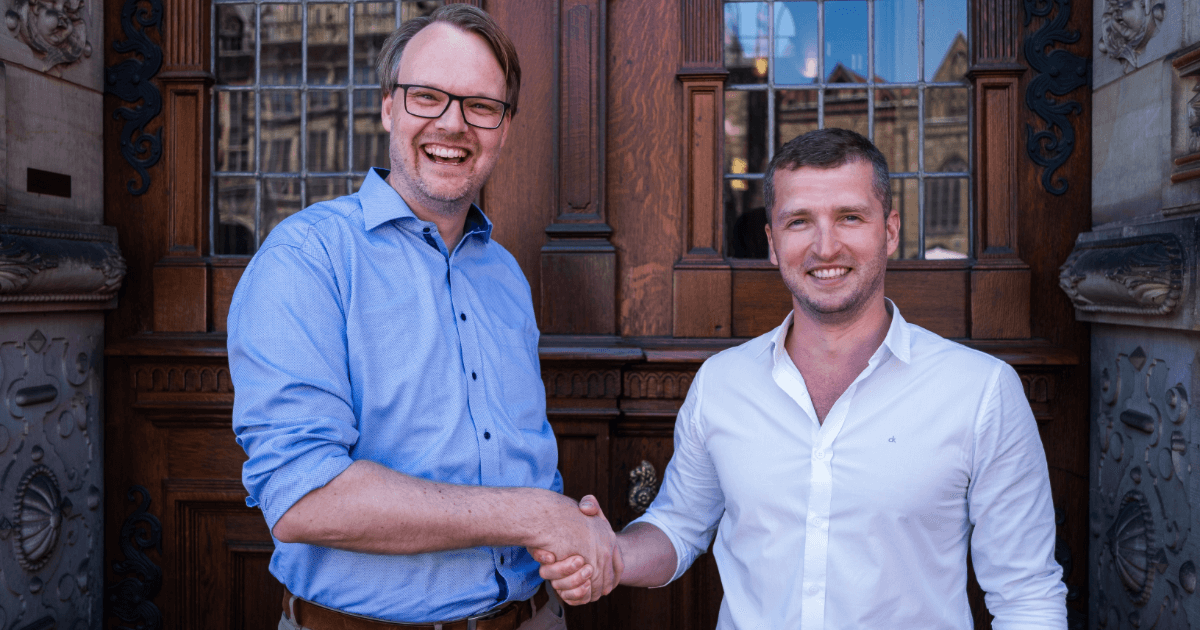
Last week Proekspert and German entrepreneur Cord Winkelmann established Sensorise in Bremen, Germany. Sensorise will produce, market and integrate smart machine components and perform machinery surveillance via IT solutions. Proekspert holds a 50% share in the new company.

“The golden rule is that if you want to enter a foreign market you need to have unique technology to offer, and you have to be close to the people you’re trying to sell to,” said Marko Sverdlik, Proekspert CEO and Partner. “And if you want to operate on the German market, it’s important that you’re based there and can speak German. In that regard, we begin in a strong position thanks to our co-owner, Cord Winkelmann. We got off to a good start at the Hannover Messe trade fair, where potential clients showed interest. Business will begin with contracts signed with four clients.”

Co-operation with manufacturers of standardized components

Sverdlik added that while Sensorise produces smart machine components itself, it will also work with manufacturers of standardized components.

“Sensorise integrates sensor elements into normed machine components. The standard components have all the certification needed for that. Cord’s knowledge will be of huge help to us where that’s concerned since he’s been involved in integrating sensors for the last 10 years.”

Measurement data for smarter business decisions

Cord Winkelmann is optimistic about the future of the new firm. “The idea of establishing a company oriented towards Industry 4.0 in Germany came to us in mid-2018 when I went to Estonia to see for myself what Proekspert was all about. Smart machine components are highly compatible with existing machinery. The generated measurement data, in turn, needs to be processed into information that the customers need for their production and business processes. That’s what the specialists at Proekspert will be doing, and it’s thanks to their smarts that Sensorise will have such a strong starting point for its future.”

A patented solution sets apart from the fierce competition

Sverdlik admitted that there is fierce competition in the Industry 4.0 field.

“But we stand out from others because we offer a unique, patented solution for measuring static and semi-static loads on the machine components. Plus, Sensorise can provide retrofit solutions for old systems and factories, bringing them closer to Industry 4.0.”

Sverdlik says that the point of Industry 4.0 is to help companies avoid unexpected technical issues and equipment breakages that could bring operations to a halt. “And that could be for weeks at a time,” he warned. “Take a wind turbine out at sea, for example – if it breaks down, Sensorise smart machine components prevent damage from occurring that could run into millions of euros. Newer generators are a lot more powerful, and since we have no long-term experience with their durability, getting information in real time is important to operators and manufacturers. By way of comparison, look at cars: we’ve been making them for almost a hundred years, and that century of practical experience means virtually no one’s being left on the side of the road anymore because their car inexplicably breaks down.”

In describing Sensorise’s solutions, Winkelmann highlighted what sets them apart from the competition. “Schaeffler, SKF, and others are working in the same sort of areas, but the focus with Sensorise is on applications that monitor machines with slow or static motion, like conveyors. In addition, our patented smart screw provides exciting new opportunities for monitoring static structures like wind turbines where a lot of screws are subject to a mandatory monitoring obligation.”

Similar business cultures

Winkelmann added that in his opinion the business cultures of Estonia and Northern Germany share similarities.

“Perhaps it’s because we both were part of the Hanseatic League all those centuries ago. I really liked Proekspert’s company culture from the start, because it’s so open and international, and so it’s absolutely not about its managers. That’s one area German companies get bogged down in. But I think Sensorise will embody all those positive elements.”

Machinery as a target market

Target clients for the new company are manufacturers of wind turbines and operators of wind parks, companies in the timber industry, the mining industry (which utilizes large numbers of conveyors), builders and operators of LNG vessels, heavy industry (where there are large numbers of slow-moving bearings), and the automotive industry.

21st February, 9:30 – 12:00 “Digitalisation Seminar with Siemens”

Proekspert would like to invite you to join us on the morning of the 21st of February to discuss and explore data & digitalisation. Brought to you in association with Saksa Automaatika and Siemens.

We have two revered speakers from Siemens joining us to give their take on the topic. Ilmari Veijola and Jyrki Keinänen share with us their expertise and findings, focusing on the MindSphere IoT ecosystem and how to add business value using data from current processes.

Programme

9:30 – Coffee, snacks, and networking
10:00 – 12:00 (including a short break midway)

Ilmari Veijola and Jyrki Keinänen will be speaking about projects within MindSphere and giving us an overview of the ecosystem concept. They will also be covering the topics of connectivity, security and edge computing during their presentation.

The audience will have the opportunity to hear these cases explained from a technical perspective with particular focus on processes, not forgetting the challenges that often appear.

As a participant at the seminar, you will be able to attend a short workshop where companies can meet, chat and discuss any issues they have with their business, in relation to the content of the presentation, with our guests from Siemens. All you need to do is register below or email kristinm@proekspert.com for further details.

Please sign me up!

Tap on the button above to register and book your meeting with our guests.

From all of us here at Proekspert, we very much look forward to meeting you.

Further information:

Date: 21.02.2019
Duration of the seminar: 9.30 – 12.00
Location: Sõpruse 157, 3rd floor
Parking: free of charge in front of the Siili Pub; at visitor parking places in front of the Proekspert building
Further details: kristina.marfeldt@proekspert.ee


Seminar partners:

Python Applied to Machine Learning and Data

An overview by Travis E. Oliphant.

Most tech companies today are struggling to figure out how they can best work with their data. Travis E. Oliphant, the founder of startups Quansight and Anaconda, and the primary developer of NumPy and SciPy packages for Python, gave a talk at North Star AI conference, powered by Proekspert on how Python can be used effectively for machine learning and data – the heart of ML-driven technology.

Oliphant’s connection to Python dates as far back as 1997, when he was working with version 1.4. The very first problem he focused on was actually a data problem, and this led him to understand that in order to do anything with machine learning you have to get the data right.

While data seems to be everywhere these days, said Oliphant, the biggest problem is how you gain access to and utilize that information.

Applying Python to machine learning problems

In Oliphant’s mind, Python is one of the best languages to apply to machine learning problems. During his talk, he gave a thorough overview as to why and presented how he imagines artificial intelligence might develop in the future.

Not Artificial but Augmented Intelligence

When Oliphant thinks of AI, he thinks of “augmented” rather than “artificial intelligence.” For at least the next fifty years this technology will be more about “empowering people rather than replacing them,” he said. To be sure, AI might take over some tasks that you are doing today, but then you will shift to doing something more important, while the machine takes care of more mundane assignments.

What can AI be used for? Oliphant noted a multitude of possibilities.

Any time you have a complex function with many variables for which you want to have an understandable input and output—you can apply AI. For example, self-driving cars, medicine, and geophysics are a few of the fields where AI technology can make a big difference.

Big companies using Python in machine learning

In order to apply ML and be successful with your applications, Oliphant noted, you will need to work with people who have domain expertise, who know the business. The good news is that every major tech company is now involved in the AI field. Microsoft, Google, Apple, IBM, and Amazon are pioneering machine learning and artificial intelligence research.

These AI applications, said Oliphant, are on the verge of broad usability. Moreover, they are all written in Python.

Obstacles in the Industry

There is amazing promise in the AI and machine learning industry, but we have a very long way to go, said Oliphant. The current landscape contains challenges such as organizational infrastructures that make data-sharing difficult, and out-of-date regulatory structures that were created for a different era. Technology is changing faster than education can keep up, and software is lagging behind hardware advances; programmers are not yet tapping into the full potential of the hardware that is available to them.

As quickly as things progress, there remain many silos of technological advancement and a general lack of integration when it comes to methodology. “Can’t we figure out frameworks that everyone can use?” asked Oliphant.

AI exists in some basic forms now, but the dream is something bigger. There is still so much that needs to be done in order for the promise of AI to become actual capability, said Oliphant.

Anaconda, a Possible Solution

Launched by Oliphant himself, Anaconda is an open-source tool that simplifies package management and deployment in the Python and R programming languages. It can be used to great effect for data science and machine learning applications. Moreover, its open-source package and environment manager, Conda, is language-agnostic and can distribute software for any language.

Ecosystem frameworks

When it comes to AI, Python is not enough, explained Oliphant. You need ecosystem frameworks to solve your problems as well as machine learning tools—and Anaconda can bring all of these technologies together. “One of the key things we need is AI integrators bringing people these capabilities in everyday applications.”

Everybody loves modeling, predicting, classifying, and visualizing in AI, and these are fairly easy tasks to complete. The harder things are feature labeling, data-cleaning, data-extractions, deploying, reproducing, and scaling—and this is where Anaconda can help.

Oliphant discussed two other Anaconda tools, Numba and Dask, that he believes are crucial for anyone working in the realm of machine learning. Numba, he explained, is designed to help with scaling up. It is an open-source Python compiler that comes with a CUDA simulator. It can also compile for the CPU and GPU at the same time and make array processing easy. Most importantly, Numba executes code ~2.7 times faster than NumPy.

Dask is a parallel computation library for scaling NumPy arrays and Pandas dataframes. With Dask you can make a collection of arrays or dataframes that are larger-than-memory and can be used in distributed environments. It has a task scheduler that is optimized for computation, helping to run your custom algorithms on distributed nodes. Dask also has beautiful diagnostic dashboards that provide users with performance insight.

You can find more information about these tools on the Anaconda website.

Using AI in Your Organization

To end his presentation, Oliphant discussed how these tools should be applied within an organization or company. How do you actually go about integrating AI into your technology?

Using machine learning and artificial intelligence in any way requires a process, he said. First, you have to bring your data together. Here, he suggested using visualization tools because the best way to understand your data is to look at it. Next, it is important to do AI brainstorming and consult with people who have real experience in the field. Once you have found the “right” features for your work, it’s time to build and validate your model and repeat that for many models, then publish and manage at some time-scale.

Following such a rigorous approach to machine learning and armed with tools such as Anaconda, we can start making the transition from the AI we have today to a more seamless AI of the future, concluded Oliphant.

Save the date – March 7th, 2019!
North Star AI powered by Proekspert is coming again and tickets are now available.
More info: aiconf.tech

On Dataset Shift in Machine Learning

Best Practices Presented by Peter Prettenhofer.

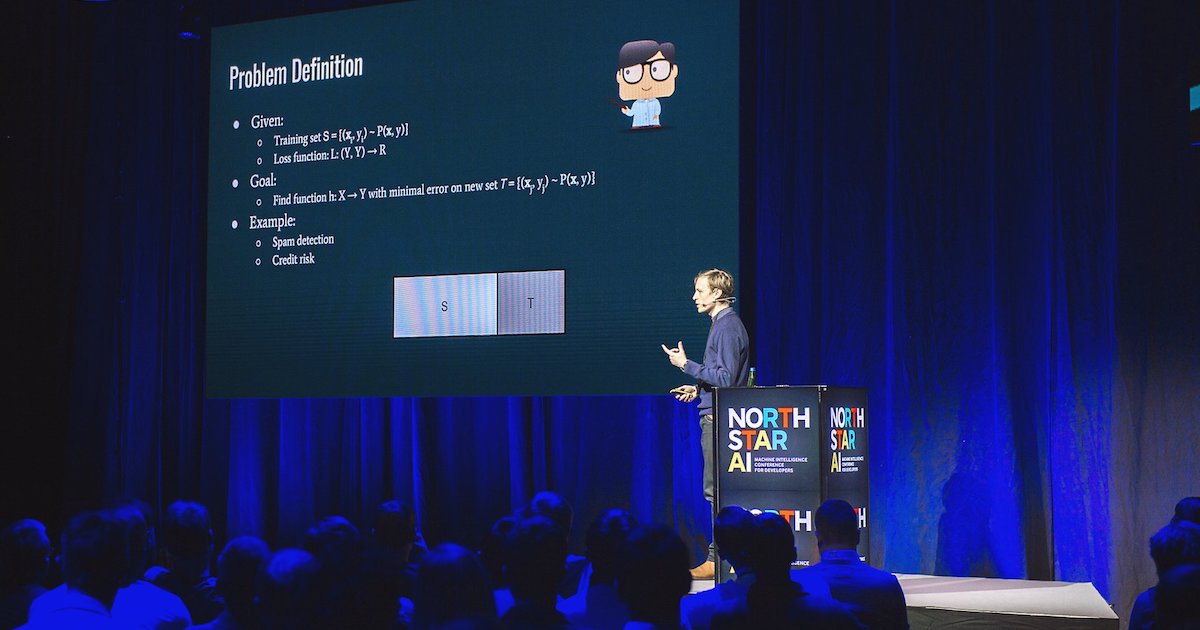
During the North Star AI conference, powered by Proekspert, Peter Prettenhofer, VP of Engineering at DataRobot, presented one of the most fundamental questions in machine learning: What happens if the data applied to a model looks quite different from the data that the model was initially trained on?

This phenomenon is often referred to as a ‘concept shift,’ where changes in the relationship between input features and outcomes can lead to a decrease in model accuracy, impacting both model performance and target distribution.

The obvious question that naturally follows, noted Prettenhofer, is: Does the model, in this case, need to be retrained?

Introduction

In the ever-evolving field of machine learning, one of the most significant challenges is ensuring that models remain accurate and reliable over time. This is where the concept of dataset shift comes into play. Dataset shift occurs when the data distribution changes between the training phase and the deployment phase, leading to potential degradation in model performance. Understanding and addressing dataset shift is crucial for building robust machine learning systems that can adapt to real-world changes.

In Supervised Machine Learning

In supervised machine learning, the goal is to train a model on a labeled dataset to make accurate predictions on unseen data. However, in real-world scenarios, the data distribution can change over time, leading to a phenomenon known as data shift. Data shift occurs when the training data and the data on which the model is deployed have different distributions. This can significantly impact the performance and reliability of machine learning models. For instance, a model trained on historical sales data may struggle to make accurate predictions if consumer behavior shifts due to economic changes or new market trends.

In supervised machine learning

In supervised machine learning — which was the focus of Prettenhofer’s talk — you are given a set of samples, X (feature vector) and Y (a class label) pairs, as well as a loss function that can be used to assess how well your model is making predictions. The goal, explained Prettenhofer, is to find a function (h) that maps from X to Y, and has a minimal error on new, unseen data.

How do you find the function h? Empirical Risk Minimization tells you to pick the one that minimizes the error on the training data. Like most machine learning techniques, it assumes that training and test data need to be drawn from the same distribution, specifically an independent identically distributed (IID) distribution. The identical aspect means that the distribution that generates data over time stays fixed. The independence aspect boils down to sampling a sample that has no effect on the next one. This means that you need to submit to the idea that all data is drawn from some probabilistic process.

Uses of machine learning

In dataset shift, said Prettenhofer, you fiddle with this fundamental assumption of machine learning. You go from a classical view that training data and test data are drawn from a fixed but unknown distribution, to a view where training and test data are drawn from source distribution and target distribution. The question is whether or not learning is possible under such conditions.

Arguably, if training and test distributions differ, then learning is not possible; if the future has nothing in common with the past, then you cannot learn. Prettenhofer concluded that supervised learning techniques are thus negatively affected by dataset shifts. However, there are simple methods that you can use to detect this kind of change.

What is Data Shift?

Data shift refers to the difference in the distribution of the training data and the data encountered during deployment. It is the mismatch between the data used to train the model and the data it will encounter in the real world. Data shift can occur due to various reasons, such as changes in user behavior, changes in the environment, or changes in the data collection process. Understanding data shift is crucial for building reliable and robust machine learning systems. When data shift occurs, the assumptions made during the training phase no longer hold, leading to potential inaccuracies in model predictions.

Characterizing and Identifying Dataset Shift

Prettenhofer presented a taxonomy of methods that can be used to identify whether or not dataset shift is a problem you may have. In general, there are two methodologies for detecting dataset shift issues, supervised and unsupervised. Prettenhofer noted that he will focus on unsupervised methods because they are more common and practical.

1) Statistical Distance

The Statistical Distance method is useful for detecting if your model predictions change over time. This is done by creating and using histograms. By making histograms, you are not only able to detect whether your model predictions change over time, but also check if your most important features change over time. Simply put, you form histograms of your training data, keep track of them over time, and compare them to see any changes. Changes in the joint distribution of inputs and outputs can be detected using statistical distance methods. This method, noted Prettenhofer, is used most commonly by financial institutions on credit-scoring models. There are several metrics that can be used to monitor the change in model predictions over time. These include the Population Stability Index (PSI), Kolmogorov-Smirnov statistic, Kullback-Lebler divergence, and histogram intersection.

2) Novelty Detection

A method that is more amenable to fairly complex domains such as computer vision, is Novelty Detection. The idea is to create a model for modeling source distribution. Given a new data point, you try to test what is the likelihood that this data point is drawn from the source distribution. Monitoring raw input data in machine learning workflows presents challenges due to the various sources, formats, and structures, as well as restricted access for ML engineers once processed by a data platform team. For this method, you can use various techniques such as a one-class support vector machine, available in most common libraries. If you are in a regime of homogenous but very complex interactions, then this is a method you should look into, because in that case, the histogram method won’t be effective.

3) Discriminative Distance

The Discriminative Distance method is less common, nonetheless, it can be effective. The intuition is that you want to train a classifier to detect whether or not an example is from the source or target domain. You can use the training error as proxy of the distance between those two distributions. The higher the error, the closer they are. Discriminative distance is widely applicable and high dimensional. Though it takes time and can be very complicated, this method is a useful technique if you are doing domain adaptation.

Another important concept to consider is the ‘prior probability shift,’ where the distribution of the target variable changes while the distribution of input features remains constant. This shift can significantly impact model performance, especially in scenarios where the class variable distribution is affected without changes to the input distributions.

Understanding Covariate Shift

Covariate shift is a type of data shift that occurs when the input distribution changes, but the conditional probability of the output given the input remains the same. In other words, the input features change, but the relationship between the input and output variables remains the same. Covariate shift can be caused by changes in the state of latent variables, which can be temporal, spatial, or less obvious. For example, in a credit risk assessment model, the input features such as income and credit score may change over time, but the relationship between these features and the output variable (credit risk) remains the same. Addressing covariate shift involves techniques like importance reweighting to ensure the model remains accurate despite changes in input distribution.

Understanding Concept Drift

Concept drift is a type of data shift that occurs when the relationship between the input and output variables changes over time. In other words, the input features and output variable may remain the same, but the underlying relationship between them changes. Concept drift can be caused by changes in the underlying data distribution, such as changes in population demographics or changes in user behavior. For example, in a recommender system, the user preferences may change over time, leading to a change in the relationship between the input features (user demographics) and the output variable (recommended products). Detecting and adapting to concept drift is essential for maintaining the relevance and accuracy of machine learning models in dynamic environments.

Correcting Dataset Shift

How do you correct dataset shift? The short answer, said Prettenhofer, is that you don’t — you retrain your model. If possible, you should always retrain. Of course, in some situations, it may not be possible, for example, if there are latency problems with retraining. In such cases, there are two easy techniques for correcting dataset shift.

1) Importance Reweighting

The main idea with Importance Reweighting is that you want to upweight training instances that are very similar to your test instances. Essentially, you try to change your training data set such that it looks like it was drawn from the test data set. The only thing required for this method is unlabeled examples for the test domain.

2) Change Representations

You can also change the representation of your data to make the two distributions appear more similar. Given that you can still make good predictions on the training data, this means that this mapping will help you during knowledge transfer. An example of this is feature selection. A feature that differs a lot during training and test, but does not give you a lot of predictive power, should always be dropped. This is one of the most important lessons in understanding dataset shifts, said Prattenhofer.



Proekspert Wins Recognition at the Estonian Design Awards

Proekspert’s new tool Pulse was a nominee in the graphical and web design category at the 2018 Estonian Design Awards and received the Bronze award for Digital / User Experience.

The Estonian Design Awards gather awards of various areas into one place to amplify the voice and message of design in society. Prizes are bestowed for product design, graphic design, web design and service design that solves problems, is aesthetically pleasing, environmentally friendly and sustainable.

The graphics and web design awards are given annually as part of the Estonian Design Awards by ADC*E (Art Directors Club Estonia).

This year’s competition saw in total 415 nominees, of which thirty of them received an award, including Proeksert’s Pulse for digital & user experience. The user experience category (under graphics and web design) is assessed by following the tool’s process by the consumption of information, combined with its fluidity and ingenuity.

This category includes digital solutions that have a primary emphasis on user experience development and innovation.

Pulse – a managing tool for a managers-free organization

Pulse has been designed to support our flat organization, enabling people to share information about themselves, and helps them by giving them information about available projects/challenges, so they can search for new opportunities and be found by project leaders.

Users do this by setting up a profile with their skills and experiences; searching for others based on their profile, posting and finding new projects, and automating previously manual tasks like filling out CVs.

Pulse introduces innovative features including:

  • Skill-based lookup: Finding in-house talent went from “people I know that might know someone” to fundamental cross-company skill-based lookup.
  • Modular CV generation: Sending CV-s to clients went from a painfully manual process that took time from talent and HR, plus needing a designer to design an easy “save to PDF” from existing information.
  • Posting new challenges: Advertising upcoming projects transformed from people being assigned to posting up AD-s or “challenges” so others can apply themselves.

Our company’s mindset is human-centric – if we do something for our employees, we keep their interest in mind. We want it to be useful to ourselves – otherwise, it’s just a chore.

Winning the bronze award for user experience at the Estonian Design Awards demonstrates our mindset. If you would like us to help you out with your digital solution also, contact us here.