Deep Learning: Training the Technology of the Future

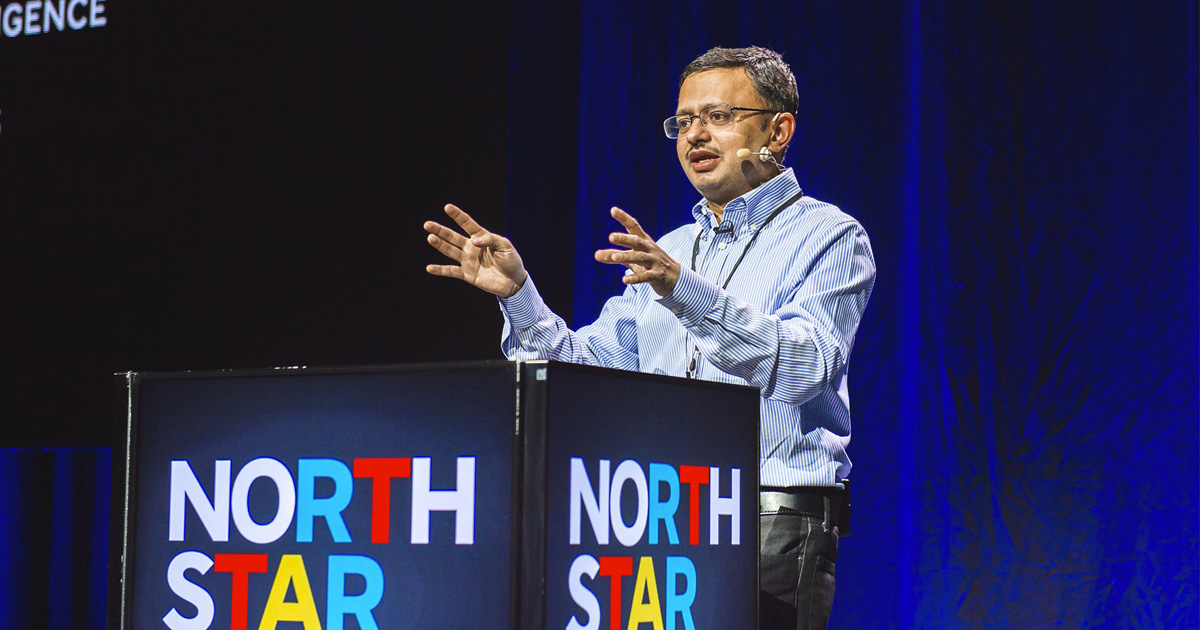
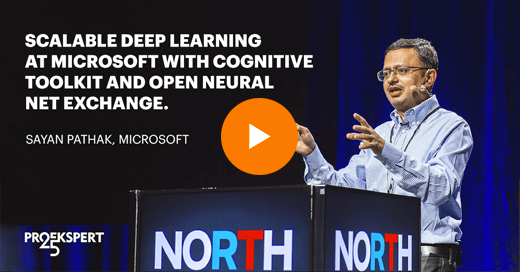
A talk by Sayan Pathak, Principal ML Scientist at Microsoft, at North Star AI conference, powered by Proekspert.

This year’s North Star AI conference in Tallinn invited industry rockstars to present the latest and most radical developments of the field. Among the featured speakers was Sayan Pathak, Principal Machine Learning Scientist at Microsoft, who gave a thorough overview of how the company is utilizing deep learning (DL). Moreover, Pathak ended his speech by encouraging developers to take initiative and join in the effort to build this technology of the future.

Deep learning and neural networks

Neural networks are not new, began Pathak. While the technology itself has been around for some time—and many have had big hopes for it—the fact is that we have not been able to train neural nets well enough to do the things that we would like them to do, let alone to have their own minds (as many AI enthusiasts might hope).

Pathak assured his audience that the process of training these systems is not simple and requires a lot of work. That said, in the last few years we have witnessed several innovations that have enabled neural networks to take their first baby steps to meeting their greater potential. This is the era when we may actually see this technology come to fruition.
The Landscape of Machine Learning

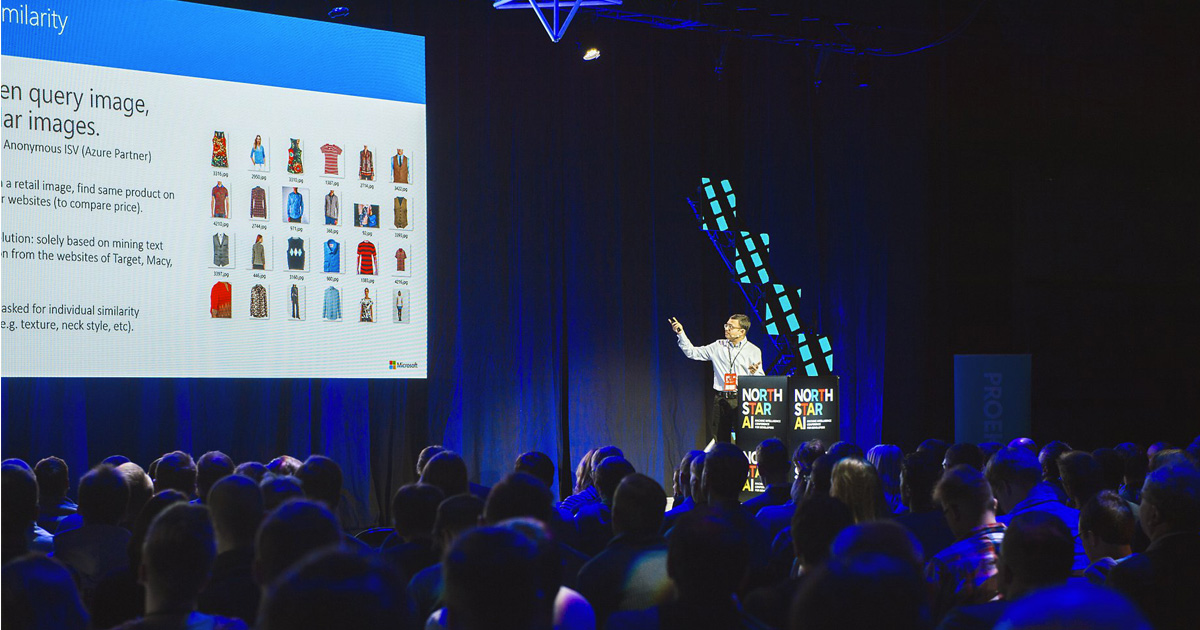
To explain and explore the greater potential of deep learning, Pathak first gave a comprehensive overview of all the places where scalable DL is currently occurring in the industry. He also hinted at how this technology might increasingly infiltrate our daily lives as we move forward.

Examples of where Microsoft Deep Learning Technology is being used:

  • Cortana – uses speech related APIs for transcribing and translating speech in real-time.
  • Bing – uses deep learning to enhance advertising platform and tools.
  • HoloLens – while use cases for this product are still being formed, there are many ways for augmented reality (AR) to integrate and utilize DL technology.
  • Office 2016 – uses deep learning to enhance popular programs such as PowerPoint.

Pathak explained that all of these powerful products have AI components already built into them and are constantly being further enhanced with deep learning capabilities. He also noted that Microsoft’s deep learning tools are being used beyond the Microsoft family of consumer-facing products.

Deep learning model example

For his first example Pathak cited the Chinese startup Airdoc, which provides doctors with powerful tools to help them detect and diagnose life-altering diseases such as diabetic retinopathy—a disease which is rampant in a country with over one hundred million diabetics. Using Microsoft’s Cognitive Toolkit together with Azure GPUs, Airdoc was able to cut down on training time for its own deep learning models and assure data security.

Another example that Pathak pointed to was Microsoft’s speech breakthroughs. With new tools, such as a powerful translator that can translate real-time conversations between people speaking in two different languages, the company is vamping up favorite products such as Skype and PowerPoint. The Asian phone carrier Huawei has also partnered with Microsoft to utilize these capabilities in newer versions of their phones.

These are just a few of the innovative ways that deep learning technology is being leveraged to radically transform useful tools and platforms. In his talk, Pathak noted that it is important for developers from all backgrounds to take part in further building this technology; there is a need for openness and democratization.

While machine learning has not always been accessible to coders with fewer resources—mainly due to the high energy cost and tremendous amounts of data involved in the training process—Microsoft is actively trying to remedy the issue. In fact, Pathak himself offers a free deep learning course online.
How You Can Contribute to the Industry

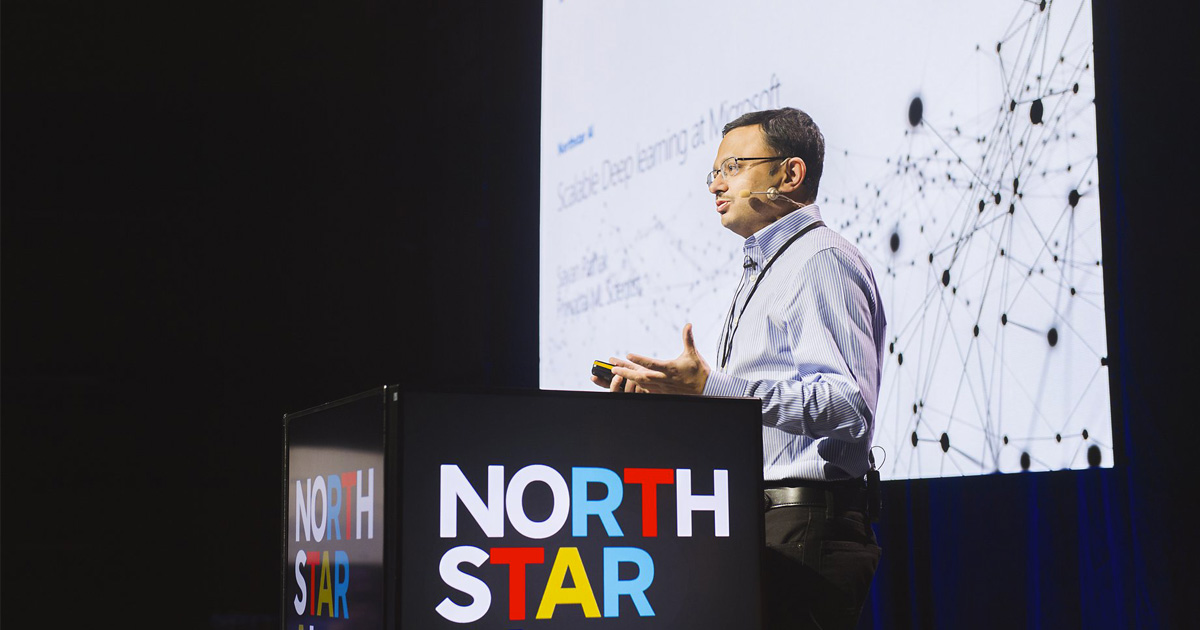
After providing background on where machine learning is being used today, Pathak turned his attention to some of the tools that Microsoft offers to developers. “We have a role to play” he said in regards to the crucial development of neural nets.

Whether it be individuals or whole startup teams, Microsoft Cognitive Services is an invaluable set of APIs that developers can tap into to complete various tasks related to speech, text, and image-related vision. Instead of building and training machines from scratch, coders can take advantage of this resource and actively start building their own applications.

According to Pathak, the Microsoft Cognitive Toolkit (CNTK) provides low level APIs which offer incredible flexibility. “The distributed framework is one of the easiest ones I have come across,” he said. “I’m biased maybe,” he added with a smirk.

CNTK allows developers to compose arbitrary neural networks into complex computational networks. The toolkit uses graphs to represent neural networks, explained Pathak. Most of these networks have automatic differentiation built into them, which enables the engine to optimize the workflow. With these tools developers can edit the models, clone them, and fine tune them to fit their applications. A major plus of CTNK is that it allows you to have lego-like compositibility for different applications.

Introducing ONNX

One of the challenges of machine learning, said Pathak, is that a variety of toolkits have to operate on all framework/hardware combinations. Moreover, it is not easy to translate from one framework/platform combination to another. Even in a large company like Microsoft, this means increasing fragmentation across teams. The solution, Pathak argued, is an intermediate representation.

Enter ONNX – an online neural network exchange that is an open format to represent deep learning models, supported by CNTK, PyTorch, Caffe 2, and MXNet. Microsoft and Facebook teamed up to create this open ecosystem for AI model interoperability out of the need to homogenize the stack. What’s more, a wide range of partners are already working on this ecosystem.

The strategy, said Pathak, is to drive AI apps and models to be built and run on Microsoft platforms. “From Microsoft’s perspective, the key is to support any popular network. The idea is to provide this IP to the community so that they can build solutions.”

ONNX is an open source intermediate representation of a computation graph with common OPs and semantics. “This is what is driving the AI field for common people who don’t have large access to resources, data, technologies, or software know-how,” said Pathak. As an open source technology, ONNX is opening up a whole realm of opportunities for the community.

“We are looking for contributions from the community. The more the community participates, the more the AI ecosystem will grow better and democratize AI resources and tools,” Pathak explained as his talk drew to a close. To learn more about these technologies, be sure to visit cntk.ai and onnx.ai.

If you want to listen to Sayan Pathak´s speech, check the video:
3 Principles to Foster Great Teamwork

Proekspert’s analyst Andrus Kuus shares stories about being a successful team leader at North Star conference.

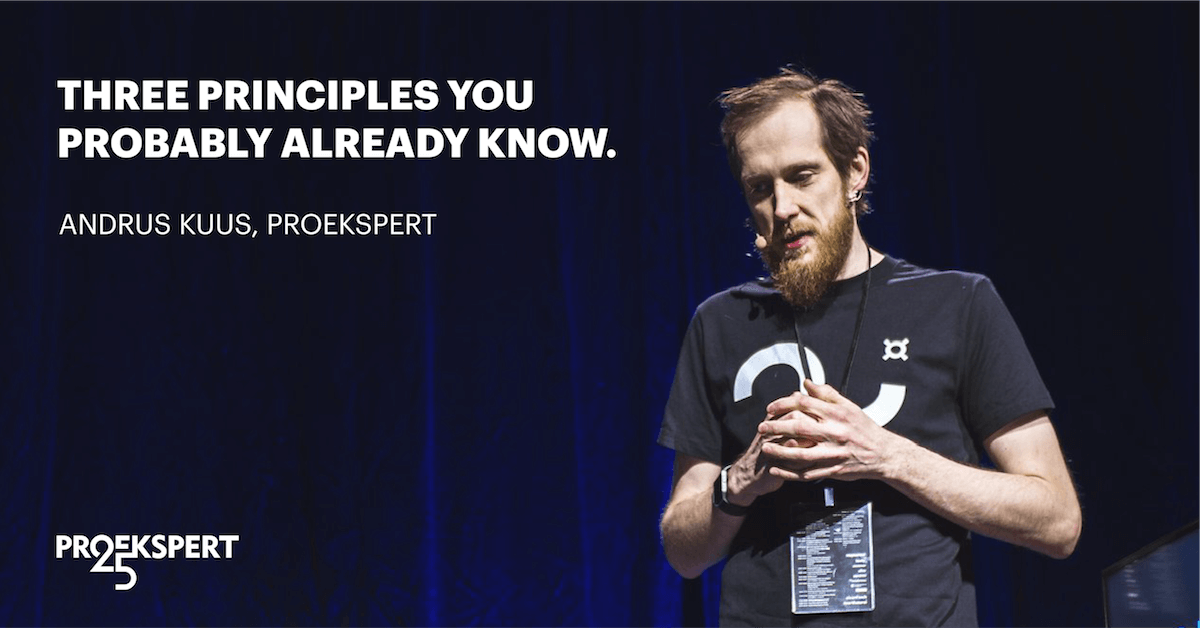
When Proekspert’s Andrus Kuus got up to speak at this year’s Northstar AI conference in Tallinn, he entertained the audience with an inventive speech. Having worked in the software industry for over 23 years, Kuus drew on his many experiences—including that of being an analyst at Proekspert—and shared some important insights on teamwork and project management.

“Today I will tell you three stories about the principles I follow in my work,” he began. “I believe that these principles are also relevant in the field of data science. So let’s start.”

Teamwork does not get better by itself.

Kuus’ first story was about his uncle, a woodworker. He explained that his uncle creates unique furniture, and rarely has a waitlist shorter than 6 months. In other words, he’s a busy guy who often has to reject new work because he feels he cannot deliver results within a reasonable timeframe. This uncle, explained Kuus, also has a son who occasionally helps him build furniture. Generally, it makes complete sense for the two of them to collaborate and share the workload. However, they don’t do this often.

When Kuus asked his uncle why, he was told that the two men have different work-styles that do not mesh well. His uncle gets frustrated when he has to work with his son because suddenly his tools are misplaced, the tempo of the work is different, and the two have trouble agreeing on creative decisions.

Why is this relevant?

Kuus said that it is quite safe to assume that within a few years those attending the conference might be working in a team of data scientists. It also quite safe to assume that a lot of their teammates will be people fresh out of university who really don’t have much experience working in a team.

“If you don’t want to end up in a situation like my uncle,” said Kuus, “you have to deal with that problem.” He also went on to say that the first thing that needs to happen is for you to acknowledge that teamwork does not get better by itself. Somebody else cannot solve the problem for you. As it turns out, as a team lead, you have to deliberately spend time on improving the way you work together. To accept this responsibility is an important step.

You need to make a habit of discussing why and how you do things in your team.

Strive for clarity in communication

Kuus’ second story was drawn from his own work experience. In the beginning of the 2000s his team had to take over the development of a system that calculated bonuses for the customers of a large company.

As is usual in these cases, there was a set of project assets that was handed over to the new team. The most important of these assets was the source code, which in this case came from a corporate workstation.

“When we got access to the computer we found the code,” said Kuus. “In fact, we found several versions of source code located in different folders. It was unclear which one of these we have to use. Soon we found out that there was also another workstation that contained code. So eventually we had 7 different folders containing 7 versions of the code.”

Kuus said that the team tried everything. They analysed the code, ran comparative tests, cross referenced the documentation. Unfortunately, it turned out that none of these folders contained the code that was running in the live system. “So we did something quite unusual,” he explained. “We patched the sources together from the content of several folders and added code that we got from decompiling the live system. This code was our best guess. And fortunately it worked!”

This project was no small task, explained Kuus. It took weeks of hard work and brainstorming. He then referenced a quote from Martin Fowler: “Any fool can write code that a computer can understand. Good programmers write code that humans understand.” This principle applies to more than just writing code, argued Kuus. “Strive to make all your work understandable to other people.”

The moral of this story: choose the tools and practices that help you achieve clarity and understandability. Refuse to use the tools and practices that make it harder.

To keep track of things, Kuus recommended using a task management system instead of Excel sheets sent over email. Choose wiki to store documentation and knowledge instead of Word documents that are hard to update. Choose version control over creating multiple copies of folders on corporate workstations. It is important to have clarity of mind when identifying your tools and processes.

Data scientists talk to data?

The final story of Kuus’ presentation—incidentally taking place very close to the lunch hour—had to do with food. “I seldom watch TV nowadays,” said Kuus, “but for some reason it seems like every time I turn on the TV I always end up watching this cooking show called Masterchef. Yes, the one with Gordon Ramsay as one of the judges.” Kuus explained that often the contestants on this show have to cook food using really strange ingredients like testicles, chicken feet, or something similarly obscure.

During one episode in particular, one of the contestants, a girl named Diana, was struggling with tripe, a part of an animal’s stomach. Like any average person, Kuus explained, Diana had never cooked tripe before. Nevertheless she had to do something, so she improvised.

She did her best, and within 45 minutes produced a nice looking menudo from it. For clarification, menudo is a spicy mexican soup made of tripe and corn tomatoes. According to Wikipedia, this dish normally takes from 4 to 7 hours to prepare. However, Diana tried to make it in 45 minutes.

“I believe that it comes as no surprise that the first thing Gordon said after tasting the dish was ‘I’ve got some raw tripe here,’’ said Kuus. Consequently, Diana had to admit that she had cut some corners and had therefore failed. Of course this created drama, and Diana was not made the next Masterchef.

“But why am I talking about a TV show?” asked Kuus. “Because you and I are living lives that are sometimes very similar to a TV show.”

We often do things that we have not done before, said Kuus. We usually do these things under time constraints and pressure, and often with limited information at our disposal. But unlike the TV show, where the ability to validate ideas has been artificially limited, in real life we can ask questions and validate our ideas.

“In my experience,” said Kuus, “ we tend not to use this ability and just improvise.” Maybe this happens because we’re afraid to look stupid, or maybe we do not want to bother people. “I don’t know. But the latest Kaggle survey shows that almost 25% of respondents feel that their research results are not used by business. Maybe this is the outcome of that,” concluded Kuus.

The third moral: validate your ideas before spending lots of time working on and fine-tuning them. Communicate. Don’t be afraid to ask.

It is said that the hardest part of data science is asking the right questions. Kuus doubts that anyone can ask the right questions without first asking lots of wrong questions. There is that cliche that data scientists talk to data. “I think this is wrong,” said Kuus, “data scientists should talk to people. Because only then is it possible to create insights that have real value.”

To wrap up, Kuus turned to his own experience once again. “Lately I have had the opportunity to talk to data scientists from several organizations,” said Kuus. From these talks he discovered that a lot of the problems that data science teams are facing today have been relevant in software development for decades. “I think that our experience can help data scientists face these problems more easily,” he said.

The three important principles that Kuus hoped to leave his audience with are:

  • Regularly discuss why and how you do things in your team
  • Choose tools and practices that foster clarity
  • Validate your ideas before spending time fine-tuning them

These principles are obvious, said Kuus. However, as it is often happens with obvious things, they are easily forgotten. “I hope that my talk reminded you to think about them in the future,” concluded Kuus.

Preparing Kids for AI

How Proekspert helps younger generations embrace robotics and make the world ready for AI.

We believe in the importance of understanding one’s tools; a painter should know how to wield his brush, and a surgeon must know how to handle her scalpel. In the dawning age of robotics we must understand our smart tools—which are totally unique to our time. And because the true age of AI will belong to future generations, Proekspert considers it a responsibility to promote robotics education.

Our Beautiful Code Award team Robotex, probably the largest robotics competition in the world.

Proekspert is an active participant and continual backer of Robotex, which recently applied to the Guinness World Records to be listed as the largest robotics competition in the world. With more than 1,300 robots, hundreds of teams, and tens of thousands of participants, the event has had an undeniable impact on robotics education in the Baltics. Our employees are always eager to participate in the competition, helping Robotex teams make their robots smarter. Proekspert has launched the traditional Beautiful Code competition at Robotex to young developers the opportunity to showcase some of their best and most innovative work.

Competitors vary from juniors to seniors – there is no age limit for writing beautiful code!

We also support student robotics teams in competitions and hackathons, offering expert mentorship. We’re actively involved with a variety of robotics clubs across Estonia, and we provide work-shadowing opportunities to the young club members so they may get a first-hand look at how Proekspert develops smart products connected to data science, including machine learning and artificial intelligence.

We’ve found that the benefits of this mentor relationship run both ways: we help kids find their potential in robotics and IT, and the children inspire us with their enthusiasm. Also,  employees who support student teams, mentor young talent, and play around with crazy ideas during hackathons, find that it feeds their own thinking and work in interesting ways. We learn by teaching.

One of our most recent projects was to establish a robotics club for school children on the island of Saaremaa. Proekspert employees run the club, where emphasis is on teaching kids how to build robots and expand their analytical thinking.

The next generation robotics pro-s from Saaremaa.

The more we work with young minds, the more we are motivated in our own work, and the more we’re convinced that the future is bright. With a little effort, the experts of today can pass on their knowledge, preparing a new generation to develop even more innovative tools.

If you’re inspired and would like to join forces to help prepare kids for a world with AI, get in touch: helen.lillep@proekspert.ee

Tähve Lõpp, Proekspert´s Business Developer, mentors at the Smart Industry Hackathon.

We invite you to “Technology. Human Capacity. Awareness.” conference

03. May will see the  Conscious Initiative conference, “Technology. Human Capacity. Awareness.”, take place in Tallinn, Estonia. Among other experts, Terry London and Peeter Meos from Proekspert will take to the stage to give their thoughts and ideas on technology, human capacity and consciousness: how do we need to change our way of acting, learning and working in face of automation, AI and VR solutions?

We will discuss ethics and new challenges facing doing business in an automated world. Not forgetting the human factor, we will seek answers to questions like, why human thinking is slower than machine thinking and why we should learn to use our own awareness/consciousness based skills such as creativity, insight and intuition that enable innovation.

We are happy to invite you to participate, share your insights and inspiration:
Agenda, registration and tickets.

Some insights: in last year´s report, the McKinsey Global Institute found that up to 800 million global workers are set to lose their jobs by 2030 through robotic automation. We are experiencing no less than the Forth Industrial Revolution right now that is larger than the previous three by far by scale, scope, and complexity. Also, the speed of technological breakthroughs has no precedent. When compared with previous technological revolutions, the forth is evolving at an exponential pace rather than linear, disrupting almost every industry and creating tremendous potential and new possibilities. The revolution has the potential to improve the quality of human life, but it also has some considerable threats, among these also some unseen developments in AI segment. Proekspert´s mission is to create the world where smart machines improve human life, not threaten it. That is why we also participate in the dialogue on how to make the transition.

Some of our thoughts about these topics:
Would you trust AI with your life?
Unknown unknowns and Industry 4.0

AI and machine learning lands in Tallinn

North Star AI, a long-awaited artificial intelligence and machine learning conference is bringing some of the best minds in the field of artificial intelligence and machine learning to the heart of Tallinn on the 8th of March 2018.

North Star AI brings together developers, tech leads, data analysts, technical founders, and anybody else who shares an interest in this area and where it’s heading. It’s a great opportunity to hear from some of the world’s leading influencers on the subject. North Star AI focuses on the exchange of real-life experiences and case studies from practitioner to practitioner. All of the speakers are either developers or analysts; with a focus on the benefits, they can bring to other developers, rather than having an explicit commercial interest.

Proekspert is a proud sponsor and collaborator with North Star AI, helping to stage the first and largest machine learning conference in the region. As well as being involved with the process of putting on the event, we will also be present both as exhibitors and speakers, not to mention that our data science team will be there in person.

The schedule is packed with great speakers:

Our keynote speaker, Sayan Pathak, principal machine learning scientist at the Microsoft AI Research Center in Redmond, WA, and faculty member at The University of Washington, will be speaking about scalable deep learning at Microsoft in depth.

We’re also very pleased to welcome AI and Blockchain expert Maxim Orlovsky as one of our speakers. Founder and visionary at Pandora Boxchain project, a medical doctor turned neuroscientist now holding several posts in the area of technology-oriented knowledge-intensive business. He is also the winner of the National prize in science and technologies (Ukraine), along with a number of International Scientific Soros Foundation prizes.

Anaconda CTO Peter Wang will speak about using Python for data science systems design. Peter has software design and development experience across many areas, including 3D graphics, geophysics, financial risk modeling, large data simulation and visualization, and medical imaging.

Other speakers include Siim Sikkut, Government CIO of Estonia; Ahti Heinla, CEO, CTO, and co-founder at Starship Technologies; Jaan Altosaar, Physics Ph.D. student at Princeton; Mattias Nilsson, AI Researcher at FOI and Swedish Defence Research Agency; Hendrik Luuk, CTO at AlphaBlues; and Peter Prettenhofer, a data scientist at DataRobot.

Andrus Kuus, software analyst here at Proekspert, will also be speaking to the attendees on the topic of streamlining data science projects, with a focus on how to unify, integrate and abridge teamwork and developmental processes to beneficial effect.

Let´s meet at North Star AI!

We are sure that everyone working in this area, will be able to benefit from the range of opinion and experience whilst attending, having the opportunity to meet and network with the speakers during the event. Our aim is to connect Estonian data science to the global scene and nurture the local data science and artificial intelligence community. Attendees looking to delve deeper into the subject will benefit from the wealth of knowledge and experience there will be, both on stage and off. Everyone is encouraged to network, ask questions and learn from the best.

For those more experienced professionals, it’s an opportunity to be inspired by new ideas, share your own ideas with others, and be part of a community that has otherwise had quite a few opportunities to gather and network in this part of the world until now.

See you at North Star AI!

Read more about North Star AI