By using technology, there are several ways that companies can recover from the pandemic faster, creating more resilient businesses in the long-term future.
The pandemic presented a need to innovate.
Current market demands for businesses now rely on more purposeful data-driven, digitalized operations, and customer experience. These are the business needs you can’t ignore anymore.
While companies prioritize safe and short-term reactive initiatives to sustain their business, here are several ways companies can speed up their recovery and develop new, more resilient businesses in the medium to long- term with the help of technology.
Increase efficiency by improving traceability and digitalized processes
Due to changing demand, production plans change on a much higher frequency, depending on the availability of raw materials, staff, assets, and actual demand, which require optimization. This can be achieved through the integration of enhanced traceability and digitalized processes.
The main components of the manufacturing process are supply, warehouse, assembly, testing, and accounting. All operational areas can be optimized with the help of technology; we can do that with you starting from the most significant pain.
The Proekspert team re-engineered an old system by building new software on the existing hardware.
To enhance the data, the team integrated Evocon’s Overall Equipment Effectiveness (OEE) monitoring software via the API, which enabled the pairing of weight data with its relevant product.
Results:
Manual labor is no longer required for collecting, handling, or matching data. People are freed for more valuable work.
Product visibility increases, the process is significantly faster, and operational costs decrease.
The change enables production line work to be monitored, analyzed, and improvements implemented. Today better business decisions are made based on trusted data combined from a variety of sources and available in the management dashboard, dramatically speeding up the production process and saving operational cost.
Be where your customers are: Focus on making e-commerce solutions smarter and more intuitive
The pandemic has put excessive pressure on many business aspects, including online self-service platforms. The amount of customers in e-commerce is growing, with some providers experiencing huge operational volumes. Initially, e-commerce solutions were meant to serve only a minor number of customers, and sustaining the rapidly increasing demand is challenging with the existing solutions and systems.
Many businesses saw their e-commerce platforms being technologically unstable, non-intuitive for users, and with a limited operational capacity to serve customers, due to some manual steps involved.
Digital self-service platforms
Digital self-service platforms allow to:
save time and deliver on demand,
forecasting customer needs,
ensure consistent service quality,
save operational costs,
drive customer loyalty and trust,
increase operational transparency,
introduce new lines of service.
The key to successful e-commerce solutions lies in a cost-effective, fully automated process, intuitiveness, and service security.
Fully automated e-commerce solutions enhance efficiency and provide customer value
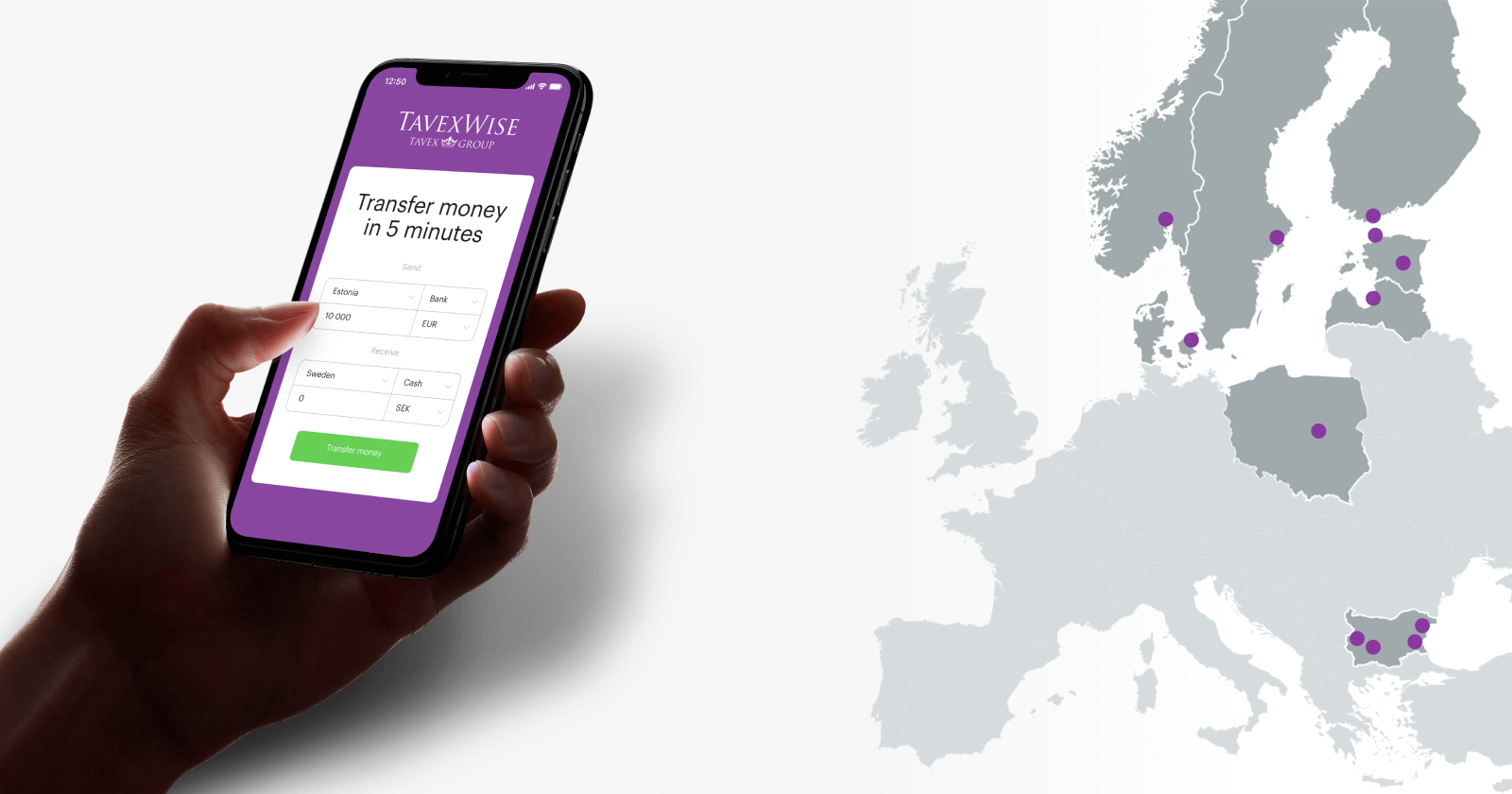
Recently, Proekspert has helped build the solution for cross-border money transfer that resulted in enhanced customer experience and lower international remittances costs. As a result of our partnership, the end-user enjoys intuitive service, where:
Money can be sent via cash or card from physical offices
Money transfers worldwide can be done through a web system
Low transaction fees are applied. To be precise, you can compare your win with other existing platforms
The transaction speed is fast, and it takes on average 5 minutes
The transaction is secure, and all the security requirements are fulfilled
Customers experience excellent service at physical locations
Our partners now have:
A healthy and efficient business model
A data-driven analytics supporting decision making
The business-critical systems were both automated and then linked with each other. Data dashboards were designed to support management decisions.
Scale your business by connecting your products
Cloud transformation allows for enhanced connectivity of your products, solutions refactoring, and updating technology stack, increasing the service’s reliability. All of these aspects result in increased profitability from new potential revenue streams and reduced operational costs. There will be no need to host the information on servers.
Connecting your products with cloud migration
Connecting your products can be done by moving your work to the cloud, including the migration of apps, software programs, desktops, data, or an entire infrastructure in alignment with your business objectives.
Cloud transformation allows for:
new potential revenue streams,
increased operational efficiency,
better compatibility,
optimization of business process costs,
centralize network security,
enhanced ability to react to user needs.
Cloud Transformation enables IT modernization in a variety of industries
Moving the online system to the cloud brought scalability, flexibility, and stability. The online solution, together with the mobile application, allows the end-users to control their heat pump from anywhere. Installers can monitor and troubleshoot issues on the go; the collected data can be used to develop better and more energy-efficient products – sharable and reusable components for scalability.
If the problem arises, the reaction time to that problem has increased optimizing the efficiency of the units.
Don’t wait for something to happen – make it happen
The new market realities have brought a lot of unexpected changes and challenges. To some extent, this is an excellent opportunity to rethink the new potential of your business, adapt, and flourish.
Don’t blame the lack of technology; it is not the problem.
Having technology at the core of your enterprise should be part of your survival plan now and into the future. All you need to do is to see the opportunity, find the right development partner, and take it.
Digitalization is not the unknown; it is the present and the future.
We are here to help you! Share your challenge with us here, and let’s discuss how we can help you!
Company culture is a defining feature of a company. Culture determines the feeling people go to work with. Culture sets the tone of communication between people. It establishes the mood and attitude they take home with them in the evening.
Why is it important to align culture in a company?
The answer is simple: People will get a common understanding of why, how and what we do in the company. If the culture conveys we care about ourselves and others, then this is how we will think and act. But if the company would, for example, always value money and efficiency first, then we would end up with a totally different company. The company would run its business based mainly on financial analytics, a lot of Excel tables, and not think of the people or the actual value produced.
Rethink your role description
Proekspert’s culture is far from the traditional hierarchical approach. We have no managers who make decisions for others. Our people may also carry a variety of roles and responsibilities at one time. We want our employees to fully realize their talent and potential, and to achieve that we sometimes work quite differently than other companies. For example: If you want to change roles, grow in another direction, initiate a podcast series, enter a new business, or pitch for a potential product, then agree on this with others, make sure it’s beneficial for the company – then you are allowed to do it.
This culture does not mean that everyone will move around, initiate, and change all the time. When you’ve committed yourself to something, it is expected that you will finish it. We are a company, where creating value is important, and without execution, value is not created.
How do we describe our culture now?
Our culture is currently described through governance principles. We arrived at these principles after telling stories to each other and generalizing the essence of these stories into commonly understandable values and principles. It made sense to divide them into four connected groups. For each group, several principles describe the group in more detail.
Proekspert governance principles
We are all human beings
I take care of my mental and physical health. I know my limits.
I am open and honest.
We believe that people around us are driven by good intentions.
We create value
My attitude towards work is that of a craftsman.
We grow and progress consciously and by experimenting.
We do our work with passion, joy, and humor.
We are heading in a clear direction.
We create meaningful value.
Our mindset is solution-oriented.
We are a community
We act consciously to support and encourage others in our team and in our community.
We all have a common cause.
We care about Proekspert.
We operate on similar principles in every cell of Proekspert.
I am the leader
I am the leader; I take responsibility.
I am responsible to, and for, my team.
I discuss my decisions with people who are directly influenced by them.
Company culture is constantly evolving
Culture is never completely ready or finished. It grows and changes with us. There are times when some principles and cultural aspects require more emphasis. It is important to bring the culture into our everyday lives. Culture is a way of working and a way of living. It is an attitude to embrace, not one to temporarily adopt. Also, constant evaluation needs to take place when bringing a culture to life – life is changing and so are we.
Collaborative product development has resulted in TavexWise intuitive solution with an enhanced customer experience and lower costs of international remittances.
Money flows where it is needed, and the business requirement is to ensure its journey is as smooth as possible.
People migrate for various economic, political, educational, and environmental reasons. Some are searching for a job, education opportunities, and as a result, increased quality of life outside their homes.
Parents are financially supporting their children during their university time abroad; migrants are financially taking care of their families in their home countries; long-distance friendships are maintained with acts of financial generosity.
It is challenging to live far from your loved ones. Most of us feel those hardships through our personal experience now, being separated from family and friends due to the pandemic. In such circumstances, communication tools help to cope with being apart, and money transfer systems enable supporting each other when it’s necessary and desired.
According to World Bank Data in its remittance report by 2021, the total value of remittances will reach $597 billion.
Challenges when transferring remittances between countries
Outlining one specific element is challenging. The importance lies in a combination of features that make up the whole international money transfer service experience. These certainly are the speed of the transfer, exchange rate, cost of the service, security, and intuitiveness of the solution.
Traditional money transfer process
However, the traditional money transfer process through big and conservative financial institutions is in contrary time-consuming, full of bureaucracy, long lines, and high fees. Remittance in banking is both slow and cumbersome, with remittance advice often out of date.
Why is the difference so drastic? What are the barriers in the remittance industry? In short, a combination of fraud and scams, changing exchange rates, security issues, burdensome regulations. One providing remittance service needs to solve all of them with no exception.
TavexWise: Acting on a market demand
TavexWise was established in 2014, challenging the notion that money transfers should be conducted through a bank or a recognized money transfer operator. TavexWise aimed to address the end-user needs with an effortless yet secure remittance solution.
The company founders understood that the heavily manual process, excel sheets, and archaic IT systems are not capable of solving rapidly growing challenges and were faced with three possible scenarios.
To put together a modular system merging all the existing solutions available on the market.
Develop the tool they urgently needed internally, establishing a full-scale development team.
Partner up with a tech company.
They chose the last option, and that’s when cooperation between Proekspert and TavexWise began.
The decision to partner up with Proekspert was not a coincidence. For TavexWise, it was essential to have a partner with extensive fintech experience, and Proekspert’s 20+ years expertise in the banking sector became a decisive factor in their quest for a partner.
Purpose of the cooperation – end-user satisfaction. From the very beginning, the cooperation was well aligned in tandem. TavexWise took full responsibility for the business needs and Proekspert for the best technological fit to design a superior experience for end-users. A joint multi-functional team was formed to design the product development strategy that ensured that each phase was correctly mapped out.
Always begin with the end-user experience
The priority for the team was to develop a brand new money transfer system that is fast and affordable for the end-user.
What challenges needed to be overcome?The main concerns to begin with were cost, speed, and usability of the service.
How? By solving what makes it so expensive and slow.
Step by step, together, we designed a system that automates and speeds up all the critical components necessary to facilitate smooth and cost-effective money transfers.
Combatting remittance fraud
Combatting remittance fraud. To verify a customer’s identity, an integration with an Estonian ID and similar systems in different countries was built. To prevent and combat financial crimes, especially money laundering and financing of terrorism, the solution was linked to the Police, fraud databases and internal credit reference tools.
Currency fluctuation risk was mitigated by real-time connections with the FOREX trading system, and the exchange rate feeds through API. The latter provides the speed and reliability needed to reduce the margin of error and ultimately save money. The pricing module was built, creating real-time customer prices for both currency and transaction fees.
The whole solution logic was replicated for eight different countries – Estonia, Latvia, Finland, Norway, Denmark, Sweden, Poland, Bulgaria, where TavexWise has a physical presence, plus additional partner countries, where transactions are happening in cooperation with local agents.
Merging different IT systems achieves true synergy
When the end-user pains were solved, we started auditing the whole IT ecosystem of TavexWise, thinking about optimizing internal business processes and creating value.
That’s how an internal transaction system for their offices in different countries was developed; it consists of a series of custom-built solutions:
A financial reporting system provides necessary input for monitoring data from global transactions effortlessly, with improved accuracy and depth from the previous approach of using paper-based and Excel to handle transactions.
The internal transaction system was created to manage currency position values over different markets, countries, and currency pairs, and perform netting transactions between company offices in nine countries.
A natural follow-on from this module was the bookkeeping solution, where transactions are generated and sent directly to an ERP system. The advantages of such a system are clear, helping the client to keep all financial reporting legally sound and easily referenced in the future – another massive plus is the ability to use it as an in-house information management system.
Cultivating customer experience is non-negotiable
One can have the best technological solution, yet it will be useless without an enjoyable customer experience. The entire customer journey for TavexWise’s service was designed using direct feedback from both sides of the solution – the agents, registering the transactions, and the end-users benefiting from it.
How?
Direct means direct. Agents, advanced users of the system, are reporting obstacles whenever they experience it or based on the feedback received from the customers. Obstacles turn into tasks in the team’s backlog and are tackled based on the priority level.
And it’s a two-way road.
When some improvements are not being used, it’s a sign of poor usability or internal communication – an invaluable input to making it better.
This kind of smooth cooperation on both ends can be possible when your partner is reliable and has a genuinely transparent and enjoyable company culture with committed employees, all of which TavexWise has.
Data-driven strategies to scale and profit
Data is a superpower, especially in the financial world. Dashboards, monitor your business’s health 24/7, enable you to make fast decisions based on real business conditions. Possibility to track and “zoom in” to the single agent in a particular country to find the root cause.
Models, built and trained based on real historical data, provide information about possible future scenarios. As a result, you feel that you are in charge of your business, with full confidence.
Where are we now?
As a result of our partnership, the end-user enjoys intuitive service, where
Money can be sent via cash or card from physical offices
Money transfers worldwide can be done through a web system
Low transaction fees are applied. To be precise, you can compare your win with other existing platforms
The transaction speed is fast, and it takes on average 5 minutes
The transaction is secure, and all the security requirements are fulfilled
Customers experience excellent service at physical locations
And TavexWise has
A healthy and efficient business model
A data-driven analytics supporting decision making
Over the last five years, a platform for automating the process of sending and receiving cash and payments was built. One by one, new countries were added. The business-critical systems were both automated and then linked with each other. Data dashboards were designed to support management decisions. The process’s effectiveness can be explained with simple math, despite the expanding geography, continually changing regulations, and the growing complexity of the system, the team size never changed. The entire system is being developed and maintained with a team of 6 people in total.
The result of this particular collaboration and partnership with TavexWise, a solution was built from ground zero, which made a significant impact on the remittance market and thus many households throughout the world.
What makes up a great product? It’s usability and value.
We achieved both by doing what we do best – build great products while the Tavex team did what they do best – see and develop excellent business potential, so you could do what you want and need to do best – take care of and support your loved ones.
That could be a beautiful end to the story, but business loves movement. COVID-19 happened, and here we are, standing at the crossroads, rethinking the right path to choose.
If you want to advance in the field of product development, understanding and forming a solid business strategy is crucial. Additionally, mastering product strategy will help you craft adaptive roadmaps and drive product direction. Here are our book recommendations to level up your process and strategy.
Resources about product development and product management
There are many books and other resources about product development available. It might be overwhelming to look through all the information and decide which book is relevant to current market needs and is worth dedicating your time to. This article provides practical advice to help you navigate through the best options. Additionally, we include real world examples to illustrate key concepts and strategies.
We got you covered! We asked our product owners, engineers, and business developers which books on product development they recommend.
1. The Product Mindset: Succeed in the Digital Economy by Changing the Way Your Organization Thinks
Authors: David H. DeWolf, Jessica S. Hall
The Product Mindset approaches product development with a new direction. It emphasizes the importance of having a solid business strategy to navigate challenges and achieve lasting success. The authors provide tools to innovate your company’s methodologies, reframe its culture, and help you succeed in the digital marketplace.
Book Extract: “Organizations that focus solely on projects and outputs miss the opportunity to deliver long-term value. Instead, by adopting a product mindset, businesses can align their efforts with the end-user’s needs, enabling them to continuously deliver value.”
Why This Book is a Must-Read: This book is essential for understanding how to shift from a project-focused approach to a product-focused mindset. With practical examples and clear strategies, it guides you in transforming your organisation to better navigate the digital economy and achieve sustained success. It is an invaluable resource for anyone aspiring to become a successful product manager.
A very simple, easy-to-read book about how to thrive away from the project mindset, which is referred to as an IT-mindset here, and how to adapt to the product mindset. Lots of real-life examples through simple stories.
Terry, Product Owner
2. Zero to One: Notes on Startups, or How to Build the Future
Authors: Blake Masters, Peter Thiel
Zero to One presents a new way of thinking about innovation; it teaches you to ask the questions that lead you to find value in unexpected places. It explores the idea of moving away from competing ruthlessly in today’s marketplace, focusing on the future, and crafting a more unique approach to product development. Eric Ries’ methodology emphasizes rapid experimentation and customer feedback and is designed to create radically successful businesses.
Book Extract: “Every moment in business happens only once. The next Bill Gates will not build an operating system. The next Larry Page or Sergey Brin won’t make a search engine. If you are copying these guys, you aren’t learning from them.”
Why This Book is a Must-Read: “Zero to One” challenges conventional thinking and inspires innovation. It encourages product developers to look beyond current trends and consider unique approaches to building future products, making it a must-read for those seeking to foster groundbreaking innovation in their work. The book also provides real-world examples that illustrate the practical application of its concepts, helping readers understand how integrated elements like marketing, design, and manufacturing come together to create effective product solutions.
This book sets you in the right direction to foster innovation in your product ideas and development. It allows you to take a step back from your current processes and rethink the approach you have towards building new or upgrading the existing products.
Piruza, Chief Innovation Officer
3. The Lean Startup
Authors: Eric Ries
The book features lessons learned from lean manufacturing and relies on rapid experimentation and counterintuitive practices that shorten product development cycles. It emphasizes the importance of a minimum viable product. The lean startup gives you the tools to shift product directions more flexible and agilely.
Book Extract: “The goal of a startup is to figure out the right thing to build—the thing customers want and will pay for—as quickly as possible. The Lean Startup method teaches you how to drive a startup—how to steer, when to turn, and when to persevere—and grow a business with maximum acceleration.”
Why This Book is a Must-Read: “The Lean Startup” is foundational for anyone involved in product development. It introduces lean manufacturing principles to the startup world, helping you iterate quickly and effectively, reduce waste, and ultimately build products that truly resonate with customers.
This book is very commonly known and referenced among product builders. It is a must-read if you’re involved in product development. The ‘Lean Product Playbook’ also offers a systematic approach to creating successful products through the Lean Product Process, focusing on MVPs and rapid customer feedback to achieve product-market fit and drive innovation.
Terry, Product Owner
4. Innovation as Usual: How to Help Your People Bring Great Ideas to Life
Authors: Paddy Miller, Thomas Wedell-Wedellsborg
In short, this book guides you through the principles of allowing innovation to happen systemically and sustainably. It also serves as a coherent framework for answering critical business questions in a condensed timeframe.
Book Extract: “Innovation is not a matter of luck or happenstance. It’s about creating a fertile environment where ideas can be systematically cultivated, developed, and executed.”
Why This Book is a Must-Read: This book provides a practical framework for embedding innovation into your organization’s daily operations. It’s invaluable for leaders who want to sustain innovation and ensure their teams continuously contribute to the company’s growth and success. Additionally, it emphasizes the importance of having a clear product strategy to guide effective roadmapping, stakeholder alignment, and overall product management success.
A great book that encourages the reader to think outside existing frames. It provides tools to encourage and recognize innovation. And as a senior innovator, it will teach you how not to kill others’ innovative ideas.
Terry, Product Owner
5. Hooked: How to Build Habit-Forming Products
Author: Nir Eyal
The book gives you great insight into ways to develop products that users need and are willing to come back to again and again. Hooked features examples from the biggest players in the digital market as Instagram, Facebook, Google, Pinterest, and many more.
Book Extract: “Companies that succeed in building habit-forming products start by identifying their users’ internal triggers. They create a feeling of craving, leading to repeated engagement.”
Why This Book is a Must-Read: “Hooked” is crucial for anyone aiming to develop products that capture and retain user attention. By understanding the psychology behind user habits, you can design products that meet user needs and become an integral part of their lives.
Hooked helps you rethink how the user engages with your product and service. It gives many valuable insights into the design and development of one of the most successful existing products. It is a must-read if you want to be more conscious of your product development process. This book especially benefits any product manager looking to enhance their strategic thinking and skills.
Piruza, Chief Innovation Officer
6. Winning at New Products: Creating Value Through Innovation
Author: Robert G. Cooper
The book outlines strategies for making stable business decisions throughout successful product development from idea generation to launch.
Book Extract: “Success in product development is not about working harder or longer. It’s about working smarter, making quick decisions, and killing bad ideas fast.”
Why This Book is a Must-Read: Robert Cooper’s methodical approach to product development helps you navigate the entire product lifecycle efficiently. It’s a must-read for professionals looking to enhance decision-making processes and successfully bring valuable products to market. Successful product managers will find this book particularly useful for aligning product vision with strategic goals and creating effective roadmaps.
A very methodical book by a very methodical Canadian professor. It teaches you how to kill bad product ideas fast and without hesitation. And much more.
Terry, Product Owner
7. Measure What Matters: OKRs: The Simple Idea that Drives 10x Growth
Author: John E. Doerr
Measure What Matters is about using Objectives and Key Results (OKRs), a revolutionary approach to goal-setting, to make tough business choices. Leveraging rapid customer feedback is also crucial for effectively iterating and innovating products. The book features examples of growth from Intel, Google, Amazon, and Uber.
Book Extract: “OKRs are not a silver bullet, but when implemented correctly, they can help you focus on what truly matters, drive alignment and engagement, and foster a culture of transparency and accountability.”
Why This Book is a Must-Read: “Measure What Matters” introduces OKRs, a powerful tool for setting and achieving ambitious goals. It’s essential for product developers and leaders who want to ensure their teams stay focused, aligned, and motivated while driving significant growth. The insights and practical guidance provided are particularly valuable for tech companies, helping them align new products with customer needs and elevate the effectiveness of product management.
Measure What Matters is structured logically and gives a great overview of the topic. Because of its comfortable design, it can be quickly reviewed, which is what I often like to do.
Tanel, Data Scientist
Have a product idea? Drop us a line so we can join forces and get your next best product to market. Share your challenge with us.
The iOS version of Siuts, the bird-sounds learning app, was released on April 22. Although in the testing phase, the app has already become popular among Estonian nature lovers.
Siuts – the name akin to chirp English – is an educational tool with the goal of raising awareness about birds and the environment. The development of Siuts is a learning process for Proekspert, an opportunity to test bold ideas and the latest technologies.
How the idea of Siuts came to be
Tanel, Proekspert Data Scientist and developer of Siuts, was always interested in birdsong. During his internship in INESC-TEC in Portugal, a colleague was working on software to identify frog calls. Tanel thought he might give it a try for Estonian birds.
This fall, Tanel created a team in Proekspert. Thanks to Tanel, Kaja, Jane, and Vlad, Siuts is now available for us to enjoy.
A bird-sounds learning tool
Hundreds of bird species can be heard in Estonia throughout the year, and distinguishing their calls can be daunting. Siuts helps limit this search and gives the user a foothold to begin discovering birds. Record the sound of birds, and Siuts narrows the field to five birds, making it easier for users to decide which bird they’re hearing.
The app opens up a whole new world for most of us who aren’t intimately familiar with birdsong. It adds a new dimension to our walks in the forest, local park, or even our own yard. Thanks to Siuts, we may better understand our surroundings.
Applications beyond bird sounds
Siuts development is a learning process for us, an opportunity to test bold ideas and the latest technologies. Siuts technology has application in a variety of industries, and we plan to adapt it to help solve problems some of our partners have encountered.
The app’s goal is to generate interest in birds and the environment. Birds are sensitive to changes in the environment, whether climate change, urbanization, or logging. Therefore, changes in the soundscape can indicate changes in the environment.
The iOS version of Siuts was released April 22.
4,470 users have downloaded the app.
On Monday, April 27, it became the region’s number one iOS free app.
61 Estonian birds are featured in the app.
The Android version in development
If you own an iPhone or iPad, the Siuts team will really appreciate feedback. The Android version will be ready in a month.
The app is currently available in Estonian only, and it knows only the most common Estonian birds – so feedback from users within Estonia would be very helpful.
All your comments and suggestions will get us closer to our goal of creating the best user experience and help people learn more about the birds of Estonia. So feel free to contact the Siuts team via email.
What do Proekspert people say about Siuts
Siuts is an interesting example of how an office coffee detection experiment could be used to teach us about nature.
Terry, Product Owner
While walking around my neighborhood or in the forest, I sometimes wondered which were the birds singing so beautifully. The common blackbird I managed to always track down, because I really love its beautiful and distinct song. Thanks to Siuts I am already getting to know more birds. People are staring at me when I’m standing with my phone extended to record birdsong in the middle of somewhere. There are so many birds that sound interesting to me, and now I really know who they are and love their songs even more!
Tiina, Chief Culture Officer
Siuts is a good example of how technology makes our lives more exciting. The complex model behind it isn’t visible to users. We’re making the model smarter by using it – its birdsong detection becomes more accurate every day.
Piruza, Chief Innovation Officer
It’s already given new color to my life. I feel great when I recognize the sound of the fieldfare, and now I know how it looks. I want to recognize all the birds, collect their sounds, and learn about them. A gate to a new world has opened to me. The music created by birds has always been around me, but now, for the very first time, I’m actually listening.
Kristiina, Product Owner
We went to Gulf Tagalaht in Haapsalu which is one of the places where you can do bird watching. We climbed the tower, saw some birds. It is the perfect place to play with the Siuts app. My kids use Siuts in different ways. They listen to bird sounds available on the app; they try to guess which songs certain birds sing and they also use the app to try and recreate the sounds of the birds themselves.
If you have a service idea, this blog post will outline matters you’ll have to face sooner or later. Addressing these areas early will help you enter into service development with a clearly identified and focused service idea.
First, let’s define service. In the context of this article, we consider a service to be a distinct, deliverable function developed according to the needs of a consumer who benefits and to whom value is delivered.
The outlined aspects will help you decide whether to pursue further design of a new service, as well as eliminate bad service ideas with low development potential. You may also use it to examine existing services to see if something can be improved.
Set your expectations for the service
Setting expectations is essential. Expectations bring clarity and focus to the process allowing you to make a go/no-go decision faster and more effective.
Will the service become a primary service for your business? Will revenue increase due to the service? Do you want to explore and test a new market and target audience?
Clearly defined expectations will act as your North Star, guiding you through the following points. Expectations should always be in the back of your mind, and your answers to the questions below should always, by default, align with your expectations. You don’t have to always have high expectations for your service. Low (yet very specific) expectations are also fine. It’s not always about earning millions. Validating a product on a specific market may suffice.
Define the purpose of your service
This is the most basic thing you must do when assessing, developing, or evaluating something. The main question to ask: Is this service actually needed?
Understand the pain your customer feels which will make them turn to your service. When assessing the idea, consider these questions:
What triggers the user to want and need your service? (What brings users to your service?) Is your service a “nice to have” solution, or is it a necessity?
What factors prevent users from resolving their problems? This question will give you insight into where the need for your service comes from. This opens a door for a possibility to upgrade, deepen, or expand your idea.
What will the user’s life look like once they commit to using your service? How will it make the user’s life better? This is an essential point in assessing your service’s market potential. Having in mind the impact you want your service to make is important. Your user’s life must be better once your service is used. If you see no scenario where that may be the case, you should reconsider the service idea.
Scalability of your service
Scalability in this context refers to the capacity of a service to adapt and develop in accordance with changes and market relevance. Evaluating the scalability of your service is necessary to assess its market and growth potential, and thus long term profitability. Does the service have the potential for introducing novel and useful tools, features, methods, and experiences to sustain customer expectations?
The first step is to define the scalability criteria that correspond to your company’s expectations. Scalability is unique to every service, but it must be defined. Once it’s done, create a model canvas analyzing your service idea and outlining its development and expansion potential. Next, based on the current market research, map the information you have produced to the criteria you have set. If there is no match, or if the two are far off and can’t be reached, this is a signal that something needs to change. Decide which of these two are non-negotiable for your company and change the other to fit your ideas. You have the option to alter your scalability criteria to fit your service idea. Or make changes to your service idea so its potential serves your set criteria.
To assess the market relevance of your service idea from the point of its scalability, the following questions may be useful:
Is the relevance of the solution temporary or long-lasting?
Does it have the potential to be marketed well?
Assess the market: does the service have a niche and a clear target group?
What is the profit potential?
Does your service create an opportunity for your user to “invest” in? It has been proven countless times that the more effort we put into something, the more we value it.
Risk assessment in service design and development
When it comes to risks, there are many to consider while you’re dealing with the development process. However, while you’re assessing an idea, there is no need to create an elaborate risk matrix. Outline the biggest risks you see associated with the idea. This will help you see if the mitigation strategies for the biggest risks are something your company is ready and willing to deal with at the moment.
What are the current and potential future challenges for this particular service design and development?
Is this field too crowded?
What are the pros and cons of market entry?
What are the potential service liabilities? Can they be managed?
Briefly map how your users would come to the service, from the time they feel the internal trigger to the point they receive the expected outcome. What does the process look like? How does it compare with competing services?
Skills and maintenance
Services don’t happen by themselves. You need a team or teams to deliver them continuously. While assessing your service idea, consider the following questions:
What are the skill sets needed?
Do all the needed skill sets exist and are they available within the company?
What maintenance and support are needed once the service is in place?
These are the most basic aspects to consider from the very beginning, so you may decide if your company has all the human resources and skills available and, if not, what and how much should be engaged externally.
Keeping in mind the maintenance of the service is also important in the early stages. This will allow you to consider how you will be allocating your resources.
Define your limits
Is there a minimum and/or maximum number of users for your service to operate smoothly and fulfill user expectations?
If the idea is unable to meet company profitability requirements, perhaps you should alter or reconsider your idea.
Setting a limit on potential users will give you perspective on the number of resources the service idea requires in order to be profitable. It will also allow you to determine your company’s capacity to deliver on those requirements before the engagement of additional users becomes necessary.
Mission compatibility
Your company should have a mission statement. Why do you do what you do?
Proekspert’s mission is to eliminate digital waste: wastes of time, money, talent, and potential. We entirely eliminate inefficient actions by building human-centric digital solutions. Every day we act in accordance with our mission by checking whether initiatives we want to pursue correspond to it.
A mission is a flag everyone can rally behind – it boosts your company culture, as well as your overall efficiency. Aligning your service idea with your purpose is paramount to the success of its design and development, so before you move forward with the idea ask yourself:
Does the idea fit with your company’s mission statement?
And the answer should be YES.
Ideally, your work should be aligned with meaning and help cultivate meaning for others.
It is not only good for KARMA but it is a business necessity.
The “me” test
This is something that I always keep in mind while assessing almost everything I do for clients: I put myself in their shoes.
In this context I would ask: Would I use this service myself if I had the need? Why?
This is something that helps me maintain belief in the service. It adds motivation by working on something that I know I would be happy to use myself.
Take time to always thoroughly assess your service idea
Taking your time to do an initial iteration over these aspects before moving deeper into design and development of your service will save you significant resources and time. It allows you to discover potential weaknesses, advantages, and opportunities for the idea. You might start off with one service idea and along the way come out with another idea that proves to serve your purpose in a more effective manner.
Vambola Kotkas, one of the creators of Proekspert, is a man of profound thought and good deeds. He was happy to share his thoughts on the co-dependence of nature and technology.
Vambola is a man of few words, as one can tell immediately upon meeting him. He is a man of profound thought and good deeds, whose gaze seems to wander beyond the horizon. Even though he is someone who cares deeply for nature and the planet we live on, he is entirely absorbed in the world of technology. As one of the creators of Proekspert, he claims to have been one of the last people to get a mobile phone in Estonia. He was happy to share his thoughts on such a seemingly contradictory occurrence and other aspects of his understanding of the co-dependence of nature and technology.
Following his curiosity
The combination of technology and nature has surrounded Vambola ever since he was a young boy. Even though he grew up in a city, he spent a fair amount of time with his grandparents who lived outside the city. Driving a tractor and haymaking were familiar to him. He had a bicycle which he enjoyed repairing and making it look and function better than others. His love for tinkering, combined with the influence of his parents’ engineering background, eventually led Vambola to take an interest in technology and the way machines work.
“Back then we didn’t have the internet and you couldn’t buy ready-made things. It was all vice versa. Nowadays, some wonder why there’s a huge garage in the yard of the old country house they’re considering buying. That’s because in the old days everyone used to go to the countryside over the weekend to repair their car. There just weren’t any car service establishments.”
The path to the world of technology was somewhat logical for Vambola. He describes his interest in transforming from machinery to development simply by being curious. “I find everything interesting. IT development is complicated and things like problem solving and computers have always driven me.” He recalls the moment when he first got the chance to explore the piece of technology which today is his main tool at work. “It was our high school physics teacher who got a few computers from Moscow and said that if any of us boys were interested, we could come and take a look at them after class.” Afterwards, they held an interest club in the economics faculty of the Tallinn Institute (now TalTech) where Vambola went to see what “interesting things the smart men did with those computers.”
“There never were any barriers when it came to communicating with people older than me,” he says of what was likely the gateway for him to acquire knowledge more easily.
Nature vs. technology? Or nature and technology?
Vambola does not see it as his love of nature being overtaken by his interest in technology.
For me, it’s all connected, the whole world. Even though when it comes to comparing the complexity of technology and nature, I believe that the former has become even more complex than the latter, especially because certain people get paid for making it so.
“Yet I believe that when comparing the achievements of the two, technology does not shine. Mother Nature has always tried to get by as cheaply and simply as possible – it took billions of years to create multicellular organisms. It was fine with unicellular ones for a very long time. It is only recently, during the last half-billion years, when diverse nature has evolved. And we’ve not been taking good care of it.”
His attitude towards the rapid advancement of technology and mass production is described quite well by the fact that he claims to be one of the very last people in Estonia to own a mobile phone.
“Everywhere I went they were asking for my mobile phone number, and when I told them to leave it blank they said that their system does not accept it. So that’s why I eventually got one, but I still tend to forget it at home. I just think that whoever needs me will eventually find me.”
He says he doesn’t want to become one of the smartphone zombies who can’t get by without staring at the tiny bright screen. He also says he doesn’t watch television. “The goal of technology is to serve humans. Television, for example, does not serve us, because it helps you waste time you don’t actually have.”
When asked about the most useful piece of technology that has been invented recently, Vambola takes a long pause to think and eventually names the world wide web. So, does this mean that the technology sector is going downhill?
“There is a tendency to produce stuff of low quality. The pride of creating a masterpiece is starting to fade, and the mass production of devices with low endurance prevails. And all of that just so you could get a new product out fast enough.”
Will it change?
“Well, luckily it’s a topic close to the heart for many of us,” he says. “I just wish technology would become more reliable in the long term.”
Fortunately, technology keeps on developing and the next great breakthrough just might transform the way things are produced.
“Thanks to advancements, a lot of cameras and sensors have become quite small and cheap to manufacture. Soon the same will happen with engines and other machines like 3D printers. Right now, 3D printing is mainly used to save on transportation – companies print parts for planes and other small details. Ordering just one piece from overseas is expensive but printing it on the spot is more affordable. Even though making just one (on a per-unit basis) is more costly than mass production, I still think one day 3D printing will become more popular and thus cheaper.” This, according to Vambola’s theory, might lead to everyone having a small factory in their home, where they might produce simple household items. It is already possible with a bit of technological knowledge. As the cost of fuel rises and transport becomes more expensive, mass production will become less reasonable.
“Also, people want to have something authentic, and by using the 3D printer they’ve got it covered. So, I’m sure this will become the next new breakthrough that changes the way the world works. But only time will tell when exactly.”
Ours is an interesting era: living on the threshold of something groundbreaking. Yet unsurprisingly, Vambola does not have unlimited time to philosophize, since his contemplation is interrupted by a coworker announcing the occurrence of an IT wildfire in one of the Proekspert’s departments, and Vambola is the only one who can save them. The Princess Developer, as he calls himself with a sly smile on his face, returns to his galaxy of technology while not forgetting his affection toward nature.
3 items that characterize Vambola as a person
ID card – it symbolizes Estonia’s dominance in e-solutions and services. It’s also recognized globally and that’s something Vambola highly appreciates.
Photograph of the President of Estonia – Vambola is a law-abiding and patriotic man, so the picture of the official representative of our country reminds him of his values.
A huge cigarette lighter – Vambola supports the theory that the human mind started developing after the discovery of fire. Besides the symbolic meaning of this item, Vambola says it’s a good lighter to loan someone because there’s a very high probability they’re going to bring it back.
What they said: “Vambola is like a mad scientist from a cartoon. He can dive into deep theoretical and technical contemplations in the middle of some small talk about the meaning of life, global warming, or women. Or any topic. And the really cool thing about it is – he would probably be able to implement his crazy ideas in reality. If only he wanted. Or had time for it.”
A predictive maintenance strategy allows for more efficient maintenance planning and reduces downtime due to broken parts or unnecessary maintenance costs. The benefits of predictive maintenance include preventing equipment breakdown, improving reliability, and reducing operating costs. Additionally, predictive maintenance leads to cost savings by reducing the total time and cost spent maintaining equipment.
How does predictive maintenance work?
Traditionally, maintenance was done by reactively fixing or replacing parts after they broke down. In addition, preventive maintenance was used by changing and maintaining parts before they could break down. Developments towards Industry 4.0 and advancements in the Internet of Things have introduced the concept of predictive maintenance (PdM), which allows maintenance to be planned more efficiently and reduces downtime due to broken parts or maintenance work that is not actually needed.
Equipment of every kind eventually fails during its lifetime. These failures typically happen due to internal wear or outside conditions unsuitable for the equipment. There are several ways to deal with or prevent failures.
One way is to look at the scale, which consists of different maintenance strategies. On one side, we have a strategy where we react to failures after they happen. On the other hand, it is the opposite; we do everything to prevent equipment failure before it occurs.
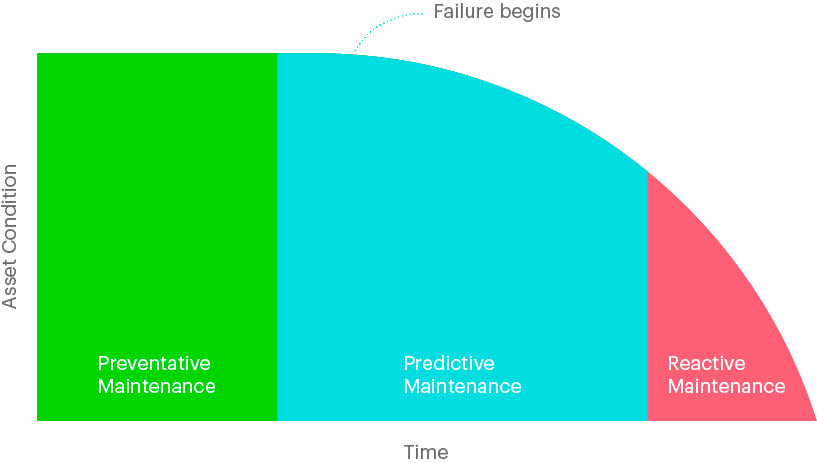
One technique to deal with equipment failure is to wait until it happens and then fix it. This is known as reactive maintenance (or run-to-failure maintenance). Depending on the equipment and its use case, this might be a good enough solution, however, often machine downtime leads to a high financial loss. It is also possible that the failure of one part can start a chain reaction of other assets parts breaking.
Another common practice is applying preventive maintenance, where the equipment is regularly serviced based on a schedule. This schedule is created by examining the statistics of previous failures on different equipment parts. In this instance, a pessimistic approach is typically adopted. Although it helps to achieve less downtime and increases the asset’s lifetime, it also increases maintenance costs.
Why? Because preventative maintenance is often done more often than is necessarily required.
There is a middle ground between these two approaches. In predictive maintenance, we monitor the system’s behavior and anticipate failures before they occur. Predictive maintenance enables just-in-time workflows, where servicing can only be executed when needed. It exponentially reduces downtime compared to reactive maintenance, reducing maintenance costs that would occur when adopting preventive maintenance.
These maintenance strategies can be visualized below as a PF-curve, where on the horizontal axis we can view time, and the vertical axis depicting the asset’s condition.
The maintenance strategy is a combination of several techniques, and for different assets, the chosen techniques can appear different, depending on the complexity and use case of the equipment.
When we have an asset for which downtime means substantial financial losses, a major effort should be placed on predictive maintenance strategies, reducing the number of maintenance works suggested by preventive maintenance while avoiding system failure. Alternatively, some equipment may be cheap and thus quickly replaced, in which case reactive maintenance should be sufficient, as there is no need for investments in predictive maintenance.
Choosing and developing the best techniques for each asset can be quite complicated, but increasing the device’s uptime can reduce maintenance costs and downtime losses.
In this article, we consider only predictive maintenance in greater detail, as reactive and preventive maintenance strategies are already quite mature and are often used within the manufacturing industry.
Predictive maintenance
Depending on available data, predictive maintenance strategies can be utilized in several ways. Here, we examine predictive maintenance techniques from the perspective of a data scientist. This allows us to examine different modeling solutions and describe what results could be achieved with each of them. Predictive maintenance programs integrate machine information and monitoring sensors to make timely decisions about maintenance intervention, preempting asset failures by identifying patterns for predicting future failures.
Anomaly detection and vibration analysis
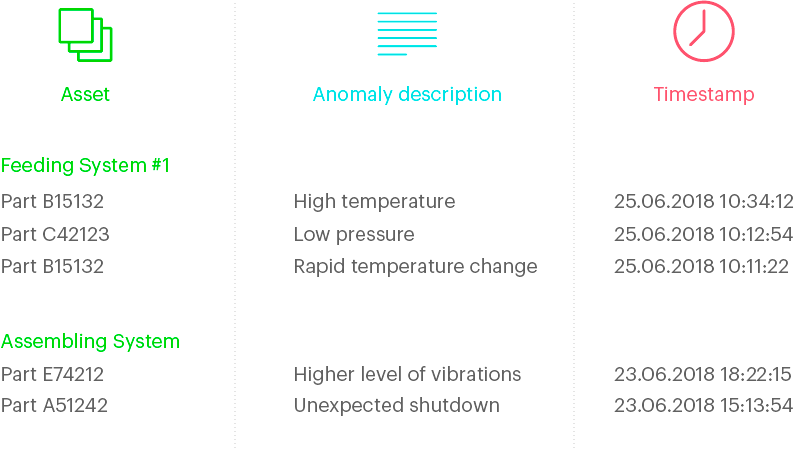
Anomaly detection, enabled by condition monitoring equipment, allows us to notice deviations from normal behavior through real-time performance analysis and notify relevant personnel about it. These models are relatively easy to develop, and there is no need for logged failure or maintenance events. The optimal thing about this is that it can also identify abnormal behavior that hasn’t occurred before.
The simplest version of this can be done by manually setting a threshold for different data sources. This requires good domain knowledge about the problem and can only detect some predefined anomalies. The challenge with this approach is that it’s hard to describe the relations between different data sources.
Using machine learning, we can identify multiple data sources simultaneously and let the algorithms learn the normal behavior and relations between different data sources. Thus, abnormalities can be automatically detected without the need to define anomalies and thresholds beforehand.
The problem with anomaly detection is that it can produce warnings and notifications when there is nothing wrong with the equipment. New behavior for the algorithm might seem like an anomaly, as this kind of behavior has not been seen before. Therefore, a feedback system should be created, allowing users to provide feedback on whether the notification was an abnormal device behavior or merely a normal behavior under unseen circumstances.
Anomaly detection systems cannot determine the exact fault source but can provide hints to an expert where the problem might be located. An expert can then examine the equipment’s history by looking at the machine data to determine where the problem might originate.
Binary classification
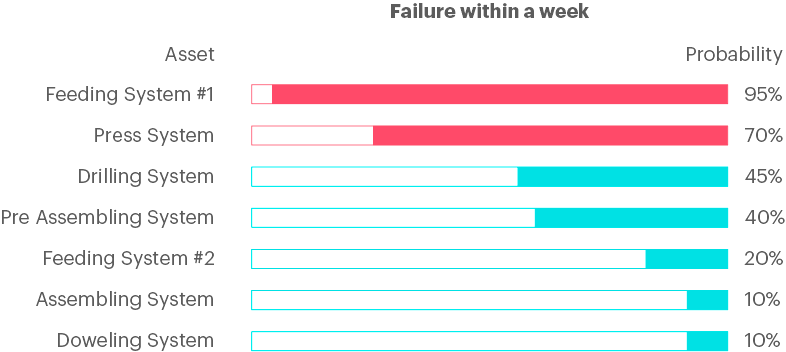
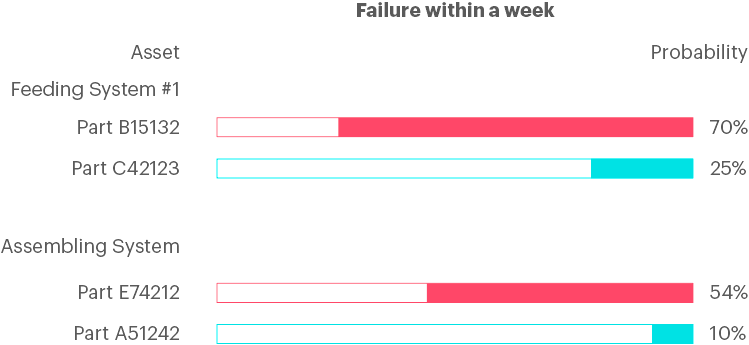
Binary classification tasks give answers to true-or-false questions. Therefore, we can ask whether a particular part will fail within a certain period, for example, a week. The probability of failure within that time window could be realized depending on the algorithm used. This approach is beneficial for determining the task list for the maintenance crew for the next period, helping them prioritize and schedule maintenance tasks effectively.
Binary classification requires historical data from our equipment but also a log of failures. The problem with this approach is that the model needs several failures of the same type before it learns enough to begin accurately predicting this failure type. Therefore, this approach could not predict failures that haven’t occurred before. It is also harder to develop models for this problem type.
Multi-label classification using machine learning
Multi-label classification is similar to the binary classification, but instead of asking only true or false questions, we can ask several questions. One way would be to define time windows and classify in which time window it is most probable that the asset will fail. Another possibility is to predict which type of failure, or for which part of the asset will occur within a time window, for example in a week.
The data needed for multi-label classification is the same as for binary classification. Developing this classification solution requires a little more effort than developing binary classification solutions. Maintenance teams can use these predictions to prioritize their work, scheduling preventative maintenance and reducing costly downtime.
Regression
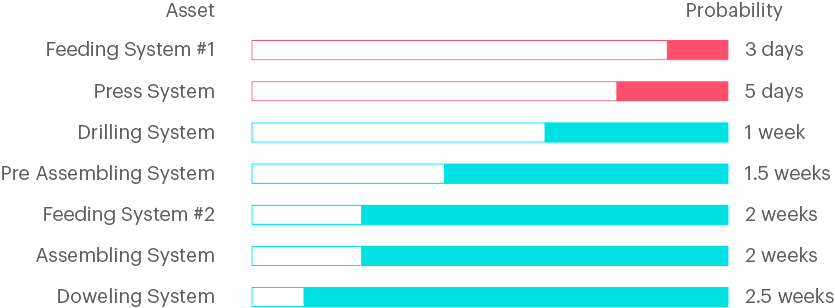
With regression algorithms, predictive maintenance work utilizes historical and real-time data from equipment, sensors, and external factors to predict the remaining useful lifetime (RUL) for equipment or its parts. This would allow the creation of a solution where it’s possible to list all the assets and sort them based on how long they will have until failure. The maintenance crew can then view the list and prioritize their work accordingly.
Regression tasks need the same kind of data as classification tasks, yet developing an accurate model is much more challenging. Typically, the problem is due to a lack of failure data.
What’s the difference between predictive and preventive maintenance?
Predicted maintenance consists of triggering and scheduling maintenance work. Preventive maintenance is scheduled based on the triggers such as times and usage, while prescriptive maintenance will be scheduled based on machine statistics.
How to start with predictive maintenance?
Although fully-fledged predictive maintenance solutions can appear expensive, it makes sense to begin with smaller steps and proof-of-concept projects as part of a predictive maintenance plan. Thus, insights and improvements can be gained quite early on at relatively low cost. Implementing a predictive maintenance strategy can lead to increased reliability, extended equipment life cycle, reduced repair time, improved equipment uptime, and significant cost savings.
Not all failures can be predicted ahead of time, and knowing when things will fail is not always essential. Therefore, before starting with predictive maintenance, we should ask whether the problem is of a predictive nature at all. Could we do something useful by predicting anomalies or failure times? Or is it possible to collect the necessary data?
We can look at these questions more thoroughly with the possible data sources we utilize in predictive maintenance.
Questions to ask before development
What problem needs solving?
A company needing predictive maintenance should first ask “Which problem is the most urgent one?” For example, this could be that we want to predict whether asset X will fail within two weeks so that we could plan the maintenance work and reduce unplanned downtime.
Do we have relevant data sources?
After we have defined the most critical problem to solve, we should understand whether we can collect relevant data from the equipment. We might find that the asset does not have the necessary sensors and we might have to install external ones. This may include introducing a Computerized Maintenance Management System (CMMS) for collecting data about maintenance works and failures.
Is data accurate?
The quality of predictive maintenance algorithms depends on the quality (and often quantity) of data. Therefore, we have to ensure that collected data is accurate and measurable. For example, we have to ensure that every maintenance work and failure can be logged in to CMMS. For some sensor data, e.g., vibrational data, it is vital that the sampling frequency is high enough to solve the problem.
Can we connect different data sources with the maintenance team?
After we have made sure that we have all the necessary data sources and they are accurate enough, we also have to ensure that we can connect this data. For example, we could match the logged failures from CMMS to the sensory data of our asset.
Have we collected enough data?
Last, but not least, we should have enough data, so the machine learning algorithms could learn to generalize. For example, we might want to apply anomaly detection for a crane in a harbor, in which case we would need at least a year’s worth of data to capture the minimum amount of weather seasonality, that might affect the results.
To predict failure times, we would need to gather data from tens or hundreds of failures to ensure the correct patterns are learned.
Types of data sources and condition monitoring equipment
Predictive maintenance relies on various data sources and advanced technology to ensure its successful implementation. The data used for developing predictive maintenance solutions does not only come from the equipment itself. Collecting and integrating additional data is beneficial not only for improving maintenance but can also help find new strategies for optimizing and further improving the whole production workflow.
Operational data
The operational data from our assets is critical to understand the current situation of the equipment. This data type might technically be the hardest to collect, as it often has to be measured very frequently, meaning that the amount collected proliferates. There may be a need for installing additional sensors. Therefore the emphasis should be put on finding out what data is really needed, and how often it should be recorded.
Asset specifications
In addition to operational data, having data about capabilities, model numbers, production dates, and other asset specifications is beneficial. Although this might not always be used in machine learning algorithms, it is crucial for developers and data scientists to develop the solution.
Failure history
If we want to predict the failure times of the asset or its part, we need to log the failures of equipment or their parts using techniques like vibration analysis to monitor equipment performance and predict failures. For this, Computerized Maintenance Management Systems (CMMS) are often used. To make this kind of data understandable to computers, we minimize the amount of free-form text and explanations about the failures. Hence, failure categories should be introduced.
Maintenance history
It is also essential to collect data about the history of maintenance work, including lubrication works and change of components. This data is typically stored and managed by CMMS. Like collecting failure history, creating and assigning categories for each work item is vital.
Operating conditions
The environment in which the asset is usually working has an impact on its behavior. Therefore, information about the surrounding environment should be continuously collected. This kind of data might include location, humidity, or temperature. For devices situated outdoors, this information might be gathered and estimated from surrounding weather stations, in which case, the weather predictions could also be introduced into predicting future behavior.
Operator attributes
Some types of devices depend very much on how they are operated. Therefore, collecting data about who is operating the device of interest might be beneficial for predicting failures or anomalies.
Summary
A successful predictive maintenance program can reduce financial losses caused by an asset’s downtime. This program relies on a methodical approach, leveraging sensor data to better understand the asset’s condition, improving the whole production and maintenance planning process.
Before predictive maintenance is applied, we integrate different data sources and start collecting data. Moving forward it is possible to begin developing predictive maintenance solutions, starting with simpler ones, like anomaly detection. This is done by taking small (and therefore cheaper) steps initially, and iteratively building a more complicated solution.
Is there such a thing as a work-life balance? Nowadays, the line between work-related and unrelated activities might get blurred and the transition between the activities becomes much less smooth.
Our employees were asked questions about ways they organize their transition from work-related to private activities. Keep reading to find out what they said.
How to find work-life balance
There are countless articles about how to find work-life balance, and there are many of us who’d like to have it. This chase for balance puts a significant amount of pressure on top of expectations we already have. Balance comes from when you feel harmony with yourself. So whatever you do to keep your physical and mental health in harmony is this balance.
We spend a significant amount of time working. At the moment, depending on the part of the world you’re living in, you’re spending most of the time in one physical space. In that one single space we organize both our work-related and personal activities. The line between these might get a bit blurred and the transition between the activities becomes much less smooth.
Have a fixed work routine
Physical presence does not guarantee mental presence. Sometimes when we work, our mind wanders to activities that have nothing to do with the task at hand, especially under current circumstances. To have mental presence, set clear boundaries for when work-related activities take place.
Have a routine. Assign specific times for starting and finishing work. Keep it consistent if you can. It doesn’t have to be a continuous eight-hour session. You can make an arrangement with your loved ones to work every other hour. As long as there’s a consistent plan, it will help you keep your focus. A plan that becomes routine helps your mind know when it’s time to unwind from work. Create some tangible activity to signal the end of the work day for you. For some, this might be logging their hours and tasks. For others, it could be planning work activities for the next day. Find what works for you and use it.
I plan my tasks according to the information gained from the morning team sync meeting. I devote more time for discussion without a set timebox.
Raido, Machina
I set alarms to remember meetings, because I seem to have lost the concept of time.
Mariam, Software Engineer
I have a habit tracker for personal tasks, and I use pen and paper to plan my work-related tasks.
Piruza, Chief Innovation Officer
I do keep track of my activities. Usually I know what I plan to do during the day, and I also have to keep in mind that I need to plan time for the things that appear unexpectedly. At home, activities merge: while cleaning the kitchen I can brainstorm work-related stuff, for example. And while walking I can have a phone meeting outside ????
Tiina, Chief Culture Officer
Making a clear schedule is important, and I have managed to create a good one for myself. Otherwise I would lose my grip, since I have to deal with so many things, like homeschooling the kids, cooking, cleaning, walking the dog, etc.
Liis, HR Lead
For work tasks we have priorities set by the Product Owner. To plan my work activities, I use JIRA, Exchange calendars, and Notepad++ throughout the day. For personal activities, I use a personal Exchange Calendar and Task List. Lately the task list travelled to Google Keep, but I try to tidy things up and keep only shared data in GK.
Denis, Jr. Software Developer
Schedule fun activities
Just as you need to schedule your work, you need to schedule your fun, as well. Give it equal priority. Taking time for yourself and personal communication is paramount to maintaining both mental and physical health. There should be something fun that you do for yourself every single day, especially now in times of the pandemic. There are many good movies and TV shows online, as well as online concerts and other entertaining activities that are just one click away. Find something that is fun for you to do and schedule it into your day.
What’s free time? I’m don’t remember what it’s like having it.
Raido, Machina
It has become a tradition on Saturday to have an online party with my sister in Sweden. I am still taking a lot of dance classes on Instagram live, geocaching, and walking. My dear colleague came up with the idea that we can take calls outside via the Zoom mobile app. It is such a great idea with this good weather now. It’s a month to combine work and health ????
Helen, Accountant
To deal with the stress of quarantine I seem to be working out more than I used to.
Mariam, Software Engineer
I use my watch to track my activity whenever I go for a walk with my dog (sometimes the cats also join) to motivate myself to go out more and give the body rest from sitting behind the computer. At least once a week, I make sure to have video chats with a variety of friends and family members to check up on them and see that they’re not up to anything too stupid. (Friendly suggestion: Do not become a hairdresser and give your husband a haircut at home.)
Ketlin, Quality Engineer
In my free time, I try to experiment with new interests and hobbies. Right now, I’m making candies with mulberry vodka, doing push-ups, and taking dance breaks between calls.
Piruza, Chief Innovation Officer
Right now, my options are limited to walking outside and doing everything else at home. So, I really like walking and breathing fresh air in the woods or by the sea. Sometimes I go winter swimming and this is really refreshing! At home I do yoga, cook, listen to music, and sometimes watch a movie. However, the screens aren’t too tempting in the evening, since the day is spent on the computer.
Tiina, Chief Culture Officer
In my free time I do ice swimming, online fitness training, movie nights with the whole family, cooking lessons for kids, and garden projects.
Liis, HR Lead
For personal tasks I try to apply Getting Things Done principles. It has mostly worked for me for over a decade. I do photography. Due to social distancing requirements, I try to find the uncrowded edges of Estonia and visit them. I’m doing my own hobby projects.
Denis, Junior Software Developer
Negotiate with yourself
You are in charge of your time, so you need to decide for yourself how much work you need and want to do. Be realistic with expectations. Schedule tasks and set up a rhythm of work and fun that you can maintain. Throughout your routine observe how you’re feeling. If something feels off, don’t hesitate to change your plan and renegotiate your focus. Take your feelings seriously and be flexible enough to adjust your activities to your own needs.
I finally took time for puzzles. But the favorite activity I’ve really missed and have more time for now is cooking! I took out the pressure cooker again and have made kimchi for the first time in my life (already two batches!). I plan to make the crème caramel that I learned from my colleague at Christmas ???? And I definitely have more time to spend with my pets, which I also consider fun!
Ketlin, Quality Engineer
Usually, I know what I need to accomplish during the week. I know where I’m heading and I know the next steps towards my goal. Right now, it is all a bit vague. In the middle of this situation you almost never can predict the week ahead. I feel I’ve become used to this home routine. The ups and downs have become more or less predictable, and there are mitigation activities for the downs, as well. Also, I need to remind myself regularly to breathe and to take care of myself.
Tiina, Chief Culture Officer
I divide my time consciously between work, homeschooling, my own personal space, free time, husband time, friends, family, and sleep! It makes things so much easier for me if I have some order in my brain. Otherwise I’d start feeling guilty for not doing this or that.
Liis, HR Lead
About Proekspert remote work diaries
Since many people around the world are bringing their work home to slow the spread of COVID-19, to keep our spirits up this diary aims to share and gain insight from each other’s experiences. Every week is new and different.
Here, you can explore our company-wide remote work experience by weeks.
Hackathons are a great place to see fantastic ideas born, build your social and professional networks, and get new laptop stickers.
To solve some of the problems created by the immediate crisis, I joined the Global Hack. The team I was in worked on building a system that connects people in need of assistance to a network of volunteers, mostly aimed towards helping the elderly and quarantined.In this post I would like to share my experience and what I have learned from that event.
Why hack?
I think everyone who has ever attended a hackathon has a love-hate relationship with them. On one hand, it’s very satisfying to down 2l cans of Coke Zero, miss a night or two of sleep, and get some semblance of a project out on a weekend. On the other hand, weekends are for resting and hackathons are stressful by nature. Either way, it’s a great place to see fantastic ideas born, build your social and professional networks, and get new laptop stickers.
In the times of self-imposed quarantine, of course, it’s frowned upon to get 100 people together in a small room, so hackathons have adjusted to the new reality. Last month, Hack The Crisis kickstarted a huge international community of remote, online-only hackathons. Now there are many events organised on both a local and global scale, the biggest so far being this past weekend’s The Global Hack – it was attended by over 15,000 people worldwide, resulting in more than 500 projects. And it had Erykah Badu at the after-party.
When an acquaintance of mine posted on Facebook that they need some front-end development help on the Global Hack, I gladly volunteered. Just in case, I also recruited some of my Proekspert colleagues (the more, the merrier)! And less work, or at least so I thought.
Lesson 1: process organization
Hackathons are often devoid of structure. You describe the idea, quickly identify what part you could help with, and then go do it until you run into problems. This kind of informal and rapidly shifting collaboration is easy face-to-face, but when you’re all online, it’s hard to see who’s doing what.
To remedy the situation I proposed that we list issues on Github and allow people to assign themselves to them. This would give us an overview of what’s being done and who’s dealing with it. I think it worked well and would recommend it for future hackathons. No need to define these issues in a formal manner, just quickly jot down what needs doing and slap some labels on it – what should be prioritized, what is a nice-to-have, and what is just an idea.
Lesson 2: prepare for unforeseen consequences
Around the time of the formal start of the hackathon (4 p.m. or so), the front-end developer declared that he will now “distance himself from the project” and I was told that I am now “the lead of front-end dev.” This came as a surprise to me and my colleague as we both joined with the expectation that there would be more people and less work. Oh well. Around the same time, Pro had the weekly all-hands meeting, so when one of my colleagues conveniently asked what is there to do on the weekend, I jumped in and said that we sure could use some hands. My colleagues stepped up and I felt a bit relieved.
These things sometimes happen during hackathons. Teams change, people leave, people join. You have to be agile and adapt fast.
The final deadline for submission was rapidly approaching, so we reviewed the must-haves and nice-to-haves. To my surprise, everything the project people deemed necessary was already present and working! We were good to go! It needed some visual fixes, though. You know, to make it prettier, more comfortable to use. The finishing touches.
Lesson 3: the weird curve of project preparation
This was a great way to start the morning – we had more people and could just take it easy.
But on the morning of the final day you’re never as prepared as you think you are. While for the first half of the day it was pretty chill, cracks started to show in everything the last hour before submission. Some people had done the same things in different ways, creating merge conflicts. I personally just felt like my brain wasn’t working that well any more. I spent at least half an hour just staring at my screen trying to come up with a way to access and manipulate the browser’s local storage from both React components and external utilities. I failed to come up with a solution.
The last half hour was the most stressful. Everything was bad. I rushed a lot, not handling the pressure well. There were 15,000 people, a 150,000-euro prize pool, and there was a huge merge conflict! In the end, we managed to get a working version up by the deadline. Not quite the full feature-set that we had hoped for, but good enough. I walked to my fridge and was immeasurably saddened by the realisation that I didn’t have any beer.
Lesson 4: the tech
This next part will be very focused on front-end development specifically, so feel free to skip it if you don’t care.
I fell in love with Formik. It’s the most comfortable form-building solution for React I’ve seen. A significant upgrade over the redux-form that we’ve used before, with a very manageable learning curve. I had looked at it before the hackathon, but this was my first experience actually applying it to a project, and I’m very impressed.
If you’re from my generation of React developers, you’re used to grabbing Redux whenever you’re building any sort of an application. Here’s some good news: I don’t need it anymore and neither do you! It has long been criticised for being high on boilerplate code. Nowadays, React Context and the React hooks APIs are more than enough for mid-sized projects. I’ve heard of people building huge applications just relying on those as well, but I’d be a little cautious of diving in head-first.
Lesson 5: impact of the work done
Our hackathon work resulted in a new ticket handling back-office application for kogukondaitab.ee – the system that connects people in need of assistance to a network of volunteers. It’s mostly aimed towards helping the elderly and quarantined. And it actually works! Call centres have been put up in Estonia and Latvia and the team behind Zelos is currently talking with partners from several other countries to get the system up there as well.
Despite the loss of sleep, the sudden changes in the team, and the stressful deadline, I had fun – I think we all did. And it’s great to be recognised – out of the roughly 50 projects that made it to the final deadline on our track, we finished in the top 10!
Lesson 6: the home office
For me, the idea of remote hackathons is brand new. But I think I like them! I am not a fan of the home office and can’t wait to get back to the real one – I don’t feel as comfortable or as productive working from home. But I think I would have felt even less comfortable and productive in some building where hackathons are typically held. It was nice to be able to be in my own environment, have home-made food, not worry about whether drinking beer or whether my clothing was appropriate. But I do miss the laptop stickers and free t-shirts.
Final thoughts
The Global Hack is just the beginning, and I’m sure there will be many more online hackathons in the near future. I recommend you check them out! Everyone and anyone can join – yes, developers and designers are often most sought after, but we can’t forget the value of people who come up with ideas, who do the copywriting, the presentations, the videos, and who look for the actual business cases and potential future partners for the projects.
The team behind the project has expressed interest in continuing with it for a week or two (as is customary with these things) and get it to the people that want to start using it to help others, but this is a whole different story. For now, I’d like to once again express my undying gratitude to my amazing colleagues for being a great team and encourage all of you to seek out online hackathons and join them. With a team or alone, there are always problems to solve!