Proekspert partnering with Microchip Technology

Microchip Technology Incorporated is a leading provider of smart, connected and secure embedded control solutions. Its easy-to-use development tools and comprehensive product portfolio enable customers to create optimal designs, which reduce risk while lowering total system cost and time to market. The company’s solutions serve approximately 125,000 customers across the industrial, automotive, consumer, aerospace and defense, communications and computing markets.  

Since September 2023, Proekspert AS is Microchip Authorized Design Partner with expertise in device security application development on microcontrollers and secure elements.

Partner with Microchip Technology

Design Partner Members specialize in designing with Microchip products. Visit the Microchip Technology website for more information here:

https://www.microchip.com/

Read more

Device parameters management solution

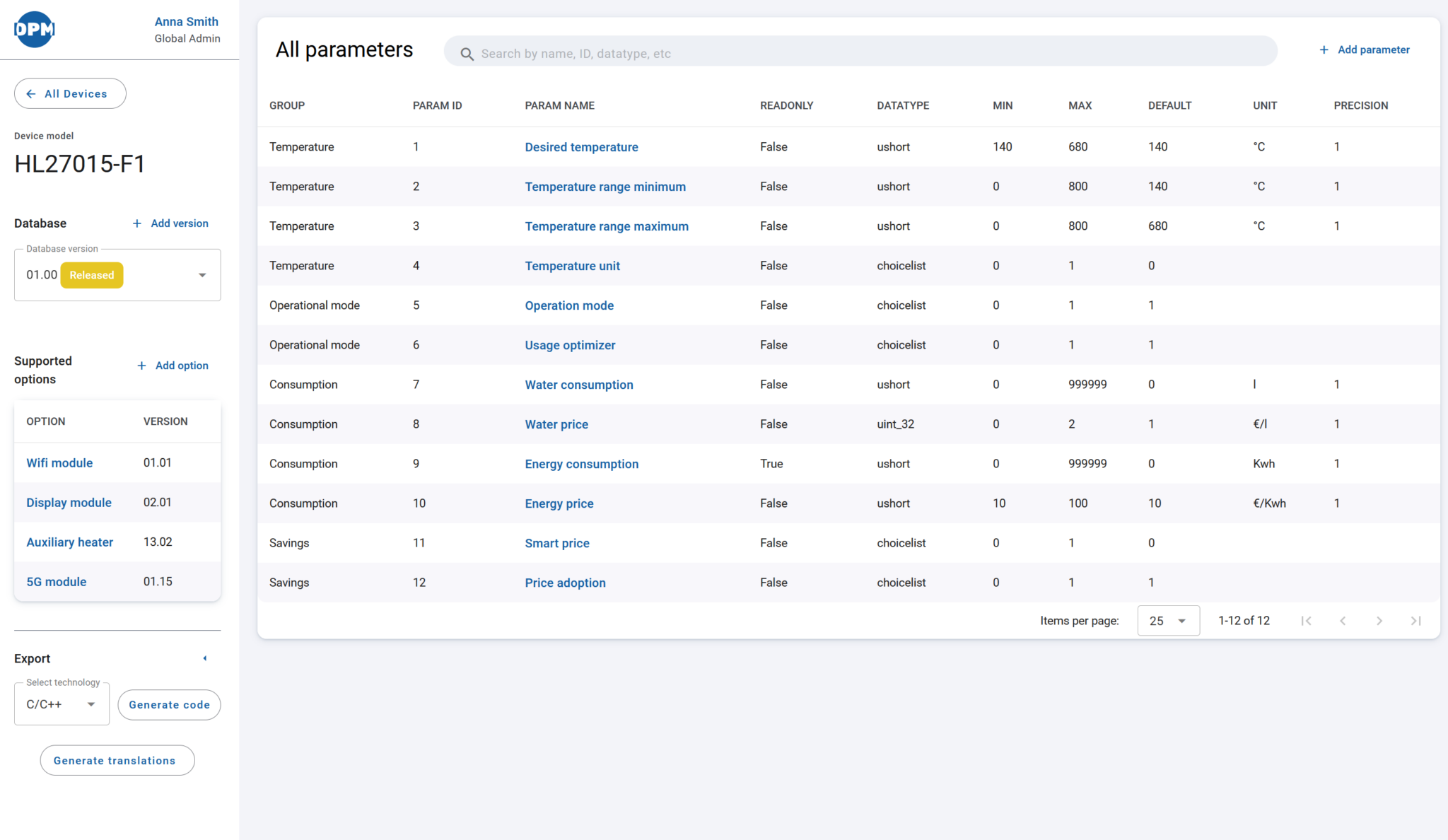
Optimize device parameter versioning, parameter dependencies, and localization.

Proekspert helps device manufacturers with ad-hoc centralized solution for device variants database management

When your portfolio of devices holds a multitude of device types and variants, it’s a challenge to keep device parameter specs congruent.

Proekspert has decades of experience optimizing solutions that handle device parameters versioning and crucially-related topics like parameter dependencies and localization.

Our solution is used in scenarios like:

1. Defining and maintaining specifications of parameters for all your device variants is challenging and prone to incongruences, but big SPLE solutions will be overwhelming for your scenario. 

Spreadsheets are excellent tools, but their complexity tends to grow exponentially with the number of device variants, options, and dependencies between parameters that need to be handled. 

Our web-based platform solution helps to keep all information centralized, congruent, and easily accessible by authorized users. 

2. You have software tools or digital services that need to support a multitude of device types and variants. 

Our solution can generate help classes and libraries in the most popular programming languages to make things straightforward for your development teams or software partners to build applications that need to interact with device parameters. 

3. Your device software needs to be localized in multiple languages. 

Our solution helps you define and manage localization strings, it can interface with popular third-party localization tools or use AI to generate localized strings. 

Key features and benefits of our solution

  • Centralized web platform to manage the specifications of your device parameters, with users’ roles and permissions management. 
  • Code generation in the most popular programming languages like C++, .NET, Java, Kotlin, and Swift, that saves developer time to build software applications that need to interact with your device parameters. 
  • Extensions that allow handling localization for your device parameters, with integration to third-party localization tools or generation of localized strings using AI tools. Export of code and support files that makes it easy to use localized strings in your software. 
  • Extensions that let you define and manage dependencies between parameters, with export of code and libraries that makes it easy to reflect parameter dependencies in software tools that need to work with your devices. 

A view from our demo application:

Get the solution brief

Discover how Shield-loT enables organizations to monitor and secure any loT device, application and network

Read more:

Three Ways to Prepare for the EU CRA

Proekspert’s Terry London explains the EU Cyber Resilience Act and offers three ways to begin to prepare

 IPEC 2024 conference speech at Germany Nurenberg, watch here:

What is the EU Cyber Resilience Act?

There has been lots of confusion about the EU Cyber Resilience Act (CRA), but one thing is sure: it will be introduced quite soon. It was originally to be released in spring but was postponed to the autumn of 2024.  

The CRA’s purpose is simple – to unify cybersecurity rules across the EU market. It will become a CE marking for digital products. The CRA covers almost any software and hardware products that connect to the internet. There are some exceptions, such as medical and automotive products. Also excluded are open-source software and software-as-a-service solutions. 

The European Commission announced the first draft of the act in the autumn of 2022, but it didn’t get a warm welcome from software developers, because it was considered too restrictive and burdening for them. But it’s quite a good initiative by the EU.  

The CRA aspires to achieve two main things. It wants to protect the end-users of internet-connected devices. And, when considering all the IoT devices around our homes and offices, the CRA wants to put a little more responsibility on the shoulders of the software developers and device manufacturers regarding device security.

Cyber threats are real 

One thing is sure: cyber threats are real. The number of cyberattacks against companies has been growing constantly and damages are costly. 

Many may still think that this doesn’t affect industrial automation since shop floor environments are typically isolated from the internet. But when we look at history, we see that isolation doesn’t help when hackers target a company.  

There are common myths regarding industrial control systems, but we have seen that digital attacks against control systems can be done without the internet and result in physical damage. Being offline doesn’t protect a facility from a person with a USB stick or mobile internet.  

Keeping devices offline is one measure against cyber risks. However, significant issues come from the need to connect devices to the internet. Manufacturing companies are increasingly implementing digital systems for efficiency and productivity. With connected systems, we have to figure out how to mitigate the cyber risks that come with connectivity.

The CRA’s main requirements 

From the CRA, I have distilled four primary requirements for industrial device manufacturers: 

  1. Get products certified. 
  2. Start compiling a software bill of materials. 
  3. Start reporting vulnerabilities. 
  4. Provide security updates to fix vulnerabilities. 

I will cover each topic in more detail later. 

What we’re doing today 

How are we related to the topic? Proekspert is a software development company. Our focus is on serving industrial device manufacturers. Typically, our clients are experts in developing highly reliable devices like electric motor frequency converters or HVAC devices. These devices are meant to work autonomously for months or years without much attention from their owners.  

Our client companies are experts in hardware development. And they know how to make the software that runs their devices. Our role is to support our clients in fields outside their core competencies, such as device security, internet connectivity, and digital user interfaces. These fields are very IT-oriented and may change too fast for a company to keep up with if their main focus is machine- and electronics engineering.

Why our experience matters  

Proekspert has been around for 31 years. Since our beginnings we have worked on specialized devices to create software that monitors and controls devices remotely or protects the data they process during operation. 

We started with writing control software for Applikon bioreactors. That experience led us to the industrial automation systems field. We have been part of Danfoss’s frequency converter development for the last 20 years. We also worked on early ATM development that used smart cards. It was ground-breaking technology because it was very fast and very secure. That experience brought us to the data and device security field. Today, we combine industrial automation with modern cybersecurity.

Product certification categories 

Returning to the topic of the EU CRA. First, be aware that it is an umbrella act. It does not specify the exact technical standards your product must comply with. Its main requirement is that every product must be certified or assessed.  

Products are divided into three main categories, depending on how critical of a task they must perform. For example, internet-connected, smart-home devices and toys are in the lowest category and require only self-assessment. However, more critical products require third-party assessment or certification if they are security-related products. 

An important note here is that everything starts with self-assessment, and that is where device manufacturers can start. 

Requirements for device manufacturers 

With the following requirements, we are moving very close to the software development world: 

  1. Product companies must compile and provide a software bill of materials (SBOM). You have to understand where your software comes from. And who is responsible for each software component inside the device. 
  2. Device manufacturers must start monitoring and reporting the vulnerabilities of their devices or software. The exact way in which the reporting process is going to be organized is yet to be decided. However, from the software development aspect, discovering vulnerabilities is essential. Again, this is very closely tied to SBOM management. 
  3. Companies must provide security updates for their products. That responsibility comes together with a requirement to decide the expected lifetime of their product.  

What is SBOM? 

The software bill of materials is one crucial element in the CRA requirements. On a very simplified level, it is a list of ingredients that describes the components of a software application. More technically, it is a list of all the open-source and third-party components in a system’s code. It shows the licenses and the component versions we use in our code, and if those components are up to date. This enables us to quickly identify any security or license risks. 

SBOM management and the ability to report vulnerabilities are the same thing. 

An SBOM is created and maintained by the manufacturer or the software supplier. And, as every professional software development specialist has experienced, even if the software’s dependencies don’t change, their vulnerabilities can change frequently. As software ages, more exploitable risks will likely be found in the code. 

That means we must use proper software development tools and implement strict processes, which is nothing unusual. However, it may get overwhelming for companies that are not experienced in software development. Implementing such processes takes work and requires years of practice.

Ways of delivering security updates securely 

Traditionally, industrial devices are not protected by software measures because internal processes usually work well. If we are talking about devices that are in physically isolated areas, protection with user passwords may sound good enough. However, we already see that companies are moving forward from that practice. More and more industrial devices are connected to the internet directly or through secure gateways. 

Two main cybersecurity measures are used to protect devices against malicious software updates. 

  1. Secure communication channels like https are used for software update distribution. 
  2. Device-level encryption is used where a device verifies whether a downloaded data package comes from an authorized source. 

There is also a third option where, with the help of crypto chips, we can turn each device into a unique identity and gain the highest security. The idea is that device manufacturers can have maximum control over software updates, and it is not possible to share the same firmware package between two devices.   

Such cybersecurity measures require IT infrastructure to manage certificates and encryption keys, plus all user roles for those who operate with devices and permissions. 

How we help our clients 

Preparing our clients for the EU CRA is our everyday job, in addition to writing software for their devices. 

  1. We help companies with self-assessment. We focus on the IEC 62443 framework covering industrial automation and control systems cyber risks. Our engineers identify and map product development processes and vulnerabilities and suggest security measures to mitigate security risks in product source code and development processes. 
  2. Managing SBOM and documenting vulnerabilities. We set up and manage a software development toolset that supports and helps monitor vulnerabilities in our clients’ products. 
  3. We implement security update mechanisms. This part is dependent on our client’s business and devices. It may vary from a simple firmware update to something quite complex. Technology changes quickly, and there is no one size fits all. 

In addition, we suggest putting together a long-term plan for maintaining and updating your IT and device security infrastructure. 

In conclusion, the EU CRA is an umbrella act that boils down to relatively obvious focus points. By focusing on the three activities mentioned above, you can already prepare yourself. 


IPEC is an acronym for the International Production Environmental Community located in Nuremberg, Germany. On March 13, 2024, Terry London, Proekspert’s Product Manager of Device Security Solutions, shared our experience about preparing industrial device manufacturers for the upcoming EU Cyber Resilience Act – from a secure embedded software development perspective.

Read more

Secure Firmware Updater technology

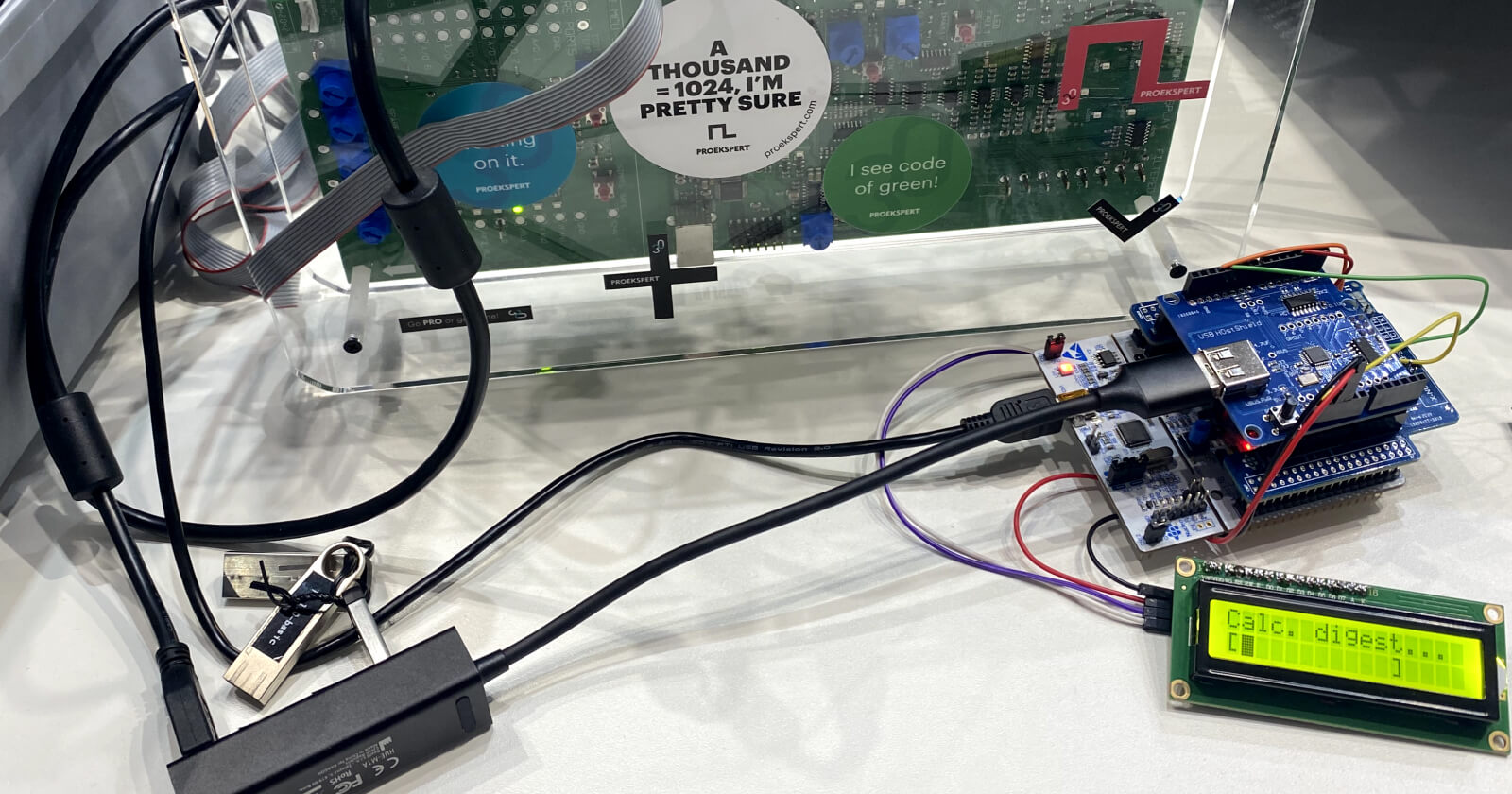
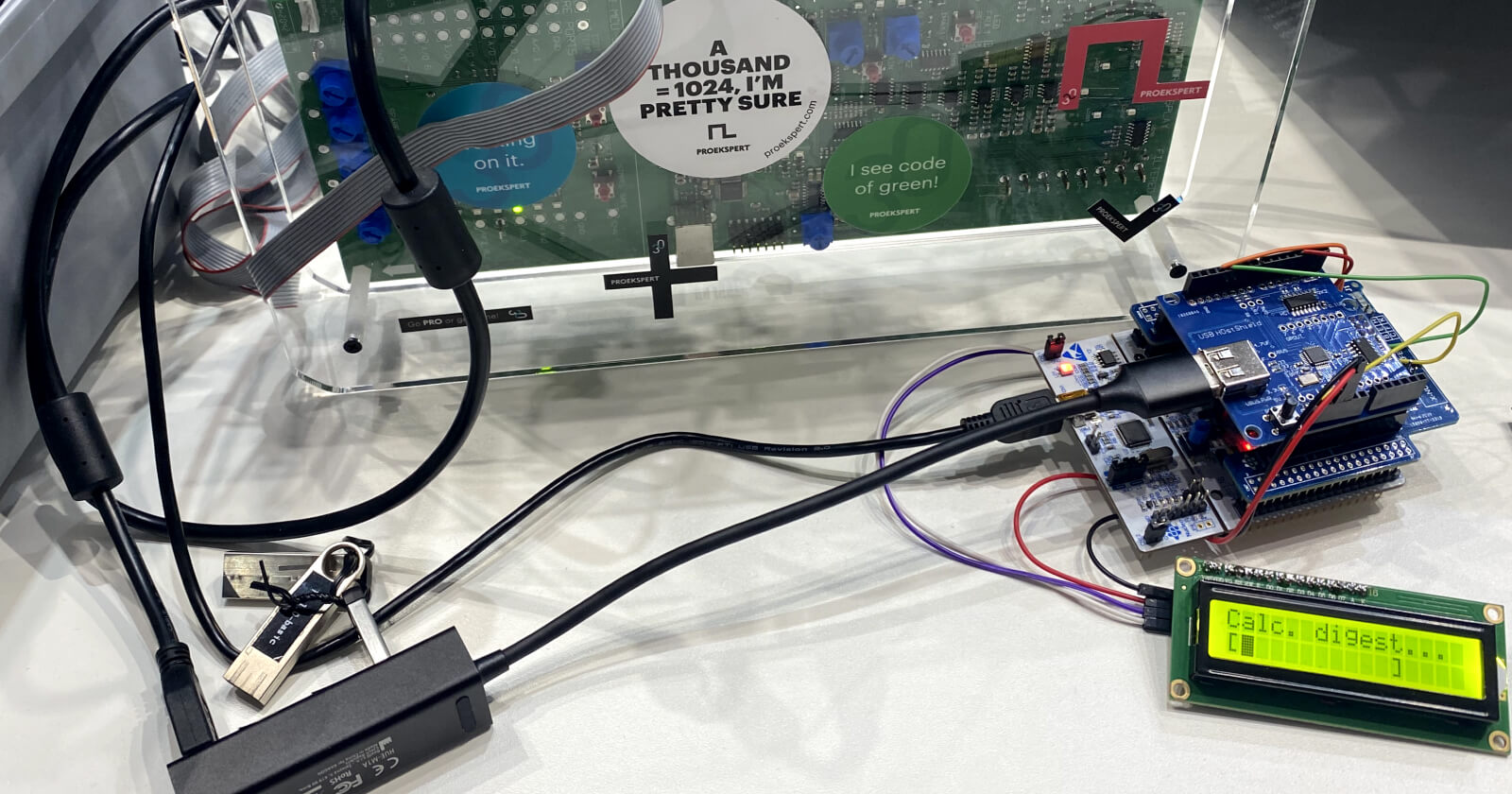
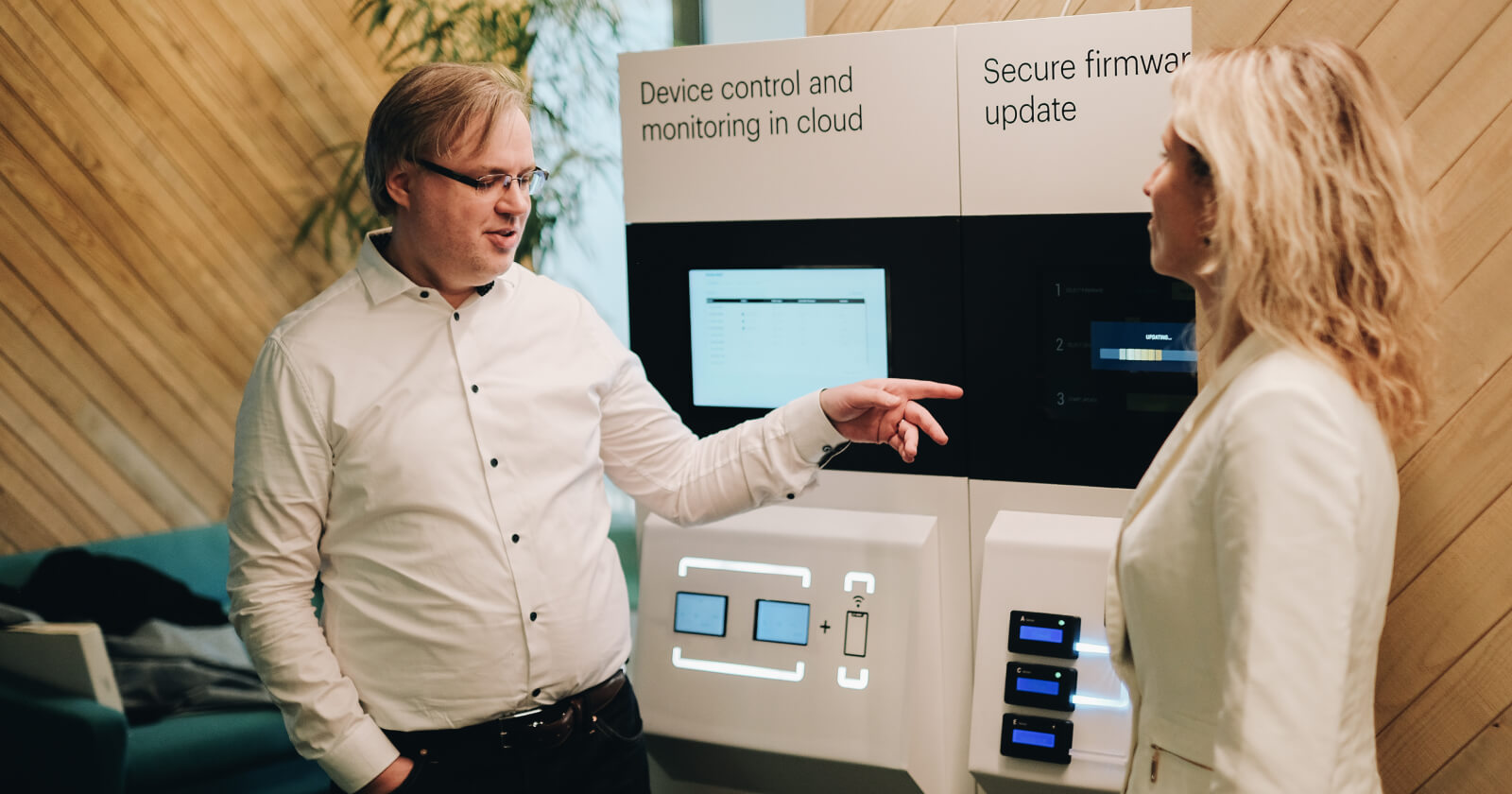
Proekspert helps to develop secure firmware (FW) update solutions tailored specifically for industrial device manufacturers. We are experienced in working with embedded software platforms and developing custom software, helping to customize the solution to your needs.

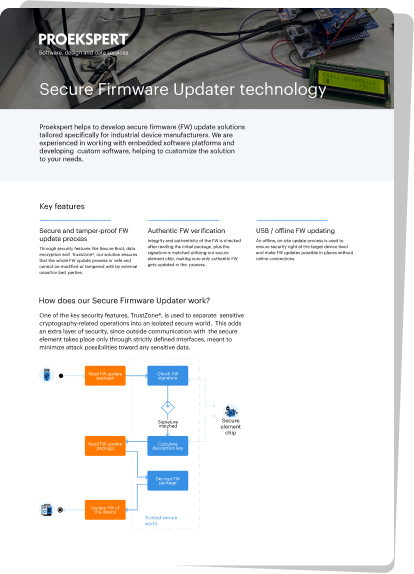
You can also download this as a PDF document.

Key features

  • Secure and tamper-proof FW update process – Through security features like Secure Boot, data encryption and TrustZone®, our solution ensures that the whole FW update process is safe and cannot be modified or tampered with by external unauthorized parties. 
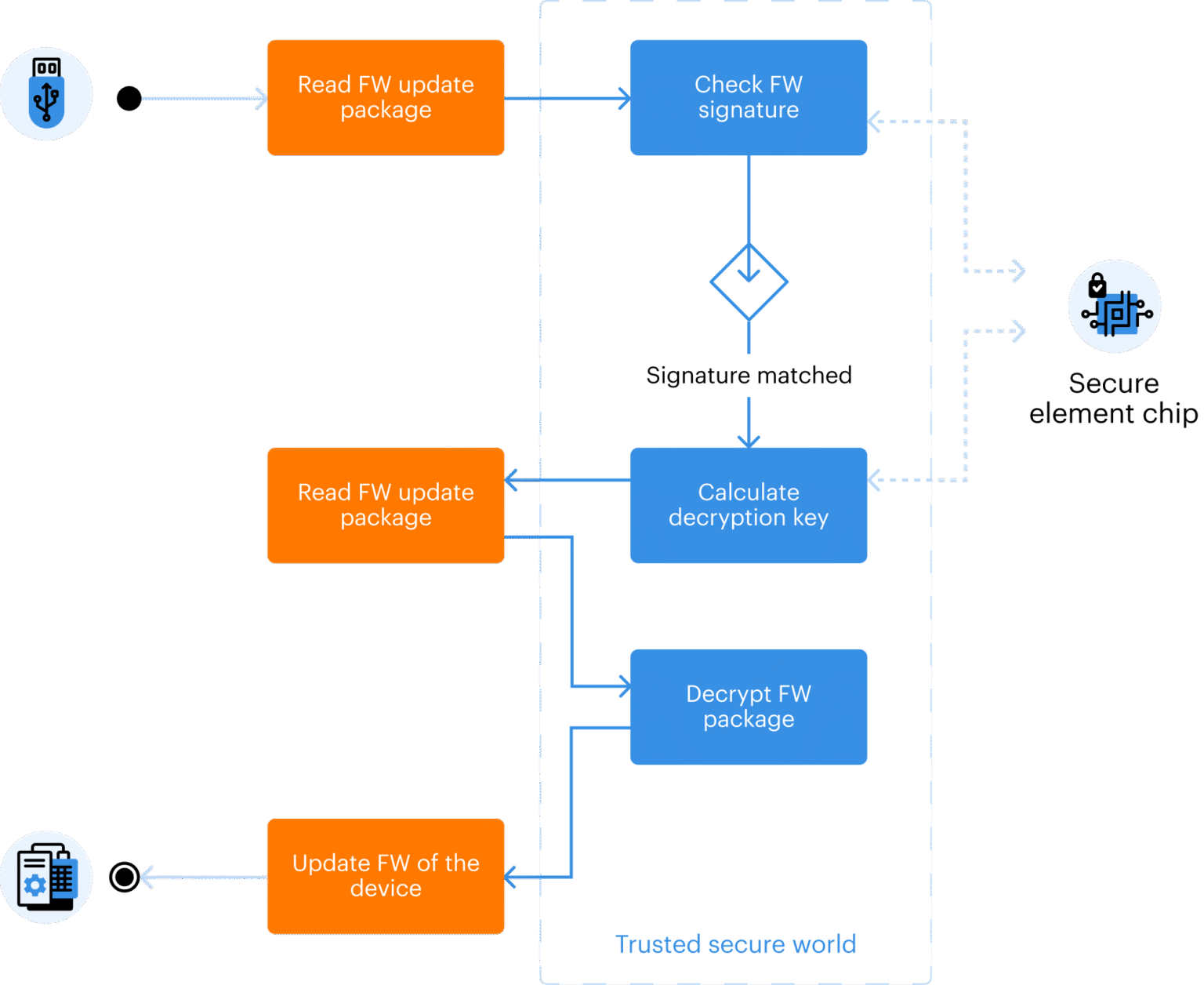
  • Authentic FW verification – Integrity and authenticity of the FW is checked after reading the initial package, plus the signature is matched utilizing our secure element chip, making sure only authentic FW gets updated in the process. 
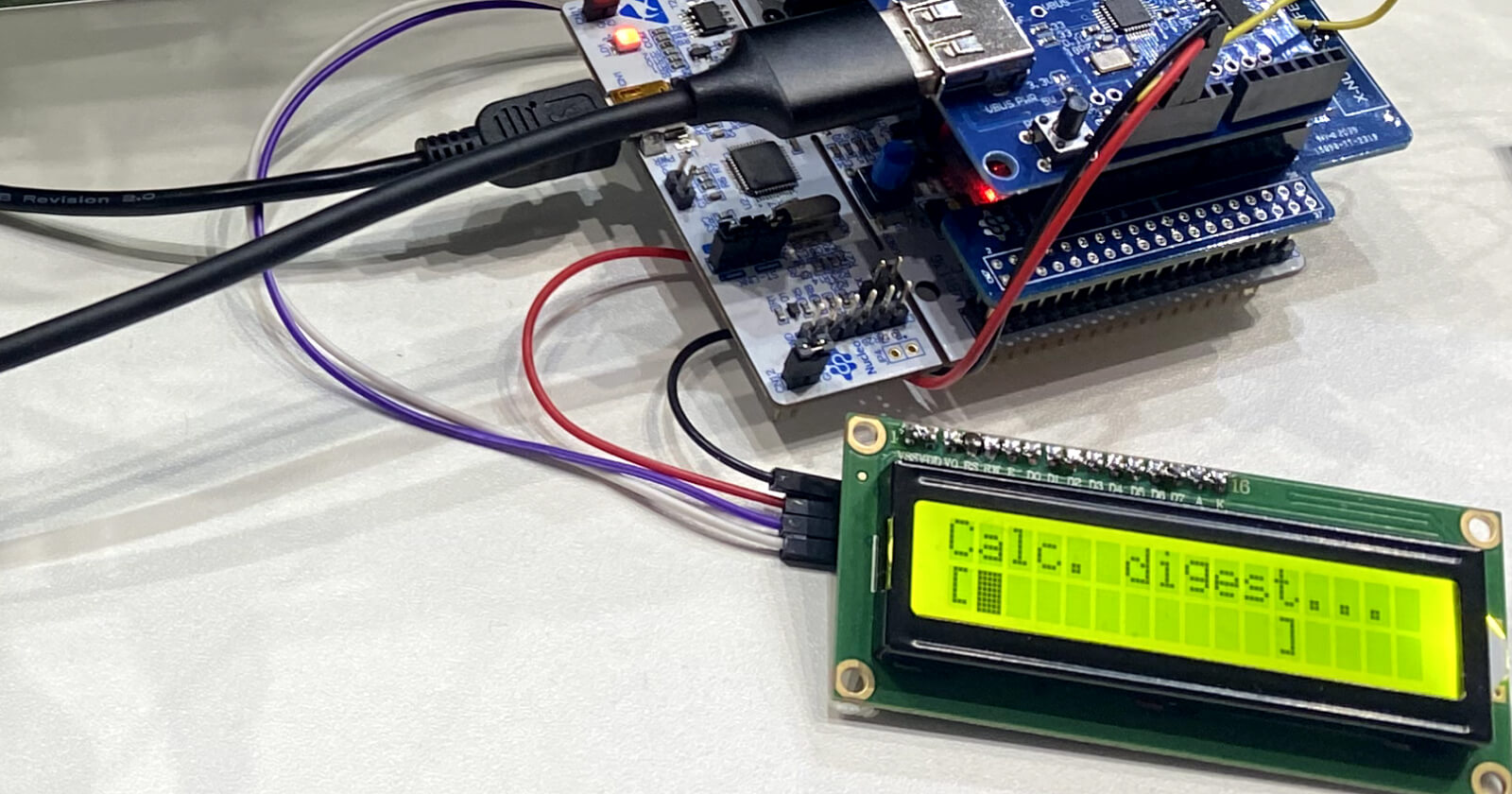
  • USB / offline FW updating – An offline, on-site update process is used to ensure security right at the target device level and make FW updates possible in places without online connections. 

How does our Secure Firmware Updater work? 

One of the key security features, TrustZone®, is used to separate sensitive cryptography-related operations into an isolated secure world. This adds an extra layer of security, since outside communication with the secure element takes place only through strictly defined interfaces, meant to minimize attack possibilities toward any sensitive data.

Enhanced security using Secure Boot 

We use the Secure Boot process during the application startup phase to ensure that only trusted software components are loaded during the boot process. The process uses a root of trust, a trusted bootloader, and a series of verification steps to ensure only an authentic version of our application is allowed to run. The Secure Boot process, illustrated in the drawing below, can be customized or improved according to the client system’s cybersecurity requirements.

Security features in our products 

Our Secure Firmware Updater ensures safe FW updates by supporting major security features. 

Secure Boot – An extra layer of security which only allows the FW updater application to run when its integrity is verified against a trusted signature. 

Secure Element – a.k.a. the Trusted Platform Module (TPM) or crypto chip. A Secure Element provides a secure storage- and generation environment for encryption, decryption, and verification keys. 

Data signing and encryption – A firmware update package is encrypted and signed by the device manufacturer, ensuring that only trusted update packages are processed. 

TrustZone® – Technology which helps us separate the device into the “trusted secure world” and “normal world,” so sensitive and critical operations such as data signature checks and decrypting the firmware can be handled securely and separately from regular operations. 

Proekspert’s supported MCUs and TPMs 

In our Secure Firmware Updater, we currently use and support a variety of families of microcontrollers and secure elements by STMicroelectronics and Infineon.  

MCU families supported: 

  • STM32F4 
  • STM32U5 
  • STM32L5 

Secure Elements supported: 

  • STSAFEA110 
  • Infineon OPTIGA Trust M 

Get the solution brief

Discover how Shield-loT enables organizations to monitor and secure any loT device, application and network

Read more

Increase your business value by investing in a cloud transformation strategy

Cloud transformation enables your organization to adopt new technology quickly, respond to immediate market needs, and scale your business operations.

A recent report by McKinsey & Company concludes that leaders need to accelerate their journey to the cloud to digitize quickly and effectively.

There is no better time to move to the cloud than now. Cloud transformation is a force of innovation and a catalyzer of organizational growth. Innovation is never too early or too late; it is always the right time to innovate and digitize your business processes.

Below is a cloud transformation strategy guide we’ve compiled to get you started on your cloud transformation migration.

What is cloud transformation?

Cloud transformation is moving your operations to the cloud per your company’s business objectives. Migrating to the cloud involves modifying, upgrading, and moving an organization’s applications, ranging in complexity, purpose, and criticality, from on-premise or co-located hardware.

You don’t necessarily have to commit fully. Start by migrating and connecting only some of your apps, software programs, and data. Once you feel confident, you can move the rest of your company’s infrastructure to the cloud.

Cloud transformation involves:

  • Moving company data to the cloud.
  • Migrating apps and software programs.
  • Moving company data to the cloud.
  • Ultimately transforming your entire IT infrastructure.

The amount of time it takes to reach your cloud transformation goals depends on the complexity of your operation. If you’ve already adopted some cloud technology, migrating your remaining systems to the cloud could only take a few months. Your migration could take much longer if you don’t use cloud services.

Cloud transformation services enable faster time to market

Companies often have an outdated IT infrastructure, making it highly challenging to keep up with increasing product and service demands and expectations. 

These aging legacy structures and applications must be replaced for businesses to grow and develop competitively. Migrating to the cloud will allow your platforms to deliver on-demand and integrate new digital customer experiences much faster and more efficiently.

Cloud transformation can: 

  • lower company hardware costs 
  • integrate new processes and features fast 
  • ensure seamless service 
  • automate the development and testing of your applications
  • enable platforms that provide analytics necessary for business growth. 
  • make your IT infrastructure more agile and flexible.

Your customers need great products and experiences, and they need them now. 

Cloud transformation will dramatically increase the speed at which you can innovate and bring new features and products to market before your competitors, making you the industry standard-setter. Cloud transformation will allow you to experiment with the latest innovations in search of ideas that work well for your business and your end users.

Cloud transformation enables access to analytics, resulting in more informed and effective business decisions.

Migrating to the cloud allows the support of highly distributed IoT networks. It opens up the capacity of cloud computing, which provides valuable insights and universal access. Since services are platform-independent, they are accessible across many devices. The only requirement is an internet connection.

  • Enables faster and more effective data analysis than on-premise solutions.
  • Increases mobility and productivity since it allows staff to collaborate on projects more easily. 
  • Increases storage capacity since you pay for the storage you need–increase or decrease storage as you go. (This is also highly cost-effective.)
  • It handles enormous volumes of data from the Internet of Things- related digital sensors.
  • Supports using artificial intelligence and other systems that identify business opportunities.
  • Solves operational problems much faster.
  • Leverages automation to enhance cloud operations and outcomes with minimal human intervention.
  • Provides a testing environment to efficiently create and test new products and services.

Creating a cloud transformation strategy

Starting something new is always intimidating. Drawing on our experience with clients, we’ve put together a cloud transformation roadmap to prepare you best and simplify your cloud transformation journey.

However, there are unknowns in any journey. 

Be agile. Don’t overthink. Start now. The help you need is available.

1. Define your business objective: the short-term and long-term cloud visions.

Before you begin on the technical side, align your focus and expectations for the cloud transformation.

Ask yourself these questions:

  • Why do you want to migrate the business?
  • Do you want to find new ways to store your data?
  • What resources do you have?
  • Do you want to make your business more scalable?
  • Do you want to have more centralized data storage?

The answers to these questions will determine your cloud transformation strategy. Whether to go with the cloud-native or lift-and-shift migration approach will become apparent.

2. Establish a core team responsible for the cloud transformation.

Establish a dedicated team that would lead the process of cloud transformation and be responsible for implementing and developing the transformation roadmap. Once your business objectives are clear, assess your ability to execute with existing internal resources and, if necessary, engage an experienced partner.

Cloud transformation requires expertise and experience. Don’t underestimate the time and effort needed to migrate to the cloud. It is a full-time job. When looking for a partner, focus on their past cases to evaluate compatibility with your goals.

Finding a good partner for your cloud transformation journey is crucial to determining the outcome. Take time to research and test the collaboration properly.

All further steps of the cloud transformation can be taken together with your partner who supports the initiative.

3. Outline possible cloud transformation constraints.

Understanding the risks and limitations of the process specific to your business allows you to develop the best mitigation strategies, or you may eliminate constraints to avoid any possible setbacks. It also shows which parts of the process need the most attention, focus, and priority.

Constraints may include:

  • not understanding what cloud transformation is
  • your company culture
  • inability to find a good cloud transformation partner
  • impact on existing operational models is too hard to control

Once your vision is established, it and the value of cloud initiatives must be articulated and well-socialized among all parties affected. Leaders and influencers must actively engage and support the change.

4. Establish cloud transformation metrics.

Establishing a concrete metrics system will help you track progress and ensure you’re moving in the right direction. Focus on metrics that are most important for the process you’ve outlined. 

Metrics show your migration-in-progress, illuminating visible or invisible problems hiding within your application.

5. Choose an application to migrate. Start small.

Our experience suggests starting with applications that are

  • not mission-critical
  • consume the least resources,
  • are expected to experience quick growth.

Mission-critical applications are usually not good candidates for migrating first since any problems they experience can cause more significant issues throughout the business.

Cloud updates are relatively quick and easy compared to on-site updates, and scalability allows the number of users to be increased easily.

6. Choose the right cloud provider.

Select a partner that matches your needs and ethics.
There are many cloud providers in the market, both public and private.
Start by evaluating what matters most to you:

  • brand
  • capacity
  • cost
  • customer support
  • security

7. Consider multi-cloud

By choosing multiple cloud providers, businesses can take advantage of the best parts of each provider’s services, customizing them to suit their needs and expectations.

Additionally, a multi-cloud strategy gives organizations greater ownership over their data, reduces the risk of downtime, and arms them with negotiating leverage. It lets them shop around for service needs from multiple vendors.

8. Make sure your process is aligned with the GDPR.

When moving data to the cloud, you should not only make sure data is safe but also be certain that sensitive data is not distributed uncontrolled since data may be transferred from one location to another or hosted in multiple locations simultaneously.

At this stage, you may face GDPR challenges. Here are the steps necessary regarding the GDPR:

  • Data Protection Officer – GDPR law stipulates that companies must appoint Data Protection Officers.
  • Data breach notification and coordination – a contract with a cloud provider must define breach notification obligations.
  • Data ownership – make sure you own the data, not the cloud provider
  • The right to be forgotten – if an EU resident no longer wants their data to be processed or stored, they can request the complete removal of data, and you and the cloud provider must guarantee this
  • Although the GDPR can be frightening since it’s connected with high fines, you should not worry if you have the exemplary cloud architecture, cloud transformation partner, the right cloud provider, and the correct processes in place.

Using a cloud transformation services provider enhances service scalability and the digital customer experience.

In a recent case for a global heating system provider, Proekspert delivered a complete, cloud-based software solution that contributed to a single platform, allowing sharable and reusable components and service scalability.

Moving the customer’s online system to the cloud brought scalability, flexibility, and stability. The online solution and a mobile application allowed end users to control their heat pumps from anywhere. Installers may now monitor and troubleshoot issues on the go, and the customer may use collected data to develop better and more energy-efficient products.

Results of effective cloud migration:

  • Significant savings were had by examining how a system runs and making changes to the configuration.
  • End users expect a heat map to work flawlessly and, if a problem arises, action to be taken quickly. Proekspert built an online monitoring tool to enable timely action, a critical part of service for end users, making heat pumps a service as commonplace as water or electricity.
  • Even if not all users use the online solution, many are happy to know they have a trusted option. The client is now focused on building new products instead of servicing the existing system at much lower costs.

With smart algorithms and analytics enabled by the cloud, data is analyzed more effectively, and a company can react to changes significantly faster.

Adopting a cloud transformation strategy drives innovation for your IT infrastructure and overall company culture. 

Technology is only a part of the solution. 

Integrating this technology into your company’s processes and culture is the real challenge. The technological capability and experience exist to ensure an effective cloud transformation for you. Deciding what is better for your company’s comfort zone and how far you can stretch it to learn and develop would be best.

Cloud transformation reduces the overall capital expenditure while maximizing efficiency and productivity. Innovation never comes without risk. It is what you can gain despite these risks that matters. 

“Cloud infrastructures stand at the core of many transformation initiatives.”

A transformation is incomplete if it does not ultimately change your mindset, making you more innovative and less afraid to experiment. When you begin a cloud transformation, you will notice other aspects of your business that are technologically unfit for current demands. These will require change or upgrade.

You may need to update some of your legacy systems to move to the cloud effectively. This will give a needed boost to your IT infrastructure innovation and open up many other technological possibilities.

Start your cloud transformation now. You are ready. 

Cloud transformation in the current global market state is necessary to remain competitive, and it’s an essential component of any innovative organizational strategy. It is the prerequisite step for digital transformation initiatives.

Cloud transformation brings about many benefits for businesses across all industries. For it to be successful, you need a clear cloud transformation roadmap and, if necessary, engage an experienced partner. The cloud provides agility, scalability, stability, flexibility, and access to innovative analytics applications. All of your business development and operations can be improved with the cloud. Moreover, you can better connect with customers and improve and empower your employee culture. 

When the opportunity is no longer interrupted by outdated technology, your team stops wasting time and resources. It focuses on what matters most: bringing more value to your customers and your business. Begin your cloud transformation now. Share your challenge with us, and we will grow your business together.

Cloud Transformation FAQs

What are the benefits of cloud transformation?

The market needs change fast and often, and cloud transformation’s principal value for any business is the ability to quickly onboard the latest technology and rapidly adapt and respond to market needs.

Cloud transformation allows for:

  • new potential revenue streams
  • increased operational efficiency
  • sharable and reusable components
  • optimization of business process costs
  • centralized network security
  • better analytics
  • enhanced ability to react to user needs
  • the lowering of analytics costs (just as mining big data in the cloud has made the analytics process less costly)
  • better business continuity and disaster recovery

How does using the cloud enable digital transformation?

Cloud computing gives businesses the agility and innovation needed to thrive in the digital era. It enables rapid deployment of new applications and services, reducing time-to-market. Organizations can experiment with new ideas, test prototypes, and iterate quickly.

How is cloud computing cost-saving?

Cloud computing provides natural economies of scale, allowing businesses to pay only for what they need. This reduces costs by optimizing software licenses and hardware or storage purchases on-premise or within the data center.

Some of the most popular cost-savings benefits of the cloud include:

  • No upfront hardware and software purchases
  • Reduced spending on computing, storage, networking, and security
  • Reductions in operational costs, maintenance, and upgrade expenses
  • Reduction in operation-oriented personnel

How do I find a reputable cloud transformation partner?

Ensure they have the following:

  1. A portfolio and case studies.
  2. They have delivered a high success rate for the digital transformation journey.
  3. Experience in achieving internal alignment, fixing existing internal resource issues, and the types of support they can provide to your business.
  4. Must have a history of innovation.
Secure Firmware Updaters on STM32 MCUs

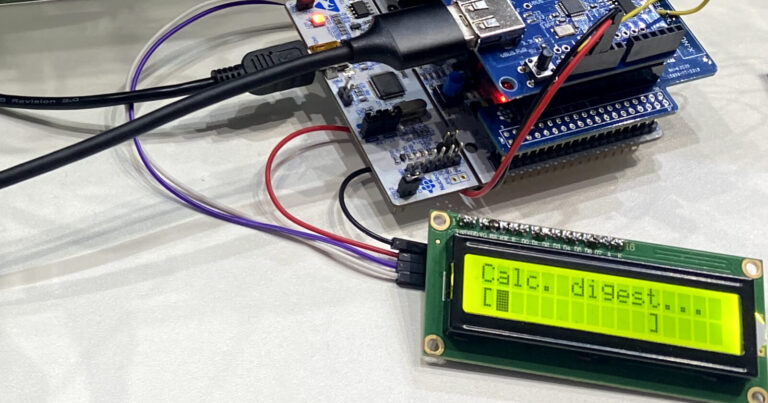
A standalone Secure Firmware Updater provides secure offline, on-premise firmware (FW) updates for industrial devices. The product is designed to make secure FW updates, providing a security layer in front of a target device and using encrypted firmware, TrustZone® technology, and a secure element chip in the process to ensure only authentic tamper-free FW can be updated and taken into use.

You can also download this as a PDF document.

Key features of Secure Firmware Updater

  • Secure and tamper-proof FW update process 
  • Authentic FW verification 
  • USB / offline FW updating 

Custom features: 

  • Custom integration with target device 
  • Custom FW updater logic 
  • Custom MCU flashing of the target device 

Supported microcontrollers and hardware

Security features of Secure Firmware Updater

Family

MCU device

Secure element

TrustZone®

Secure Boot

PCROP

Data signing

Data encryption

STM32F4

STM32F446RE

STSAFE-A110

N/A

Custom feature

Yes

Yes

Yes

STM32U5

STM32U575ZI

STSAFE-A110

Yes

Yes

N/A

Yes

Yes

STM32L5

STM32L552ZE

STSAFE-A110

Yes

Yes

N/A

Yes

Yes

Get the solution brief

Discover how Shield-loT enables organizations to monitor and secure any loT device, application and network

Read more

Proeksperts hosts its own AI-themed hackathon

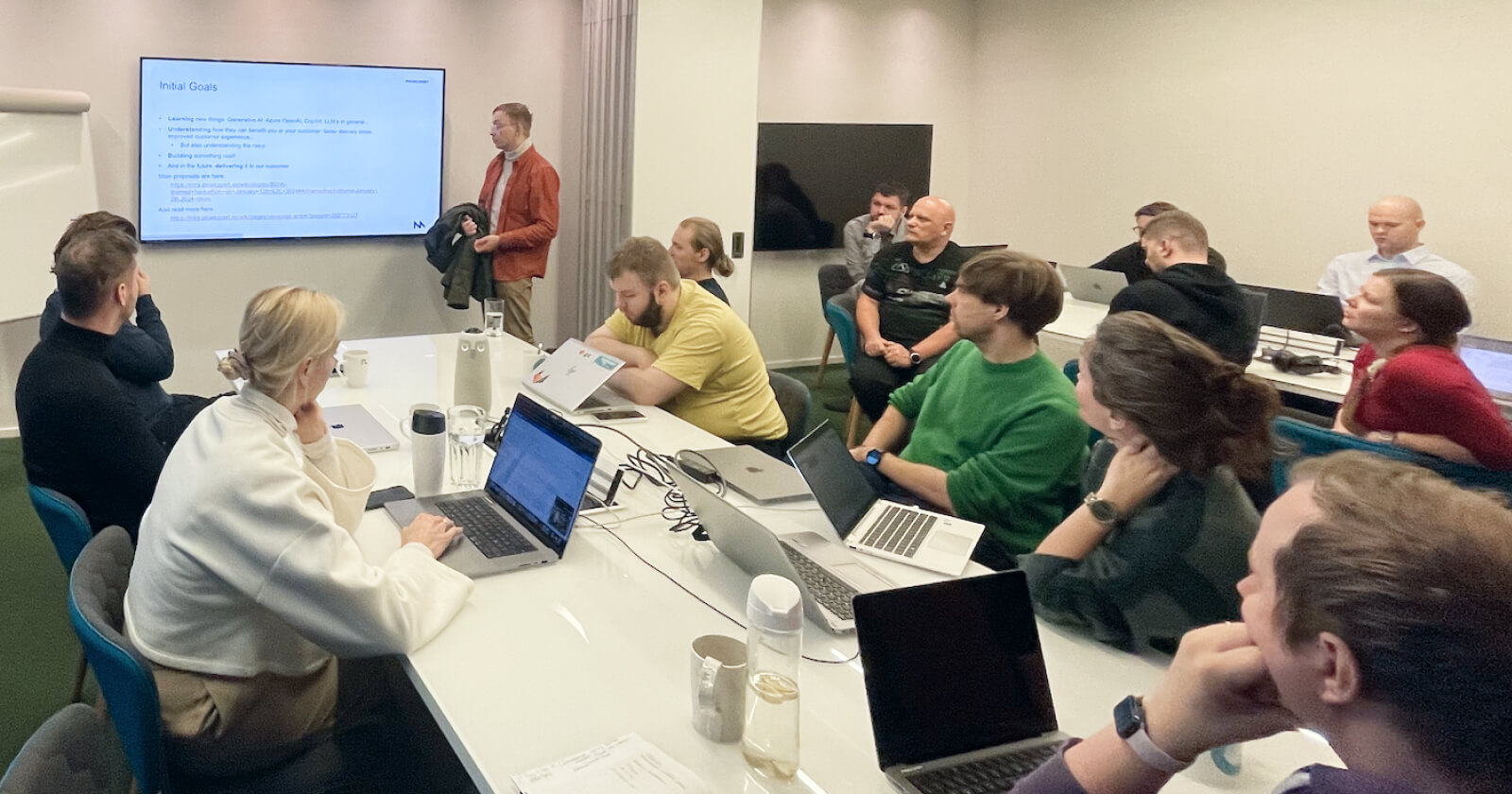
The development of AI-based products and tools are all the rage right now. Proekspert organized an internal hackathon with the goal of better understanding how we might benefit from these tools in our everyday work. On January 12, eight teams went to work and then shared their results. But let’s start at the beginning.

The goal of the hackathon was: 

  • Learning: Which AI tools are on the market and how should we use them? We were interested in how to leverage the large variety of services on offer – not just those of interest to software developers. What new ways of doing things might cloud solutions offer us? 
  • Adapting and measuring: We wanted a deeper understanding (with measurable results!) of how these impact our current work. How much faster could we deliver what we offer? What could be (almost) entirely automated?
  • Delivery: Based on what we learned, could we build something useful? Perhaps take an idea to the proof-of-concept stage, whether for personal, internal, or perhaps external use.

Since this field is broad and there are many different ways to tackle a problem, we turned to Proekspert employees to help decide what our focus would be. We agreed that ideal results would be: 

  • Increased know-how of AI tools and their possibilities.
  • A similar understanding of the solutions that are already out there and how those add value to the services we offer and benefit our customers.
  • Measurable numbers and other data-based results that express the opportunities data provides. If you can start up a project three times faster, or if you can save 40% of your time writing unit tests, for example, would be desirable results.

The event 

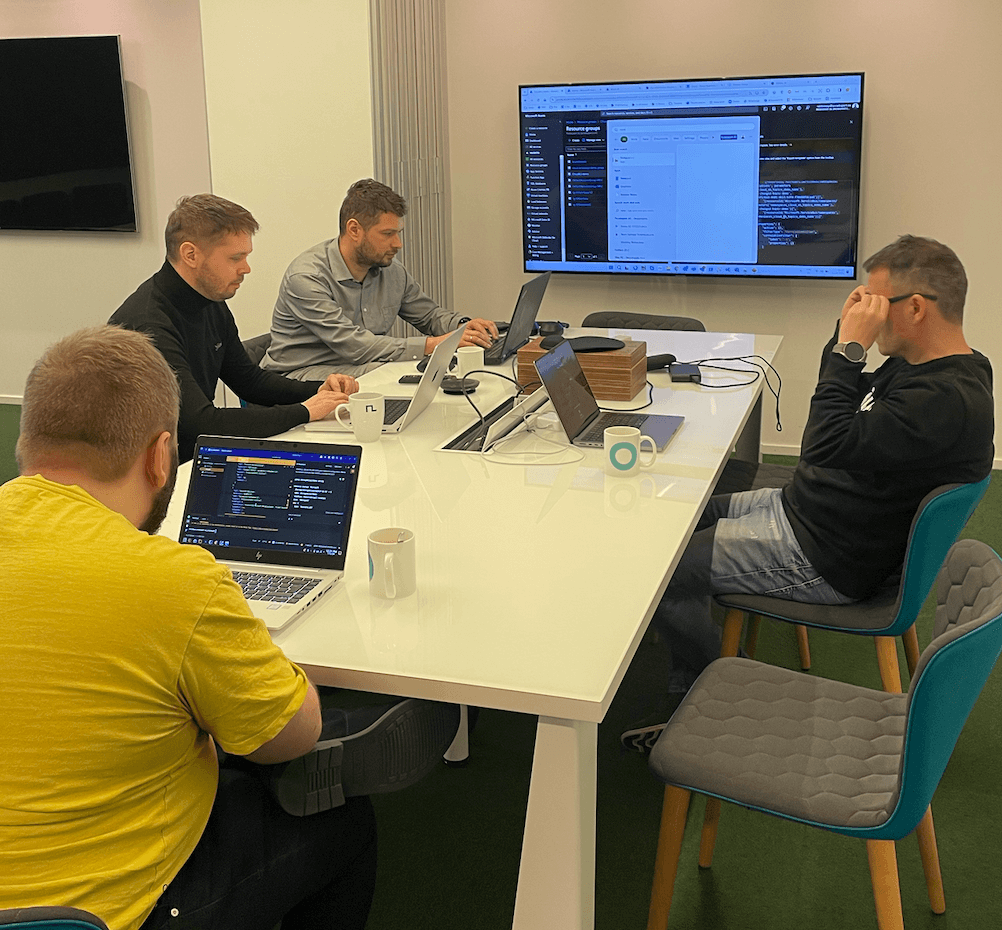
On January 12, over 30 AI enthusiasts gathered to learn, explore, and develop a variety of AI topics. Proposed topics ranged from how Copilot could save us time in using SQL, using AzureAI to do a brief analysis of code, to wanting to understand whether AI is good enough to replace human translators for ESG data management. 

The agenda was packed, and after the presentation of ideas, the teams gathered, and the work began. In between, teams convened to present overviews and ask for help if needed. In the late evening, teams presented their work.

As a result of a vote, the hackathon team, “Languages and AI,” won our competition with their goal of estimating the accuracy of translations done by two AI tools: LibreTranslate and OpenAI Azure. OpenAI Azure won this one handily, providing an accuracy of 76% initially and, once a bit of context was added, an accuracy of 93% as validated by our resident Italian Michele. You can read more in here.

General takeaways 

We discovered that AI is already a big help in business, capable, for example, of generating data, code, tests, and composing emails. It is very important how and what you ask (prompts) and the more precise, the better. AI is not yet able to understand business calculations which require specific models. It is not yet able to always write code that would fully compile, and some required functionality can be missing from the code as well. However, AI is an efficient assistant that is developing very rapidly. 

One of the teams focused on creating customer support reports with dummy data and AI-generated visuals in Power BI. The main findings were: 

  • OpenAI ChatGPT 4 is best at generating dummy data and visuals based on data, versus Bard, Proekspert MiltonAI, ChatGPT 3.5, and Microsoft Copilot.
  • Power BI automatic report generation did not produce logical results.
  • All AI chats can be used to generate DAX calculations, M, Python, R, SQL queries.
    • This can cut the time of development by around 50 percent or more.
    • Some basic knowledge of data analysis is good but is not mandatory.
    • Most important is to have an understanding of business and data to ask the right questions.

Another team tested how to use AI Tools such as Github Copilot, GPT-engineer and Chat-GPT when creating a proof of concept. Their findings were as follows: 

  • Android project
    • Using GitHub Copilot in Android Studio does not significantly speed up code writing. However, using Chat GPT 4 leads to much better outcomes.
    • GPT-engineer is not good enough for generating android projects. It can modify existing projects, but needs more learning.
    • Auto-generating a full project with AI is a complex task.
    • Using AI tools to solve smaller tasks can make the development process faster.
  • Visual Studio
    • GitHub Copilot integrates well enough with Visual Studio (since 2022). But there are some limitations, like generating new source files and adding them to a project. Some steps are easier to make manually.  

What’s next and how do we proceed  

It’s certainly necessary to continue working on this topic. The speed of development in AI is illustrated by the fact that a year ago we couldn’t use ChatGPT at work. Today, we also have Milton, our internal Azure OpenAI based assistant whom we make use of in our day-to-day work. We will definitely continue to use Milton, and aim to make him even more convenient and reliable. In the future, we hope to have Milton be able to provide up-to-date information about our projects and be able to answer any questions about Proekspert’s internal processes, reducing the amount of time lost browsing internal wikispaces.

To sum up

Stay curious – The field of AI is currently advancing at an accelerated pace. It will inevitably slow down, but it’s crucial for us to keep up with the broader developments and pick out the focus areas that benefit us (and you!) the most.

Stay hungry – We should not just observe but also participate, seizing new opportunities that come our way. Whether they’re simple code completion tools or more complex AI-based solutions, we should always strive to make the best use of them, maximizing the value we deliver.

Stay hydrated – Just as our bodies need water to function optimally, AI systems, like ChatGPT, need data and continual learning to perform at their best. Feeding quality data to AI data is like staying hydrated: it keeps the system energized, efficient, and ready to tackle the challenges of the digital world.

Created by Martin Bürkland (Product Owner) and Risto Rõõmus (Delivery Lead)

Revolutionising space travel: using AI & ML for Edge Flight Monitoring in reusable, eco-friendly space rockets

Sending a rocket into space is tricky, right? Well, yes and no. 

If you’re a rocket scientist, combining liquid oxygen and liquid hydrogen to generate thrust to propel a rocket may seem deceptively straightforward. However, the extreme conditions generated and where they operate dictate the need for precise and robust controls. This is challenging to overcome. Amongst the most critical tasks is ensuring that engine system faults are detected quickly and reliably.

This sounds complex, and truthfully, it is! Thankfully, the power behind machine learning and AI is changing how this is done.

Merging AI and machine learning with space travel

The minds behind Proekspert’s Data Science team, comprised of Alfonso García-Sosa, Karl Kaspar Haavel, Henry Ginter, and Laura Päeske, are implementing Transformer Autoencoder anomaly detection and classifications on dozens of complex sensors required, including:

  • engine valves, 
  • combustion chambers, 
  • pumps,  
  • turbines, 
  • temperature, 
  • pressure, 
  • rotational speed, and 
  • positional data.

The Engine Health Monitoring System developed by Proekspert makes it possible to follow and detect faults before they transpire and within fractions of seconds on the edge chip, a device on-board the space rocket. 

Such a monitoring system makes diagnosing and reconfiguring engine parameters easier during flight and postflight analysis. Thus, return on investment is created by faster, more reliable, and cheaper control of flights, complete use of fuel tanks, readjustment of pressure and vibrations, as well as the redesign of rockets for reusability and more efficient and cleaner fuels.

This framework methodology is advantageous for rockets and anything that feeds sensor data and needs to know if it has a fault and where it is located. 

It is a general solution that can be used in: 

  • predictive maintenance (monitoring equipment, condition-based maintenance), 
  • fraud detection (monitoring transactions), 
  • healthcare monitoring (tracking patient data), 
  • energy consumption (tracking for unusual spikes or changes in normality), 
  • network security (monitoring unique traffic patterns), and 
  • quality assurance (monitoring for defects), amongst others.

What is the ENLIGHTEN project?

The European iNitiative for Low cost, Innovative & Green High Thrust ENgine project is a program to advance the trial of cutting-edge production and deployment technologies for reusable rocket engines.

The ENLIGHTEN project and network allows Proekspert AS to continue to apply its advanced technology to the fast-developing space industry with trusted partners. The technology derived is of vital use to machine- and industrial health diagnostics and monitoring.

Alfonso Garcia-Sosa, Data Scientist – Tech Lead at Proekspert

The Enlighten consortium, headed by ArianeGroup, comprises 18 partners from eight countries: Austria, Belgium, Estonia, France, Germany, Italy, Netherlands and Portugal. It consists of industrial firms (ArianeGroup GmbH, Avio S.p.A., APP, ADIRA Metal Forming Solutions), research institutes and universities (DLR, Fraunhofer, IREPA, KU Leuven, Onera, Silicon Austria Labs), as well as SMEs and start-ups (Aiko, Areelis, AZO, Edgise, Erneo, Laser Cladding Venture, Proekspert).

Who are the ArianeGroup?

ArianeGroup emerged from a joint vision of Airbus and Safran to elevate the European space sector to new heights. Equally held by both entities, it integrates their collective civil and military space launcher activities and expertise into one unified organization.

In July 2022, the ArianeGroup was selected by the European Commission to carry out the Enlighten project, which was given a budget of €17.4 million under Horizon Europe, its framework research program.

Enlighten aims to develop and test advanced production and implementation technologies for reusable rocket engines, following the Prometheus® program. It will reinforce the new propulsion system initiatives ESA has awarded ArianeGroup to create a family of reusable, high-power engines fuelled by bio-methane or green hydrogen.

Scaling up your business through data automation

Data automation allows you to fully utilize available resources to achieve accelerated results and increase your business’s value. There is no reason you shouldn’t employ data automation in your business process. Do it right now, and watch your business scale up.

What is data automation?

Data automation uses technology and software to collect, organize, and analyze data. 

Data automation can be applied to various data types, including structured data (flat files and databases) and unstructured data (images, text, voice, and video). It can also be used across different data sources, such as internal databases, external databases, cloud-based data sources, and data from third-party applications, web services, and API. 

Data automation can be implemented using various technologies, such as robotic process automation (RPA), artificial intelligence (AI), machine learning (ML), and data integration tools. While AI and ML technologies can automatically analyze and derive insights from data.

Businesses, data scientists and analysts can free up time to focus on higher-value activities such as developing marketing strategies and making data-driven decisions by automating repetitive tasks such as data entry, processing, and analysis.

What can be automated with data automation?

Data automation can make marketers’ lives much easier by automating various tasks, including:

Data Collection

Data automation tools can collect data from various sources, such as social media platforms, website analytics, and customer relationship management (CRM) systems.

Data Transformation and Enrichment

Data automation can transform data from different sources into a unified format, enabling easy analysis and visualization. For example, it can convert currencies from different campaigns or group similar metrics that different platforms give different names (e.g., price and costs).

Data Analysis

Data automation tools can analyze data and generate reports, dashboards, and insights to guide your marketing efforts.

Data-intensive processes

No one is immune to basic human error, especially when dealing with data-intensive processes. One of the best ways to handle these processes in a more efficient and less error-prone manner is to employ data automation. Data automation helps you to maintain consistency, since processes will no longer heavily depend on human involvement.

Business benefits of data automation

So, what does that mean in real business terms? What benefits can businesses expect from automating their data?

1. Enhanced cost-efficiency and consistency

Data automation can reduce high costs since you’ll need less manual labor to handle data handling tasks. According to research by the Gartner Group, almost 85 percent of big data projects are predicted to fail. Big Data automation allows data to be analyzed and understood many times faster and more effectively, and in extreme cases, it will enable handling data that could not be analyzed manually. 

This, in turn, leads to more quality insights and opportunities to scale. The more you adopt automation in the initial data collection, storage, and processing stages, the fewer resources you’ll need to ensure and maintain high-level data quality.

2. Removal of data-intensive processes

No one is immune to fundamental human error, especially when dealing with data-intensive processes. One of the best ways to handle these processes more efficiently and less error-pronely is to employ data automation. Data automation helps you maintain consistency since processes will no longer heavily depend on human involvement.

3. Improved operational speed and competence

Markets are changing rapidly, and competition in every field grows as boundaries are replaced with interconnections. Operating based on data insights is crucial to becoming an industry leader in delivering high-quality, customer-centered services. Time is essential and a significant factor in any business’s sustainability, growth, and development. 

Manual data handling takes significantly more time than its automated equivalent. Significant time loss occurs during decision-making in the initial stages of defining source data standards.

4. Removal of manual decision-making

Before the introduction of data automation, most decisions were driven by professional judgment in combination with supporting manual data calculations. All work – data source collection, extraction, cleaning, analysis, and storage, was performed manually. 

Manually maintaining large-scale decentralized data is highly costly, error-prone, and time-consuming. This is why data automation is crucial for your business to operate efficiently.

Don’t waste the talent and potential of your data scientists.

Data scientists spend about 80 percent of their time on data preparation and cleaning. However, many data handling processes do not require human intelligence since they mainly consist of routine and recurring tasks. 

Data automation is an excellent solution for these processes. It allows your data scientist to focus on tasks that engage and require their deep competencies and creativity instead of getting involved in time-consuming tasks of basic-level data analysis.

What data automation challenges do businesses face?

While data automation has many benefits, it can also have some limitations. A few potential data automation limitations and challenges include:

Initial investment cost

Implementing data automation tools or systems involves initial investment costs or subscription charges. However, once data automation is set up, it will save an organization money in the long run. 

Evolution of team roles

When data engineers no longer focus on manual tasks, they can do more impactful and vital work. Employees who previously focused on such tasks may find their roles shift into new areas, such as determining how to effectively leverage data automation solutions and ensuring systems are configured correctly. Be prepared to examine how team roles may need to evolve and how you can shift or broaden employee roles. 

Learning curve

Introducing a new tool or technology includes a learning curve. Data automation is no different. It may take a while for employees to become familiar with data automation tools and learn to use them to their full potential. 

Human intervention is still needed for troubleshooting

While data automation can streamline data integration and reduce manual effort, critical workflow tasks may still require human intervention. For example, when a pipeline failure occurs, human intervention may be needed to understand what happened and how to fix it.

Data automation tools

Data automation tools, such as ETL, can automate data processes. Several companies make data automation tools, but finding the right tool for your needs can be challenging. A few key things to look for in a data automation tool include:

Scalability

The data automation tool should be able to scale to meet the growing demands of data processing quickly.

Observability 

The tool should provide logging and monitoring capabilities to ensure data integrity and accuracy and help troubleshoot when issues arise.

Security

The tool should have robust security features like encryption, access controls, authentication and auditing.

Integration

The tool should seamlessly integrate with other data tools and systems, such as data warehouses, data lakes, analytics platforms and visualization tools, to enable end-to-end data automation workflows. It should also adapt to various data sources, formats and workflows. 

Ease of use

The tool should allow users to easily configure, design and manage data automation workflows without requiring extensive coding or technical skills.

Using data automation

Data automation uses intelligent processes, software, equipment, or systems to collect, process, or store data. allows your business to focus the newly available resources on more critical tasks, investments, and innovation, bringing more value to your business, such as deep and sophisticated analysis and freedom for your employees to experiment and improve existing products or solutions to exceed customer expectations.

Ultimately, it describes a method of replacing manual work with machines and software, including the application of artificial intelligence.

For your business, data automation allows you to fully utilize already available resources to get accelerated results and increase the value of your business by realizing the hidden potential of your products or services.

There is no limit to the potential of data automation. Data automation is helping businesses optimize their processes and discover new business potential. It is essential to set up a good data automation strategy. 

If needed, engage the help of an experienced partner. There is no reason you shouldn’t employ data automation in your business process. 

Do it right now, and watch your business scale up.

Data automation works best on a modern platform. Read how Proekspert engineers AI-ready data platforms.

Data Automation FAQs

Data automation entails leveraging technology and software to integrate and automate tasks and processes related to an organization’s data. It uses algorithms, scripts, and tools to automatically collect, process, transform, and analyze (ETL) data without requiring manual human intervention.

Data scientists extract, analyze, and interpret large amounts of data from various sources, using algorithms, data mining, artificial intelligence, machine learning, and statistical tools to make it accessible to businesses.

It depends on the case of the company and the business. At Proekspert, we can use several tools, some of which are listed here.

Proekspert business intelligence and data analytics services help every company or organization transform data into actionable and relevant insights. This enables informed strategic decisions, improved operational efficiency, and business productivity.

Official EU Cyber Resilience Act (CRA) December 2023 updates

Since the draft of the EU CRA was proposed in September 2022, the potential impact of the act on industrial equipment manufacturers has caused much confusion. While penalties were clearly communicated, it was unclear what might be the obligations and requirements that the act proposes. In general, the act demands that developers of devices and software products must provide security updates for their products.

Now that a year has passed since the announcement of draft, we asked a the European Commission’s EU CRA expert what new details regarding the requirements of the act have become clear in the meantime:

We also shared this information in the form of a seminar at trade fairs in Germany and Finland. The full seminar with slides and text can be found here.

Several days ago Today, the European Commission released a couple of new details. For example, it was officially confirmed that the act will be adopted in early 2024. To get a better overview of what the EU CRA is and why it is still needed, consult this fact sheet.

Although many questions have received official answers, we still recommend that you go through the materials we have published. There are many relevant details not officially revealed yet: