Insights for the upcoming EU Cyber Resilience Act (CRA)

Since the EU CRA has created a lot of questions for device manufacturers, we held a seminar at the Teknologia fair and shared our knowledge regarding the matter.

Watch the seminar video of the presentation from the fair or read the text version below.

EU Cyber Resilience Act overview and discussion 

Hello! My name is Terry London. I’ve been with Proekspert for around 16 years. And I am here to give you some new information about the upcoming EU CRA.  

What is the EU CRA?

The European Cyber Resilience Act is meant to unify cybersecurity rules for hardware and software products across the European Union. The problem it addresses is the fact that the number of connected devices is constantly growing, and, at the same time, attacks against those connected devices are growing as well – almost exponentially. 

The main goal here, for the EU, is to protect end users – to have easier-to-understand and up-to-date security on the devices users rely on. Also, the EU is trying to avoid a situation where each EU country creates its own rules, which would result in a mess in the entire market. 

We can also say that the CRA is meant to make product developers more responsible for their product security. It’s not a bad thing at all. Bu, there seems to be a lot of confusion among device manufacturers due to a lack of clear information about requirements and the release date. 

Here is the link to the draft document on the European Commission’s web page. This is from September of last year. This is the only official source.

The current situation among device manufacturers 

We have had lots of discussions about CRA with our clients and other companies that manufacture industrial devices.

Here’s how we perceive the situation.  

  1. Many companies are aware of the CRA – painfully aware.
  2. However, only some are developing hardware security functionalities for their devices.  
  3. And only a very few are developing software infrastructure for their devices. 

Their approach has been to wait until they see what the requirements are going to be. 

Latest updates about the EU CRA

We didn’t want to wait. And we did our research. 

We went straight to the source at the European Commission. And here is our Interview with a Cyber and Digital Affairs Councilor. Get the link with the QR code, or find the video on our web page, Proekspert.com 

New insights about the EU CRA

Here is what we learned from the interview: 

  1. Despite the hesitation that surrounded the draft half a year ago, the act will probably be released in the spring of 2024. Of course, there will be a transition time of three years. After three years, companies that release certain critical products must start certifying their products. 
  2. Vulnerability reporting – After two years, companies must start reporting known vulnerabilities in their software and hardware products. 
  3. One big question was whether the requirements apply to already existing products, as well. The answer is no. The CRA will apply only to new products released after the transition period. 
  4. We also know that some new types of products won’t be covered. These are SaaS and open-source software (and also automotive, and medical devices, as was already known). 
  5. Finally, we got some updates on how products will be divided into categories by criticality levels. 

Criticality levels and certification requirements

This is rough simplification, but we can say that CRA divides hardware and software products into three different criticality levels. Each level has its own assessment requirement.  

  1. Common products like smart home devices require only in-house self-assessments by manufacturers. 
  2. Critical products like microcontrollers and general-purpose operating systems require third party validation. 
  3. The third group is called highly critical products. These products require certification by authorized certification service providers. Examples of such products are smart cards and hardware devices with security boxes (something similar to what we demonstrated in our booth at the Teknologia fair). 

Requirements for device manufacturers

Here are the very general requirements that device manufacturers face. 

  1. Get products certified  
    • Self-assessment 
    • Third party validation 
    • Certification 
  2. Compile software Bills of Materials (SBOM) 
    • Define software suppliers 
    • Define who is responsible for which software modules and software lifetime stages 
  3. Ensure secure software updates
    • Define the intended purpose and requirements of products 
    • Provide security updates over the product’s lifetime 
  4. Report product vulnerabilities – the details behind this are unclear

Our suggestions today

  1. For certification audits. Even if we don’t know exactly how the certification and third party validation is going to be officially organized, you can start with simple things. Map and document your product functionalities, because internal auditing is the main part of preparing for certifications anyway, and it is always a relatively time-consuming process. This will help you be more prepared when the requirements by the CRA are officially released.  
  2. For SBOM 
    • Go through your third party software packages and document what you have and who supports these with new updates. 
    • Define who is responsible for your different software modules across different product development stages. 
    • Use modern software development principles and tools. Maintain code repositories that help keep a product’s technical documentation up to date. 
  3. For security updates 
    • Review the risks you must protect your devices against. This gives you an understanding of what security measures to prepare. 
    • Plan how you will provide security updates. Is it remotely OTA or in a local network, for example? Then you’ll know what technology you need for securing your devices. 
  4. Additional recommendations 
    • What we know is that the EU cares about the competitiveness of SMEs. They plan to release special support programs for SMEs, including sandboxes to test your products with regards to the CRA. 
    • Plan ahead on how to prepare for the EU CRA. 

How can Proekspert help?

Consulting – We are up to date on the CRA and have been building software solutions for 30 years.

  1. SFWU solution – A solution for high-level device security on an embedded level. 
  2. Device Identity Management infrastructure (PKI) – A solution for managing devices with unique identities. 
  3. Remote device connectivity – A solution for managing remote devices over the cloud. 

You can also download slides from the seminar here:
Insights from 2023 trade fairs—what we learned

Proekspert representatives participated in numerous trade fairs this year, including embedded world23, Data Innovation Summit, Teknologia, Productronica, and SPS Fair, just to name a few.

Taivo Liiv, Proekspert’s business development lead, expressed his satisfaction with the resurgence of face-to-face events. “Even though online work is feasible, we like to meet people face to face because real problems tend to surface better in lively settings. In addition to understanding industry trends, trade fairs also give us the opportunity to showcase our custom software solutions for device manufacturers. After all, everybody can claim that they are experts. But not all can back that up by showing actual case studies and demonstrating how they have solved similar problems multiple times.”

embedded world

For the second time, Proekspert was represented at the embedded world Exhibition & Conference in Nuremberg, Germany from March 14-16.

“There is so much interesting happening in embedded systems at the moment,” said Proekspert’s embedded business unit lead Jukka Halttunen. “You have to keep up with technological challenges and make sure your solutions are innovative and sustainable. The topics we focused on at the fair were secure firmware updates and remote device management. Many industrial device manufacturing companies who we met acknowledged that software-level security is not enough anymore and they are looking for a solution to implement hardware-level security for their devices. We keep finding better and more effective solutions and plan to come back in 2024.”

Teknologia23

Teknologia23, held November 7-9, in Helsinki, Finland, is the leading event in technology in the Nordic countries. The event centered around four key themes: the green transition, supply networks, the hydrogen industry, and artificial intelligence. 

Proekspert connected with partners and found new companies interested in our software solutions. Events in Finland are always interesting since our markets have a lot in common and face similar challenges.

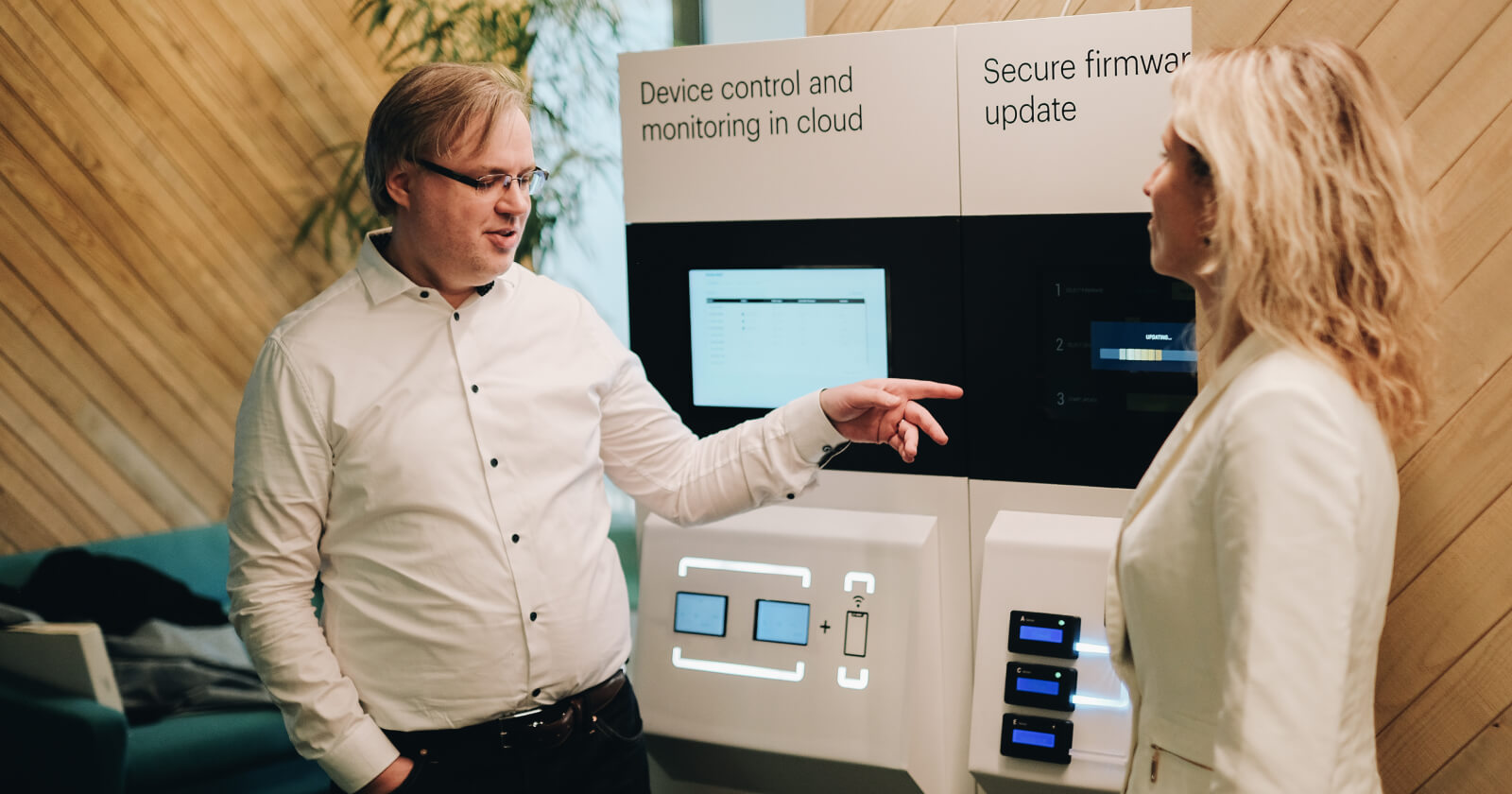
Terry London, Proekspert Product Owner and Partner, said, “Our secure firmware update solution that we demoed at the fair ensures that individual devices cannot be compromised by attacks against device firmware, which is critical as companies prepare for the upcoming EU Cyber Resilience Act (CRA). The biggest learning was that even if most device manufacturers are aware of the upcoming EU CRA, very few of them are already preparing their devices and products for compliance. Hardware-level security requires lots of planning and work, not only at the device motherboard electronics level, but also work with the company’s IT-infrastructure and organization processes as well. Since the EU CRA has created a lot of questions for device manufacturers, we held a seminar at the fair and shared our knowledge regarding the matter.” You can see the overview of the presentation here.

productronica

The world’s leading trade fair for electronics development and production, productronica, 2023,  took place November 14-17 in Munich, Germany.

Proekspert collaborated with the Estonian Business and Innovation Agency, as a part of their mission to take companies to the world’s largest leading trade fair for electronics development.

Tiina Kalju, Proekspert IoT-Cloud Integration and Applications Lead, said, “A couple of years ago you could find a few electrical equipment manufacturers who did not have digital services enhancing their products–but not anymore. This was evident at all the fairs I attended in 2023. Remote management and control of complex devices has opened a new range of services and business models to many manufacturing companies. Cloud technologies have changed the ways manufacturers’ clients are using their products and services. I’m happy to see that our solutions in this field not only serve the current needs but also anticipate and address emerging needs before they become critical.”

Meet us in 2024

This year, Proekspert plans to attend more fairs, starting with the embedded world fair in Nuremberg, Germany, April 9-11.

Our location: Hall 4, Booth 4-380

Business process digitalization: streamlining workflows for efficiency and new added value

One of the frequent requests from our clients centers around the imperative concept of “business process digitalization”. However, in practical terms, our clients often phrase it more directly: the desire to minimize paperwork and manual processes through the integration of digital tools. In this blog post, I will try to elaborate more about the primary motivations, challenges, and why Proekspert stands out as a reliable partner for such transformative projects. 

I will first try to summarize what could be the keywords for takeaways from this blogpost. 

The drivers for such kind of digital transformation projects can be summarized as follows: 

  • Boost work efficiency. 
  • Digitalize data and make them have a more central role in your business. 
  • Reveal new business insights from centralized data. 

The main challenges you are probably going to face are: 

  • user reluctancy to adapt to change and new tools/way of working. 
  • complexity of systems integration when the relevant data are scattered among different owners. 
  • dependence on vendors, in case of adoption of 3rd-party software. 

Now a few more words about each of the above listed points. 

Drivers for business process digitalization

Boost work efficiency. The challenge in increasing work efficiency is very much tied to the hours of employee work saved through the automation and digitalization of manual procedures. Frequently, our clients have already conducted some analysis, calculating the time invested in manual processes. This exercise not only brings light on the current costs but also paints a picture of potential gains. By quantifying the time spent on manual procedures, clients gain insights into the cost/benefit dynamics, providing a foundational understanding as they embark on a digital transformation journey. The time saved with digitalization can be spent on more useful tasks. 

Digitalize and centralize data. The process of digitalizing and centralizing data often results in an important shift in reporting dynamics as well as time saved. It’s not an unusual scenario where generating a report could require days of collecting information from disparate systems, documents, and Excel files. But with digitalization, this information can be made available within seconds, accessible to all via a web dashboard or any other platform, for instance. 

However, the benefits go beyond efficiency gains. The streamlined access to digitalized data opens doors for providing innovative services to clients. This not only enhances client engagement but also elevates the overall attractiveness of your value proposition. A proper digitalization not only optimizes internal processes but also positions your organization to deliver enhanced value to your clients and gives you a key competitive advantage. 

Reveal new insights from data. BI tools built on top of collected data help in building a wider understanding of various aspects of the business, enabling better planning and scheduling, and eventually revealing patterns which would otherwise stay hidden behind the high effort needed to get the same information using manual work. 

Main challenges

User reluctancy. This has often been the number one concern and challenge in making sure that the digitalization project will be a successful one. As I always like to say, it’s not always so easy to replace the easy-to-use “pencil and paper”. While it is tempting to build a digital tool that is a very close copy of the manual procedure that it is going to replace it (in this way, the end users would have something that is still somehow familiar to them), this is, in many cases, going to fail if we forget to ask the right questions. With the help of Service Design, we can have a more holistic view of the entire process, observe and interview those who will be the main users and the main stakeholders who will benefit from the digitalization process. So that there are less assumptions based on limited data and instead more accurate requirements are put in place, making the new tools efficient and appealing for everybody.  

Talking about extremes, it was not so uncommon to hear about stories that seemed to have great potential but failed on the small, yet crucial details. Coming back to the earlier example of replacing the pen and paper, users of an application in the agricultural sector who could not use the newly built mobile application because they were usually wearing thick gloves while performing their work and were thus unable to use the application at all. Instead, they reverted back to the tried and true pencil and paper solution they used originally. Or digital tools that were succeeding only halfway through, because the places they were using the application had poor internet connectivity which had not been considered at all during an early stage of defining the core requirements. And there are many other similar examples of aspects that should be considered when approaching digitalization of procedures and tasks. 

And worth mentioning, the reasoning behind user reluctancy could also be “social”: people just might think that new digital tools are threatening their job position. It is a debate that today we see very popular with AI tools for example. It is crucial to educate the end consumer on how these tools will instead elevate the work they do. 

Complexity of systems integration. There are various situations where the value of digitalized data would be greatly enhanced if they were integrated with data from other sources and processes. One of the domains where we have seen this the most is factory and production process digitalization. In addition to  digitalizing human procedures, we had to study and understand different types of machines and 3rd-party software tools from the most popular providers as well as internal custom-made, decades-old software tools. All just to understand the end-to-end user experience in its complexity. But similar patterns appear from time to time in other domains as well. It is vital to go through the whole flow of using such tools because a half-working solution may end up decreasing efficiency instead of increasing it, eventually resulting in a decrease in user and customer satisfaction. 

Dependency on vendors. When opting for third-party software solutions in your digitalization journey, awareness of potential pros and cons is essential, as it helps to more precisely evaluate where custom-developed solutions ultimately cover your current and future needs in comparison off-the-shelf products. While large corporate software platforms often address various needs (as they are often built to cover many domains), it’s important to assess the relevance of the entire feature set to your specific requirements, as well as the opposite: how much the missing features can impact your current and future ambitions. In other words, consider whether the paid license aligns seamlessly with your specific usage patterns, business requirements and technological limitations. 

On the other side, relying on well-established, up-to-date and secure software components, including libraries, plugins, and packages used in custom development, is equally vital. This ensures not only immediate functionality but also guarantees long-term support and maintenance, a foundational consideration for a sustainable digitalization strategy. 

Why Proekspert

Do you have a topic of digitalization of business processes and manual work on the table and are looking for a partner to help with? Feel free to reach out and book a meeting with us, we will be happy to discuss it further. 

Our data scientists and services team created an internal AI translation service for confidential texts

Proekspert has an internal AI NLP translation service for confidentiality. It uses argos, Libre. Translates English, German, Danish, Dutch, Finnish, Spanish, Estonian and 14 others.

With the storm of large language models (LLMs) that began almost a year ago with the release of chatGPT, everybody started using and testing it for various purposes, which led to a series of discussions around using external and internal LLMs, with the focus on data privacy of our clients and ourselves.

One concrete idea that arose from these discussions was the need for some kind of internal translation service since using popular online translation services may not be compatible with privacy rules in many cases, as all the text goes through third-party software in third party servers. A local service will prevent any data from leaving Proekspert or your company premises if you wish to start using the same service.  

The Proekspert data science team created a sensitive, data-safe, internal translation service.  

The service: 

  • is based on open-source LibreTranslate (interface) and argos-translate, but can also enhance precision using chatGPT;  
  • supports text, documents, and API calls; 
  • supports many languages (English, German, Danish, Dutch, Finnish etc) with new ones being added; 
  • argos can also be used as a regular python library; 
  • is accessible only from an internal network. 

Why argos?

We performed a brief search for tools, and several came up, both free and proprietary, stand-alone and self-hosted software and SAS-based (mainly proprietary options). Since we wanted to:

  1. Look into the topic of in-house AI solutions like LLM-s or NLP services (Maximum customer data privacy assurance); 
  2. Have maximum control over the solution so that in principle, we could offer setting up a similar type of service to other use cases or for our clients; 
  3. Cover most useful languages while still being an AI/ML based solution not some older translation tech, which will probably become outdated soon; 
  4. Provide translation possibilities not only for pure text but also for files and web pages; 
  5. Provide an API for integration with other software; 
  6. Does not require any special hardware, not even a GPU (which most deep learning models require to run fast or run at all). 

Therefore, the best solution for our needs was open-source self-hostable ML based software, which provides an API, a web interface, and file translation possibility. 

Out of the solutions we could find, argos-translate + Libre Translate ticked most of the boxes. The translation quality is also OK. It is not “the best” but it is very likely to improve, as translation models can usually be exchanged for newer versions without requiring any source-code changes, while it may not be so for any classical translation services.

Why Azure AI?

While argos-translate is quite good and especially energy efficient compared to resource hungry LLM-s, smaller NLP models do lack some context awareness. Therefore, Azure AI with context awareness is perfect for cross-validating the results in edge cases but does not have to be used in simpler cases.

The simpler cases can for example be identified by round trip translations such that if the forward translation followed by reverse translation through multiple languages results in exactly the original text, it is safe to say that the translation is good. If not, then the validation with LLM-s could be employed.

However, we continue to experiment with finding the perfect balance between using different models.

Our recommendation 

Context matters with translation services. If possible and needed, give some additional context and try to remove it from the translated text after translation, it can change the translation quality (and perhaps help to improve the overall message quality by removing confusion!). Also, rephrasing a sentence may be helpful. 

Example: 

English: An electronic component driving the motor is a motor driver. 

German: Ein den Motor antreibendes elektronisches Bauteil ist ein Motortreiber. 

English: A person driving the car is a driver. 

German: Eine Person, die das Auto fährt, ist ein Fahrer. 

Avoid slang and acronyms. Argos-translate usually fails to translate acronyms and slang terms as these are rarely a part of the language core dataset. It is better to keep the text professional and formal. 

Example: 

English: Where is the requirements.txt file? 

Finnish: Missä ovat vaatimukset. Txt-tiedosto? 

English: The ISP API is broken 

Finnish: ISP API on rikki 

English: The Internet service provider’s (ISP) application programming interface (API) is broken. 

Finnish: Internet-palveluntarjoajan (ISP) sovellusliittymä (API) on rikki. 

Use round-trip translation. Translate a text into one language and then translate the result back into the original language. It can help catch some obvious mistakes. 

How to use such services? 

After testing several different texts with various technical terms, we can say that currently, it’s best to use such translation services for sending small responses/”thank you’s” on LinkedIn or translating e-mails from a foreign language into English. Translating short phrases, like button names in software is also safe. But it’s still a good idea to manually check the translations, as a synonym might fit better for example. Luckily the automatic translation speeds up the whole process and checking the result is easier and faster than starting from scratch. The service is also useful for multi-national and multi-cultural companies, where several working languages are used. 

It pays to be even more attentive and aware of the risks when translating highly technical or legal texts, long semi-technical blog posts or when sending out important information.  

Remember that slang, jargon-heavy technical texts, abbreviations, and acronyms are usually a hurdle for the software.  

Outlook 

LLM-s have gone through an explosion in the past year and LLM-s smaller cousins, NLP translation models are benefiting from this development as well. In principle, in the future, it is possible to integrate Helsinki-NLT models from Hugging Face into this translation system and probably also the recent Seamless-M4T model from Facebook, which may have a higher quality compared to argos-translate. Anyhow, the service is up and running in Proekspert and we’re currently gathering feedback.  

Ensuring device identity and security: a crucial aspect of modern connectivity

“Device identity means establishing the authenticity of devices attempting to connect to services, services connecting to devices, and the data exchanged between them.”

When discussing secure firmware updates, an essential topic that often goes hand-in-hand is device identity. Device identity refers to the strategies, policies, and technical implementations that safeguard the communication of connected devices with the outside world. It’s worth noting that this concept isn’t limited to only “cloud-connected” devices. As emphasized in the draft of the European Cyber Resilience Act (CRA) (Annex 1, Section 3.h), security principles should extend to all communication channels, including devices capable of communication through hardware ports like USB and other industrial standards.

The need for device identity arises from the imperative to establish the authenticity of:

  • Devices attempting to connect to services
  • Services attempting to connect to devices
  • The data exchanged between services and connected devices

The fundamental principles behind device identity revolve around well-known mechanisms of symmetric and asymmetric cryptography that employ encryption keys. Device identity hinges on how these keys and certificates are generated, stored, and managed, both by the devices themselves and the external services they connect to.

Depending on the specific use cases and security requirements, device identity can be implemented in a variety of ways. Some scenarios call for a unique security level for each individual device, entailing a distinct encryption setup for each. In other cases, it may suffice to have security applied at the group level that covers multiple devices.

Regardless of the scenario, the initial step is the same: equipping the device with the necessary tools for secure communication. This is typically accomplished before the device leaves the factory and can be referred to by a variety of terms such as “factory injection,” “factory initialization,” or “labeling.” It is critical that this process occurs within a secure and controlled environment in the factory.

This procedure also defines a device’s identity in its strictest sense, since a unique device ID is stored in the server and paired with a device certificate.

But what exactly are these “tools”? When we refer to tools, we are talking about the certificates and secret keys required to generate the data encryption key (DEK). The DEK is a symmetric key used to encrypt the exchanged data.

To summarize:

  • To ensure security, data exchange between the device and the outside world is encrypted with a data encryption key.
  • To guarantee the DEK’s authenticity, it is generated using certificates and private keys that are securely put in place before the device leaves the factory.
  • The aforementioned certificates are also employed to verify the origin of the data.

In a manner similar to security principles in other domains, various approaches exist for managing the Data Encryption Key. It can be a permanent key, generated and stored on both sides, with the option for updates when needed, or it can be ephemeral, generated only when data transfer is necessary and then deleted. For instance, the use of Elliptic Curve Diffie-Hellman encryption enables securing communication between two actors over an insecure channel.

The process of generating and storing a permanent DEK is commonly referred to as a “pairing procedure” and may occur later when the device is installed at the client’s premises.

The choice between using ephemeral or permanent DEKs depends on the specific use case. For example, if a device is expected to receive data or firmware updates from a passive storage medium like a USB memory stick, ephemeral keys are not a suitable option, since they require real-time interaction from both sides. Pairing procedures also enable the categorization of multiple devices by client, by machine, and so on.

In cases where a high level of security is required, with each device necessitating its unique security encryption, all essential private keys and certificates can be generated within the device during the injection phase. Alternatively, these can be prepared in advance (still within the secure factory environment) and then stored in the device during the injection phase. This flexibility accommodates scenarios where a single DEK is desired for a set of multiple devices, such as those owned by a specific client.

Furthermore, these practices extend to handling licenses, particularly in device-as-a-service business models. If you require assistance with a device identity and security case, don’t hesitate to reach out and book a meeting with us.

Device Identity FAQs

Device identity means establishing the authenticity of devices attempting to connect to services, services connecting to devices, and the data exchanged between them.

A unique device ID, stored on a server and paired with a device certificate, is critical in ensuring secure communication and authentication in a connected, networked environment.

This digital certificate is often issued to the device by a trusted certificate authority (CA). It contains the device’s public key and other identification information, and the CA digitally signs it. This certificate is crucial in establishing a secure and trusted connection between the device and the server or between devices.

A Data Encryption Key (DEK) is a specific kind of key crafted for the purpose of both encrypting and decrypting data, potentially on numerous occasions. Generated by an encryption engine, the DEK is utilized for both the encryption process and subsequent data decryption. Consequently, retaining the DEK for a predetermined period is imperative and essential for decrypting the cypher text it has produced.

Elliptic-curve Diffie-Hellman (ECDH) is a protocol for key agreement, enabling two parties possessing their respective elliptic-curve public-private key pairs to generate a mutual secret, even over a non-secure channel. This shared secret can be employed either as a direct key or to formulate an additional key.

Preparing for the upcoming EU Cyber Resilience Act: advice for industrial device manufacturers

An interview with EU CRA expert Thorwald-Eirik Kaljo.

Watch the interview video here or read the text version below.

What does the Cyber Resilience Act mean in simple terms?

The Cyber Resilience Act is currently a proposal for a regulation on cyber security requirements for products with digital elements or, simply put – connected devices. So, it is known as the Cyber Resilience Act. Its goal is to bolster cyber security rules to ensure more secure hardware and software products.

What are the main goals that the EU wants to achieve by adopting this Cyber Resilience Act?

The general perception is that there are plenty of products on the used market that are connected. The number is of course growing, and everybody has seen the predictions for 2030. 

Many of these products have quite a low level of cybersecurity. And vulnerabilities in these products have been one of the main causes of incidents over the past few years. We have seen some very significant supply chain attacks, for example. We see the devices being more and more interconnected as well. 

So the goals of the Cyber Resilience Act are to create conditions for the development of secure products by ensuring that hardware and software products are placed on the market with fewer vulnerabilities and ensure that manufacturers take security seriously throughout the product’s lifetime. And I think there were some clear objectives set out by the Commission when proposing this piece of legislation, objectives that are supported by both the Council of the European Union and the European Parliament. 

So one objective is a lifecycle element, another to fit this whole product security topic into a wider cybersecurity government’s framework, and finally to ensure transparency for the consumers, and for manufacturers themselves, when using the products. 

One of the reasons for coming out with this piece of legislation is to avoid fragmentation and the legislative patchwork throughout the EU, since Member States had started to take individual steps to create separate pieces of legislation at the national level. So this is why we need to avoid fragmentation and harmonize this area across the EU.

How does the Cyber Resilience Act affect industrial equipment manufacturers?

It of course has a strong impact on these actors. 

From the beginning, risk-based approach to understand the criticality of different products has been chosen, and industrial device manufacturers have been selected, I’d say, over consumer devices, as the main targets of this regulation. Because, quite often, microprocessors, controllers, and general purpose operating systems are components of other consumer products or industrial products. So, they would have to be taken with stronger scrutiny before placing them on the market. 

There is a list of critical products and highly critical products. Some of the industrial devices are in neither of the categories and would therefore have a lower threshold of requirements that are expected from them.

Can we state what kind of devices the Cyber Resilience Act targets? 

Yes, so, as I said, there are multiple layers. And there are different methodologies that have been singled out. We are also talking about different approaches, because currently we are at the final stage of negotiations of this regulation. Meaning that the EU Commission, the Council, and the Parliament all have different methodologies. 

As I represent Estonia at the Council of the EU, I’ll be able to reflect on our approach a bit more. 

So we have chosen a multi-layered approach based on criticality and most of the products go in the simpler category where they would be considered as just regular connected devices, like children’s connected toys or some wearables or some of the more basic smart home devices. 

There are two critical categories of products: the critical category (which includes anti-virus software, operate operating systems, microcontrollers and processors) and the highly-critical category (which includes smart meter gateways, smart cards, hardware devices with security boxes). These are quite narrow areas, I would say.

And then some of the products or areas are out of scope. Let’s say Software as a Service (SaaS), generally, is out of the scope of this regulation. Also vehicles except for tractors and motorcycles which are not covered by the respective European directive, and medical devices as well. So some of the exceptions here reflect on the very specific areas which are known to have already higher standard of cybersecurity for their products.

What can industrial equipment manufacturers do to ensure they are ready for the Cyber Resilience Act?

If I were an industrial device manufacturer, I would think about the expected product lifetime and the intended purpose of my devices, as these are some of the essential requirements in this regulation.

I would also go through the information that I’m making available for users. I would check if my product would allow for automatically installed updates. And if I could turn them on, how and when they should be turned off.

I would also go through my Software Bill of Materials (SBOM), or try to establish one and try to understand the different supplies and where the responsibility for each part of my product lies. Who should be responsible at which stage. 

Then I would also be looking out for different opportunities to test my products in regards to this regulation, as the EU intends to make some funds, testbeds and sandboxes available for this regulation, especially for SMEs (Small and Medium Enterprise). So, if my company was an SME, I would know that there would be some opportunities, which would allow me to keep the pace with the bigger players.  

Are there already any guidelines on how to get those products certified for the Cyber Resilience Act? 

This is essentially one of the most complex subjects and also very difficult to explain and understand from the perspective of an industrial manufacturer, because you need to cross-read the regulation to understand in which category does my product fit in, and which is the exact conformity assessment procedure that I have to follow. And how does this conformity assessment look like.

So there are multiple stages for this, depending on the criticality of the product as I previously said. 

One of the main elements for all the products is the use of harmonized standards. While harmonized standards is a pivotal element of this regulation, they will take time to be drafted. So probably two years for the standardization organizations to draft it. 

But then there are also some simpler ways for self-assessment, for example using Annex 1 for essential cybersecurity requirements and vulnerability handling. Then, you should cross-read Regulation Article 24 and Annexes 4 and 6, which give more information about the specific category and the type of conformity assessment that the entity should go through. 

Let’s say they can also go through a full quality conformity assessment which would be more suitable for, let’s say, software product producers. 

And then there’s also the element of certification schemes. Currently, in the EU we have no certification scheme available. Probably the first one to come out is the EU Common Criteria scheme, which can probably be used for this regulation.

And then for the highest criticality products, they will have to go through third-party conformity assessment, which is obviously a very burdensome procedure. In most of the EU member states, we don’t even have the authorities in place who could do the conformity assessment for cybersecurity purposes. But in some member states, that already exists, such as in Finland for example. 

Does the cyber resilience also affect the already existing devices that are in use in the field or in factories and etc? 

No. Generally, it affects only the new products made available on the market. This is the terminology we’re using. 

When does cyber resilience come into effect? What will be the transition period for device manufacturers? Does each state force the Cyber Resilience Act separately?

Yes, so, we are currently negotiating this regulation, and we are in quite an advanced phase. I expect the regulation to enter into force somewhere in the spring 2024. And if everything goes smoothly now with the negotiations, then from that point, there will be a transition period of 36 months, which will start ticking from next spring. Both co-legislators, the Council and the European Parliament have found that 24 months will not be sufficient for both the manufacturers’ and the Member States authority’s perspectives. Only the vulnerability reporting deadline will kick in earlier, 24 months from the adoption of the regulation. This means that entities are expected to share information about actively exploiting the vulnerabilities with specified authorities in their member states. 

So, what comes to the enforcement of the CRA, then it should be understood that once you pass through the conformity procedure in one member state, your products should be eligible throughout the single market. The same goes for devices imported from outside the EU. They will have to pass through the same procedure in one of the member states. So from the single market’s perspective, the products should circulate freely. 

There are also some exceptions, which relate to entities that are considered essential in the NIS directives’ different categories. And for these entities, member states can impose some of the stricter requirements regarding their supply chains. Also, there is a general exception for national security, where member states can ask for stricter requirements to be put in place. 

How Proekspert helps industrial device manufacturers to prepare for the upcoming Cyber Resilience Act

Proekspert works on secure device connectivity and remote device control solutions on a daily basis. Our long experience with secure industrial solutions can get you on your way, no matter how simple or complex your requirements for PKI and device identity management.

It’s quite a leap to upgrade device-level security and the infrastructure for managing device identities, permissions, and licenses.

Proekspert helps device manufacturers prepare for the upcoming EU Cyber Resilience Act. Register for a free meeting where we will help you to discover how to improve your device security.

Read more: Cyber Resilience Act – Factsheet

Cyber security: why it shouldn’t be an add-on

In the tech world, the standard approach to cyber security is to develop first and protect later—here’s why that model is both wrong and dangerous.

In this era of cyber attacks and ransomware, security is on everyone’s mind. We tend to rely on platforms, frameworks, and cloud providers to ensure the security of our information, but can we trust these solutions?

What is cybersecurity, in simple words?

Cybersecurity involves safeguarding systems, networks, and programmes against digital attacks. These attacks often seek to steal, alter, or delete critical data, extort money through ransomware, or disrupt normal business activities.

How we approach cyber security and why

At Proekspert, we always say that putting a powerful lock on a paper door won’t make a cardboard house secure. Indeed, this is the perfect metaphor to describe the approach widely used today.

Perhaps it is high time we reinvent our approach to cyber security.

Regarding security, countless companies will try to sell you a one-fits-all solution. Their offer might be security as a service, high-quality penetration testing, or log analysis for finding outlying incidents and anomalies. While they may seem compelling on paper, none of these solutions work in the real world because security comes down to people, behaviour, and the processes and standards you have in place. Different kinds of software can help and assist you in ensuring the security of your data, but they will never do the work for you.

How many companies, in a variety of spheres, implement security is not perfect either. Considering how quickly circumstances change in the world today, it is understandable that no one seems to have the time to document, plan, or consider theoretical security aspects if features are not ready and the MVP is not delivered. Most importantly, security and privacy requirements are left out of the MVP. Only when design and development are complete do we consider talking to the security team and ask for their final sign-off.

An approach of this kind is fundamentally flawed: we build a house with a paper door, and when the product is almost finished—its launch date due—we ask the security team to put their best, most secure lock on that paper door, leaving no time for a deeper analysis. Moreover, in that final phase, any fundamental change would delay the project and be extremely costly.

Types of cyber security threats

What is a tailgating attack?

Tailgating is an attack in which an unauthorised individual gains access to a restricted area, such as a password-secured zone, potentially to steal confidential data, harm property, obtain user credentials, or introduce malware onto computers.

‘Piggybacking’ resembles tailgating but includes an employee’s unwitting consent. In this scenario, a hacker, possibly masquerading as a delivery driver, convinces an employee to grant access, unlike tailgating, where the employee remains unaware of the breach.

What is a phishing cyber attack?

Phishing is a cyber-attack where malevolent actors send deceptive messages, posing as credible individuals or organisations. These messages coax users into actions like downloading harmful files, clicking dangerous links, or revealing sensitive details like login credentials.

Phishing, a prevalent form of social engineering, involves manipulating or deceiving computer users. This tactic, a growing threat in many security incidents, often pairs with other dangers like malware, code injection, and network attacks.

Using different cyber security tools

Using different cyber security tools, services, or penetration tests is undoubtedly helpful, but there is much more you can do and many more measures you, as a company, should take.

Perhaps you are wondering, what exactly would be a better approach?

Unfortunately, there are no foolproof answers. But having extensive expertise in this field, Proekspert can provide at least the beginnings of a comprehensive solution.

Above all else, we would advise an approach wherein security and privacy are planned and designed for—not dealt with as an afterthought or the final stage of development.

What does security by design look like?

Well, first of all, it means onboarding security analysts as early as possible with projects, even if a project is still in its whiteboard-drawing phase. When security is factored in so early on, changes and preventive measures are easy to make and way more cost-effective.

What is cyber security software, and how do we use it?

Cyber security software, designed to thwart complex cyberattacks, frequently integrates various tools like machine learning and AI solutions for dynamic protection against constantly emerging threats. Additionally, it ensures resilience in case of successful attacks by safeguarding email, backing up vital data, and maintaining business continuity.

At Proekspert, we ensure our software is also designed with security in mind.

You will never be able to eliminate all bugs before a release. Still, you can avoid as many errors as possible before the final version goes out and penetration testing begins. During the development process, it is best to practice threat modelling (more on this in our next article) and systematically identify weaknesses and attack vectors. This way, you can prepare for the worst and develop solutions for your product.

What is a Security Development Lifecycle, and why do we use it?

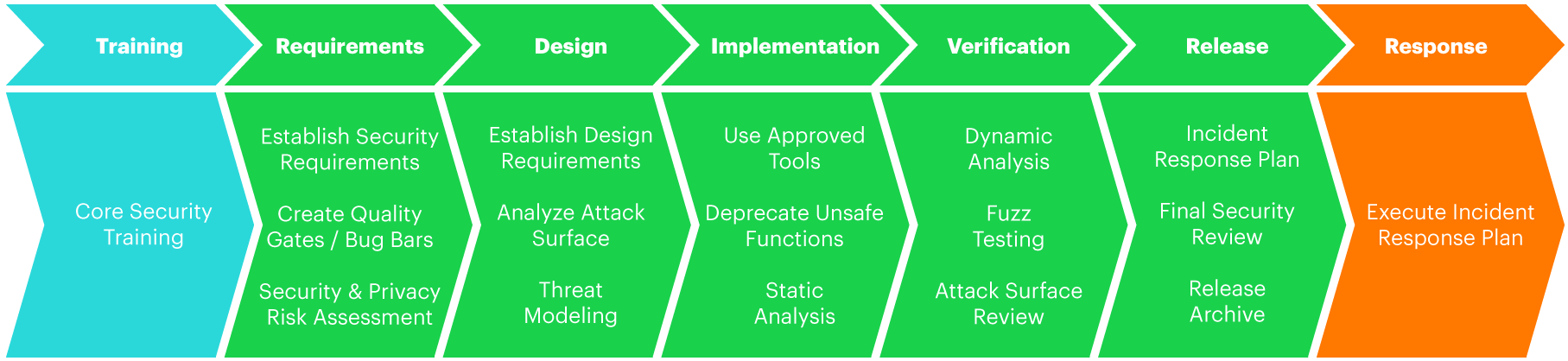
The Security Development Lifecycle (SDL) consists of practices supporting security assurance and compliance requirements. The SDL helps developers build more secure software by reducing the number and severity of vulnerabilities.

If your company has not yet implemented any Security Development Lifecycle, we recommend that you experiment with the Microsoft model and then adjust it to your company’s needs.

But if you are eager to look at other best practices on creating a custom SDL, we suggest that you also take a look.

After implementing a suitable SDL and integrating security analysis within earlier stages of your design process, you can still take several measures to ensure security. Here are just a couple:

  • Train your developers regularly to ensure that the majority understand the most common attacks, defence mechanisms, etc. This may be time-consuming, but as long as attacks change, so must protection mechanisms. Your team must be on top of the latest trends.
  • Make sure you have a dedicated security team that can assist with design and architecture, conduct penetration testing, give general advice, and work on research to help product teams deliver secure software.
  • Try to implement a plan to ensure that protection is cheaper than any potential loss. Create a system where some services can be taken down in case of critical incidents without causing any disruption to business. At the same time, mission-critical systems need the best possible security you can implement.

Regarding software, there are no foolproof solutions and no 100% guarantees against hacking. Critical bugs are bound to go around, and they may not even happen in your code but in the library or service code that you are using.

It is impossible to mitigate everything, so you must consider these risks in your threat model, acknowledge them, and prepare for their eventual occurrence—no matter how unlikely.

Assessing cyber threat risks

A cybersecurity risk assessment involves assessing threats to your organisation’s IT systems and data and your ability to protect these assets from cyber attacks.

Organisations can (and should) use a cybersecurity risk assessment to identify and prioritise opportunities for improvement in existing information security programs.

A risk assessment also helps companies communicate risks to stakeholders and make educated decisions about deploying resources to mitigate those security risks.

Managing your cyber threat risks

Every organisation using IT infrastructure must perform cybersecurity risk assessments. However, limited resources can hinder small businesses from thoroughly evaluating and mitigating risks. Consequently, many turn to cybersecurity software for enhanced evaluation, mitigation, and monitoring of their risk management strategies.

Modern cybersecurity solutions focus on threat intelligence to guard against the three primary cyber risk categories: malware, ransomware, and phishing.

But why is understanding and mitigating cybersecurity risk so important?

It’s all about assessing and managing risk. If you ignore potential problems, and then one day they begin to flare up, you might discover that you are unprepared:

  • You don’t have logs.
  • You don’t have abuse-detection mechanisms.
  • You don’t have any protocols for properly identifying and analysing an attack.

That’s precisely the kind of situation all companies should try to avoid.

Security takes time and effort, but it is always worth it.

Contact us if you want to ask for advice about the security of your digital products.

Put your customer first – now more than ever

New realities are emerging. The most effective way to react to challenges for you and your customers is to collect real-time information taking real-time measurements based on your customers’ needs. Don’t wait for the “right” time to start listening to your customers and partners. Collaborate, communicate, and act now.

Cost cutting is the trend we see across industries and with our customers. In light of reactive measures to fight the economic impact of the coronavirus pandemic, not many are thinking about investments in research, development, and digital business transformation. However, now is a great opportunity for innovation. Along with the coronavirus comes a new set of unmet consumer needs and new expectations for products and services.

The most effective way to react to challenges

The most effective way to react to challenges for you and your customers is to collect real-time information, taking real-time measurements based on your customers’ needs.

We understand that you may receive advice to follow a crisis management manual and reduce innovation expenses, focusing on the essential parts of your business. However, your strategy must be more flexible to interface with the customer’s world. Right now, you can get better feedback if you accept moderate risk. Choosing the safest path is choosing stagnation.

Research customer experience

A lot of emphasis is placed on companies communicating with their partners to address business impact. However, most companies are not paying enough attention to communication with their users. There is too little investigation of customer needs and experiences. Looking at the situation through the lens of your customers, communicating with them, and reaching out to them drives innovation and builds loyalty.

Assembling a team for customer research in these turbulent times may be challenging. Engage an experienced external partner who will help you understand where your customer stands at the moment already in two to four weeks. Your customer may already know about possible solutions to their pain points. This customer insight is paramount to designing a solution that can connect to your core business outcomes and capabilities, offering a spark for innovation.

Captivate your end users by reacting to their pain when they need it most. Don’t wait for things to return to normal – because they never will.

Even if the insight you collect from your customers does not lead to innovation, it will make a huge difference for customers who see that you care about their needs and well-being. Be there for your partners and end users when times are difficult; they will be with you when times are good.

The pain is now. React to it now. Begin researching your customer experience!

What is customer experience research?

Customer experience is the summation of every interaction with your company throughout their journey. From a cold call to a service inquiry or a coupon in the mail, each interaction helps create individual impressions, perceptions, and behaviours that make up the customer experience.

Meanwhile, customer experience research represents the actionable steps your company can take to understand CX. This includes collecting customer data — pre- and post-sale — and then analysing that data for trends that can lead to process, product, or service improvements.

Why does the customer experience matter?

Customer experience is an increasingly popular term in business, especially regarding long-term strategy and planning. You set the overall context of a customer’s experience: your product or service, messaging, and interactions at the sale and post-sale stage. But the perception of how these touchpoints are experienced is the customer’s. You cannot control it (although you can certainly influence it). Instead, it is defined by your customers and their journey.

Most organizations recognise the importance of customer experience: delivering consistently on your brand promise and providing customers with an optimized experience brings financial rewards.

Don’t wait – innovate

Product innovation shouldn’t take a lot of time and resources. If you carefully listen to and observe your customers’ pains, behaviors, and choices, the most crucial part is done. You’ll know what they expect and need from you most. Your main objective now should be to resolve customer-related challenges but balance them with business drivers and your organization’s capabilities.

Now, you need to innovate more than ever – and innovate smartly.

You will build the needed solutions significantly faster by assembling or engaging multidisciplinary teams with wide skill sets and experience across many industries.

We were asked by one of our clients to develop a thermostat. We discovered that the thermostat did not make accurate measurements. Instead of the allowed 0.5- degree celsius tolerance for error, the thermostat was off a full degree or more. You know the feeling when you set your thermostat, but the room still feels cold. This happens because the components in the PCB are getting heated, causing inaccurate signals to be sent to the temperature sensors.

Starting the customer service design process

We began the service design process with a specific problem. We launched the ideation stage of the double diamond to gather the options. We applied machine learning to solve the business challenge outlined by service design. After several iterations, and in the face of technical restrictions such as shortage of memory space and limited testing conditions, we solved the problem. It took us two weeks of development and three months of model improvement during the testing phase.

Find the courage to investigate. Investments will contract as a result of the pandemic. However, huge investments and years are not required to make changes and improvements to your products and services that will make a huge difference to your customers right now.

Find a great external service/product development partner to help you react, test, and redesign products and solutions until they meet the market demand.

What is customer experience design?

CX design refers to positively shaping every consumer interaction with a business—from contacting customer service to using the company’s products and services.

Companies use CX design to have high-quality interactions with people before, during, and after they become customers. To engage consumers across many stages, support teams must understand every step of a buyer’s journey.

Keep up employee spirits

With many countries forcing employees to stay home, new challenges for preserving company culture are presented. Engaging your employees in new projects and keeping them occupied with new ideas might make a huge difference in how your company spirit will fare in these turbulent times. When you have identified your customers’ needs, you can make an internal digital hackathon and conduct brainstorming sessions.

While your employees are working remotely, this practice will help people to unite under a single idea, and they’ll feel that a real difference is being made for their customers. They’ll find purpose and incentive to stay proactive.

Considering this is unlikely to be the last health crisis the world will experience, it is a perfect opportunity for us to test how well our businesses are ready to respond to challenges. Don’t wait for the “right” time to start listening to your customers and partners. Collaborate, communicate, and act now.

Is digital business transformation putting the customer experience first?

The purpose of digital business transformation should be to enhance customer and employee experience. Building services per user needs gives no reason for your customers to look elsewhere.

Digital technologies – and how we utilize them personally, at work, and within our communities – have changed the face of business.

But, the speed at which it occurs is faster than an organization’s pace.

The digital transformation market is worth $880.28 billion. Global spending on digital transformation is expected to hit $3.4 trillion by 2026. 74% of organizations consider digital transformation a top priority. 

What is digital business transformation?

Digital business transformation exploits digital technologies and supporting capabilities to create a robust new digital business model. COVID-19 forced organizations around the globe to speed up digital initiatives to drive their response to the crisis. Now, the C-suite focuses on prioritizing investments in the right initiatives to fuel future growth.

But is this digital business transformation priority actually putting the customer experience first?

Why digital transformation is essential for business growth

Digital business transformation is a method of exploiting digital technologies and their supporting capabilities to generate sound new digital business models.

Digital changes in society are highly disruptive, causing us to shop, interact, and do business differently with organizations. Now, we can do everything in a digital space, sign documents, gain education, and coordinate teamwork.

No company, industry, or area of society is unaffected.

Rather than stand still, businesses have sought to transform to gain a competitive edge. To do this, companies try to modify either several components of their business or only one part. Despite there being a lot of emphasis on the distal aspect, the key is not to forget that it is a transformation after all. 

These areas for digital business transformation include

  • Business processes. One or several connected operations or activities that achieve specific business goals. Business process reengineering is essential to improve internal or customer-facing aims. 
  • Business areas. From human resources, sales, marketing, operations, finance and administration, and customer service.
  • Business models. How a business functions, from its go-to-market approach and value proposition to how it seeks to monetize. Transforming a business model aims to tap into new revenue streams. 
  • Business ecosystems. The partner and stakeholder networks of a business. Plus, it will include economic and regulatory factors that impact an organization’s ability to transform. Can a partner continue to integrate with a company that has digitally transformed? 
  • Business asset management. Typically, it focuses on traditional assets but also on more tangible assets like data and customers. Customers must be treated as an asset in digital business transformation. 
  • Organizational culture. Understand what culture is – it’s an employee’s mindset. Your culture should be agile and human-centered. Explore your employees’ pains and gains and how to listen to and understand them better. Only then is it possible to change the culture to be more customer-centric? If your employees feel cared for, your customers will feel the same.

It is a holistic transformation, including customer experience, technological innovation, and digital disruption. It is not only a buzzword.

Business transformation

Any business transformation should have a clear purpose. And that purpose should be the customer and the employee experience combined.

It is easy to see why.

When asked why digital transformation was implemented, nearly half of all organizations in a PWC report cited customer experience as the main factor.

With a better customer experience and increased profits, digital business transformation is the silver bullet to company success.

Yet, alarmingly, only 35% of the companies had achieved a successful digital business transformation. Furthermore, 78% failed to meet their business objectives.
There are several reasons this could be, including putting technology over customer experience.

Why is keeping the customer experience in mind challenging to transform a business?

It’s easy to forget the customer when attempting to transform a business.

A common problem is the scarcity of accurate customer insight. 

Customer data is often trapped within business silos: sales, customer service, marketing, even finance. This data cannot be linked to create a holistic view of the customer. 

A lack of usable, harmonized data leads to endless discussions about what the customer experience should be, why, and where. 

As a result, digital transformation initiatives lose momentum or pivots. Judgment calls lead to futile outcomes.

Businesses view customer experience as either customer service or customer acquisition. They don’t include customer preferences that cater to continuous customer engagement. 

Poor customer experience design makes the interaction a company provides its customers worse. 

Efficiencies and productivity gains are the primary reasons why companies seek to digitize. But if the customer does not benefit, the organization will not either.

Ignoring a business’s customers means missing clear opportunities. 

Using digital technology should improve brand awareness, customer acquisition, and customer retention – the overall customer experience.

Why is focusing on customer experience necessary for your business?

Customer experience is your customers’ perception of a business or brand.

It forms from every interaction a customer has with your business, from navigating the website to talking to customer service and receiving a product/service they purchased.

Everything (and everyone in it) a business does will impact customer perception. They are influencing a customer’s decision to keep coming back or not.

A good customer experience leads to your customers spending more. In fact, 86% of buyers are willing to pay more for a great customer experience. And according to research from PWC, the more expensive the item, the more they are willing to pay

Excellent customer experience then is a key to profitability.

Delivering a great customer experience is critical for any business. The better customers’ experience, the more repeat customers and positive reviews they will receive. 

The benefits of achieving excellent customer experience include:

  • increased customer loyalty
  • increased customer satisfaction;
  • increased positive reviews and recommendations;
  • increased business profitability.

There is no single checklist to guarantee an excellent customer experience: a business is unique, and so are its customers.

Before transforming a business, an organization should consider improving the customer experience.

This approach begins with understanding how the business needs to change to deliver improved customer experiences.

Leaders, managers, and employees implement technologies to deliver customer value early on.

The customer experience should lead to digital business transformation, not vice versa.

Final thoughts on digital business transformation

Digital business transformation offers organizations an opportunity to engage modern buyers. 

Companies can deliver a seamless customer experience regardless of which channel or place a customer uses.

That being said, despite the desire to be innovative, not putting the customer first risks sending them to competitors. 

Digitization allows you to create an understandable, comfortable customer experience and consistent across channels, products and services. 

Digitalization of your services per user needs gives no reason for your customers to look elsewhere.

Enhance your customer experience with digitalization now! Share your challenge with us.

Factory automation tool allows to focus on a job and raise the engagement through gamification

Companies are constantly searching for innovative solutions to enhance employee engagement and productivity. Oshino Electronics, a leading assembly factory, faced a similar challenge in its testing department. Oshino Electronics team looked for ways to induce a motivational boost among operators and a way to stay focused on their value-creating tasks.

They had a factory automation tool in mind, that not only would streamline operations but also drive engagement through gamification. By combining Oshino’s electronics assembly manufacturing experience and Proekspert’s software design and development skills, the software tool named Yoshi was made.

How did Yoshi transform Oshino Electronics and how can Yoshi benefit manufacturing companies seeking similar solutions?

Features of Yoshi:

Motivation-driven automation

Yoshi arose from the need to elevate motivation levels and reduce distractions among assembly factory testing operators. Its primary goal was to enable employees to concentrate on core tasks while enhancing overall throughput.

Precise task measurement

Yoshi is designed to measure progress accurately for predefined operational tasks. It offers operators the freedom to choose their tasks and decide when and how to perform them, while still maintaining a structured approach.

More balanced, effective and engaged teams

Yoshi runs on touchscreen interface displays, showing an operator’s progress versus the team’s performance, as well as their own average. There are many different types of operations in electronic assembly manufacturing, some a better fit for some operators, depending on the operator’s individual characteristics. Transparency in personal performance makes people more aware of their strengths. This information allows people to assemble more effective operator teams, to divide tasks across the team, and operate most efficiently.

Performance analysis and feedback

Upon completion of a task, operators review their performance compared to previous results. Public dashboards showcase team- and product performance without revealing personal records, ensuring self-esteem remains intact.

Managerial insights

Yoshi collects statistics on team- and employee performance, enabling fact-based leadership and management decisions. Managers can identify motivated employees ready to take on higher responsibilities.

Early defect detection and manufacturing optimization

With the help of instant data, Yoshi enables production managers to identify defects or production obstacles in the early stages of production, issues that make the assembly process more difficult for technical reasons and therefore waste valuable seconds on the assembly manufacturing shop floor.

Transparent, paper-free environment

Yoshi provides a transparent, intuitive, and paper-free work environment. It simplifies documentation processes, allowing operators to focus on value creation rather than paperwork.

Catering to the new generation

To attract and retain the new generation of operators, gamification and healthy competition is crucial. Modern workers want challenges, not bureaucratic tasks. Thanks to Oshino’s human-centric culture, Yoshi helps to empower Operators and support their freedom of choice in their work goals.

Empowering career growth

Yoshi empowers operators with the freedom to choose operational tasks. This approach empowers and encourages employees to stay and grow within the company, enhancing brand loyalty.

Factory automation tools like Yoshi are vital for manufacturing growth

Yoshi is a remarkable factory automation tool that has successfully addressed the need for increased engagement and efficiency at Oshino Electronics. Its features make it an ideal choice for manufacturing companies looking to empower their workforce, streamline operations, and foster a culture of growth and innovation.

Tools like Yoshi are invaluable – they not only help to optimize processes and save time but also ensure that employees feel valued and motivated, ultimately contributing to the success and reputation of the manufacturer. Yoshi embraces automation, manufacturing data collection and analysis, and gamification, which pave the way for a brighter future in the manufacturing industry, where both productivity and employee satisfaction thrive.

The Yoshi – Operator Interface increased engagement of shop floor operators by 100%.

Ingvar Kuusk, CEO, OSHINO Electronics Estonia OÜ

Skills and services Proekspert provided:

Analysis, UX/UI design, ERP integration and software developmentMS SQL, Azure, ASP.NET, ERP-integration, ReactJS
As our serviceAnalysis, UX/UI design, ERP-integration and software development
To ensure qualityUnit testing, manual testing

Read more our case studies here.