CRA and secure firmware updates for industrial devices

Proekspert helps device makers prepare for the upcoming CRA.

CRA from a device firmware update perspective

The upcoming EU Cyber Resilience Act (CRA) proposes stricter security requirements for electronic and electric devices sold in the EU. In other words, device makers should:

  • have mechanisms to distribute software updates securely.
  • provide stable and security updates for their devices to immediately deal with discovered weaknesses.
  • provide automatic updates and notifications to deal with discovered weaknesses.

CRA from device makers’ perspective

Most device makers that Proekspert is in contact with are (painfully) aware of the upcoming CRA (7/10). Still, only some are actively working on developing next-gen secure software update solutions (3/10) and integrating crypto chips (TPM) into their new devices and/or developing software infrastructure.

In general, device makers sense that the software-level security measures to protect their devices are no longer enough. Devices should have a hardware-level identity and better measures that can mitigate risk of human error, prevent attacks against devices, and prevent the end-user installing functionalities not intended by the manufacturer.

Public Key Infrastructure (PKI) development is a complex process. It is heavily dependent on a specific organization structure’s complexity, like device- and user permission logic.

Secure software updates by Proekspert

Proekspert develops custom secure firmware update solutions. We help device makers:

  • choose and integrate proper microcontrollers (MCU) and TPM chips that provide device security online over the cloud and even in offline premises.
  • design and develop PKI and other software infrastructure that help manage device identities and user permissions throughout the business organization.
  • develop a remote solution to provide automated or manual device firmware updates over the cloud.

Register here for a free meeting where we will help you to discover how to improve your device security.

What’s behind quality?

Quality Engineer Karl Toomas Vana explains how Proekspert ensures quality, each and every time.

At Proekspert we have learned that quality can never be an add-on. Whether it’s a mobile application, internal web portal, or cloud integration, delivering software that meets user expectations and performs flawlessly is crucial for success. It is standard at Proekspert to include a dedicated Quality Engineers (QE) in our projects. QEs help teams deliver the best possible results, focusing on: 

  • prioritization
  • risk assessment
  • design validation
  • identification of shortcomings during grooming
  • discovery of edge case problems others may have missed
  • design of release and work processes
  • monitoring
  • creation of automated tests 

In addition to creating unit tests, we also cover end-to-end test automation for web applications with Cypress or Selenide and for apps with Appium. We aim to cover test cases that have the biggest impact with automated end-to-end tests. Professionally-written, automated tests give more assurance that critical things are working, and they save time to focus on hard-to-find edge case problems that could still cause big issues if not attended to. When projects grow big over time, without test automation it is either too risky, time-consuming, or costly to continuously release new features.  

As projects grow, it is important to properly balance testing weights. All functionalities should be covered by unit tests, and at least 40 percent should be covered by integration tests, depending on how many critical features the project has. Aiming for 100-percent integration test coverage is not reasonable, since writing and maintaining the tests is more time consuming and costly than unit tests.  

Click on the picture to zoom in

When planning testing resources, the consideration of a solution’s risks and impact is essential. If a solution involves physical devices, caters to large user bases, or includes critical functionality, any issues can result in significant financial losses and damage to reputation. In such cases, testing and automation must be exceptionally thorough. Of course, there is also manual testing. 

When it comes to manual testing we do integration, acceptance, exploratory, compatibility, performance, and usability testing. When connecting your devices to the cloud, for example, we want to make sure that they continue to communicate as expected, that users are able to conveniently operate and monitor the devices and, most importantly, that the system is reliable. For conducting tests, we use actual test devices connected to our environments whenever possible. This helps to validate the full user flow as close to reality as possible. When testing web interfaces, we make use of a variety of tools such as BurpSuite, browser development tools, and self-built simulators to cover hard-to-test scenarios. We make sure that APIs have proper validations and the right access checks in place. For meeting accessibility criteria, we use the WAVE tool, in addition to manual verifications. What matters more than tools is the expertise our people have gained over the years. We’re able to make sense of complex configurations, data, and how they affect the users.  

Since Proekspert was founded by programmers for programmers, we have a good understanding of the complexities that come with quality assurance. Our quality engineers are included in all meetings and communicate well with the client, designers, developers, and product owners.  

The key to success is having the whole team focus on delivering high-quality solutions. It can take great technical knowledge to be able to see beyond user interfaces. Our passionate testers, who take interest in even the smallest bits of the solution and processes, are there to take the teams to the next level.

Unlocking success: why React Native is the ideal choice for your mobile app development needs

In the rapidly evolving world of technology, businesses are increasingly turning to software solutions to fuel growth, enhance operations, and engage their target audiences. When it comes to building powerful and scalable software applications, React Native emerges as the clear frontrunner. In this article, I will delve into the multitude of reasons why React Native is the ultimate choice for your mobile app development needs.

I will explore its cross-platform capabilities, accelerated time to market, cost efficiencies, scalability, and user-centric experiences that drive business success.

Aren’t React and React Native the same?

If you’re new to web and mobile app development, you might wonder the same thing.

It might seem logical for beginners to equate React.js with React Native, given the shared ‘React’ in their respective names. 

However, despite having numerous similarities, they possess distinct characteristics. In this article, we will explore both React.js and React Native, focusing on the particular merits of utilizing React Native.

What is React.js?

ReactJS functions as an open-source, front-end JavaScript library for crafting user interfaces or UI components. It facilitates the construction of all website segments that users can visually perceive and engage with within their browser window.

Now, how does employing React stand apart from using basic JavaScript? React simplifies the process of user interface design considerably. It enables the development of components that can be conveniently replicated across different sections of the website or application.

What is React Native?

React Native enables the development of mobile applications for iOS and Android with native rendering capabilities, all through JavaScript. It permits the establishment of applications utilizing a unified codebase for diverse platforms.

The worldwide acclaim of React Native can be attributed to several factors. To begin with, it allows businesses to write code a single time to fuel both iOS and Android applications, resulting in substantial time and resource conservation.

Next, React Native has its foundation in React. This JavaScript library enjoyed immense popularity at the time of the mobile framework’s launch. The contrasts between React and React Native are elaborated further in this segment.

Lastly, this framework has endowed front-end developers, previously confined to web-based technologies, with the ability to craft sturdy, ready-for-market mobile applications.

React vs. React Native

In simplest terms, React Native should not be construed as a ‘recent’ iteration of React despite its reliance on it.

React Native, propelled by React, facilitates developers to employ a collection of UI components to assemble and deploy iOS and Android applications expediently.

React and React Native blend JavaScript and a distinctive markup language, JSX. 

Nonetheless, the syntax used to depict JSX components’ elements varies between React and React Native programs. Furthermore, while React incorporates some HTML and CSS, React Native supports the integration of native mobile user interface components.

Benefits of using React Native

Cross-Platform Excellence

React Native’s ability to seamlessly operate on both iOS and Android platforms sets it apart. By leveraging a single codebase, you can maximize resource utilization and reduce development costs while ensuring a consistent user experience across different devices. Whether your audience uses iPhones or Android smartphones, React Native empowers you to reach a broader user base and extend your software’s impact.

Accelerated Time to Market

In the dynamic and competitive software market, being swift is the key to success. React Native significantly expedites the development process by enabling code sharing across platforms. With a streamlined approach, developers can write code once and deploy it across multiple platforms, slashing development time and ensuring faster time to market. By embracing React Native, you gain a competitive edge, seize market opportunities, and start reaping the rewards of your software solution sooner.

Cost Efficiency

Keeping an eye on costs is a vital consideration for any software development project. React Native delivers cost efficiencies by eliminating the need for separate development teams and codebases for iOS and Android. With a single codebase, you optimize development and maintenance costs, allowing you to allocate resources strategically. This cost-effective approach makes React Native a compelling choice, enabling businesses to maximize their return on investment while delivering top-notch software solutions.

Unparalleled Scalability and Futureproofing

As your business grows, your software solution must grow with it. React Native is built with scalability in mind, enabling you to expand your application’s capabilities and seamlessly adapt to increasing user demands. Moreover, React Native boasts the backing of Facebook and a thriving community of developers, constantly pushing the envelope of innovation. This ensures a continuous stream of updates, bug fixes, and feature enhancements, future-proofing your software solution and keeping you at the forefront of technological advancements.

Engaging User Experiences

Delivering an exceptional user experience is paramount to success in the software industry. React Native empowers designers to create captivating and intuitive user interfaces. With an extensive collection of pre-built UI components and libraries, designers can craft visually stunning interfaces that engage users at a profound level. By choosing React Native, you guarantee that your software not only meets functional requirements but also delivers an immersive user experience, fostering loyalty and satisfaction among your target audience.

Reusability

Reusability is a vital concept in modern application development, and both React and React Native offer powerful capabilities to maximize code reuse. By leveraging reusability across these platforms, developers can create efficient, scalable, and consistent applications for both web and mobile environments. In this article, we explore the best practices for harnessing reusability in React and React Native, enabling the creation of shared codebases and reusable styles across these platforms. Here are forms of reusability that can be applied in both React Web and React Native development.

Here are a few more examples:

  1. Component-Based Architecture: Both React and React Native follow a component-based architecture, enabling reusable UI components. By sharing modular components, developers reduce duplication and ensure consistent functionality across platforms.
  2. Cross-Platform Libraries and Packages: Leverage cross-platform libraries like React Navigation and Formik to maximize code reuse. These libraries seamlessly integrate with both React Web and React Native, allowing the reuse of logic and UI components.
  3. Abstracting Platform-Specific Code: Abstract platform-specific code into separate modules or components. This approach creates a shared codebase for core functionalities while adapting UI components to meet platform-specific requirements.
  4. Reusable Styles: Consistency Across Web and Mobile
    • CSS-in-JS and Style Constants: Utilize CSS-in-JS libraries (e.g., styled-components, Emotion) for reusable styles. Define style constants to share and apply consistent styling between React Web and React Native, ensuring a unified visual experience.
    • Platform-Themed Styling: Implement platform-themed styling to maintain consistency while adapting to native platform aesthetics. Use platform-specific style themes or conditional styles to apply appropriate styles based on the platform (web or native).
    • Shared Design Systems: Develop a shared design system with reusable styles and components. Establishing a consistent visual language and UI patterns enables easy reuse of design system elements across React web and React Native projects, reducing development time and effort.
  5. Data Management and State: Implement reusable data management and state solutions like Redux or React Context. Centralize application state and share it across components and screens for efficient data handling and reduced redundancy.
  6. Custom Hooks and Utilities: Create custom hooks and utility functions for commonly used logic or operations. Reusable hooks and utilities simplify development and improve code maintainability by sharing them across components and projects.
  7. Shared Business Logic: Identify and extract shared business logic into separate modules or libraries. Centralizing common logic, such as data processing or API interactions, allows for reuse across multiple projects, reducing duplication and ensuring consistent behavior.

Pros and Cons

Pros

  • Cross-platform development saves time and effort.
  • Reusable components promote code efficiency and consistency.
  • Native performance with GPU-based rendering.
  • Hot reloading speeds up development and enhances productivity.
  • Vibrant ecosystem and community support.

Cons

  • Limited native functionality may require custom native code.
  • Performance optimization challenges for complex tasks.
  • Platform dependencies can cause compatibility issues.
  • Debugging can be more complex compared to web development.
  • The learning curve for developers new to React Native.

Proekspert’s Unique Approach

Proekspert is a leading software development company that employs React Native to build exceptional cross-platform mobile applications. With a highly skilled team, we collaborate closely with clients to understand their requirements and create innovative user-centric solutions. Proekspert’s expertise in React Native ensures efficient development cycles, native-like performance, and visually appealing user interfaces. It helps us stay up to date with industry trends, offer comprehensive support, and ensures client satisfaction and successful application launches. Partnering with Proekspert guarantees cutting-edge solutions that drive business growth and deliver outstanding user experiences.

Conclusion: React Native stands as the unrivaled choice for businesses seeking software development solutions that unlock success. Its cross-platform prowess, accelerated time to market, cost efficiencies, scalability, and ability to deliver captivating user experiences make it an unparalleled framework. By harnessing the power of React Native, you can effectively address your software development needs, reach a wider audience, and stay ahead in today’s fiercely competitive market. Embrace React Native, and open the door to a future of limitless possibilities for your software endeavors. 

We at Proekspert are proud of making apps that communicate with machines and use different technologies for this as needed, read more from the case studies below.

Proekspert awarded Responsible Business Forum recognition

Proekspert is one of 49 Estonian companies to receive Responsible Business Forum recognition.

This year, 49 companies and organizations received a quality label from Estonia’s Responsible Business Forum (Vastutustundliku Ettevõtluse Foorum in Estonian, or VEF). VEF recognizes organizations for their corporate social responsibility, those whose activities stand out in terms of environmental, social, and good governance. We are proud to have received a Bronze Label from VEF for the second time. VEF’s Responsible Business Index is a self-assessment tool, verified by third parties, that enables the comparison of a business’s activities to both a market standard and to the activities of its competitors.

The Responsible Business Forum unites companies that believe it’s important to act responsibly to ensure the sustainability and viability of their company, society, and state.

At Proekspert we: 

  • have formulated principles of responsibility for our company;
  • follow principles of equal treatment;
  • minimize digital waste.

The index methodology has been developed in cooperation with international experts. The evaluation takes into account the principles of the UN Global Compact, the ESG evaluation frameworks, and the UN Sustainable Development Goals. The index questionnaire is structured in such a way that it can be changed according to the development trends of the background system and the business environment. 

We are proud to be among those who received the award and are even happier that the number who receive the label grows every year, as more and more companies take measured steps to achieve their CSR goal.

“The responsible company label gives us confidence and recognition that our company is moving in the right direction and we will contribute to the sustainable development of the Estonian economy,” says Triin Sepp, Proekpert`s CEO. “We certainly still have room for improvement, because today we have achieved the bronze level. It’s a good starting point to put even more effort into it and keep the aspect of sustainability in focus in our everyday work. In addition, I am pleased that the number of companies that have been recognized is growing. I wish good luck to all the nominated companies.”

Read more (in Estonian) here:

Manifesto for Secure Software Development

From the very beginning, Proekspert has kept safety, security and precision in the sharpest focus. Since security is becoming more and more important, the Estonian Association of Information Technology and Telecommunications (ITL) has initiated a secure software development manifesto. 

For decades we’ve developed software to different sectors – ranging from banking to IoT. Therefore terms like OWASP, PCI DSS, ISO13849-1 PLd and SIL 2 are not unknown for us. Being an active member of ITL, it sounded logical to sign and join with the secure software development manifesto. 

In every software development project, Proekspert leverages the following principles:

  • Security by design – implementing best security practices of respective development framework/design patterns
  • Privacy by design – all personal data is adequately protected
  • Compliance – developed solution adheres to industry specific security standards
  • Confidentiality – software developed during the project is stored in secure repositories, no proprietary or confidential information is exposed to external parties, including modern AI tools
  • Risk awareness – deep discussion and explaining of potential security risks with customer

The Estonian Association of Information Technology and Telecommunications (ITL) wanted to take on a greater role and responsibility in secure software development in Estonia and has created a manifesto, The Good Practice of Secure Software Development. They state: “At a time when digitization has become the norm in almost every field, it is necessary to pay serious attention to the security of the digital space.”

“We are very grateful to ITL for the initiation, raising the issue, and creating this manifesto. We hope many software development companies in Estonia will join this movement and secure software development will be standard practice in Estonia,” says Proekspert`s CEO Triin Sepp.

Read more here: Manifesto for secure software development | Estonian Association of Information Technology and Telecommunications (itl.ee)

Estonian page: ITLis allkirjastati turvalise tarkvara arendamise manifest | Eesti Infotehnoloogia ja Telekommunikatsiooni Liit

Proekspert celebrated its 30th anniversary!

In April, Proekspert celebrated its 30th anniversary. 

On April 6, 1993, a small team of engineers and developers founded the IT company Proekspert. Already with its first projects, Proekspert differed from the so-called classic software companies in that solutions were created not only for computers but also for smart devices. For example, control systems were programmed for bioreactors, payment machines, and industrial production lines. Recently, Proekspert celebrated 30 years of growth with an inspirational seminar and a party with our employees, alumni, and core customers.

The early 1990s was a period of uncertainty in the business landscape. Proekspert’s founding member Vambola Kotkas recalls: “We saw an opportunity in the newly independent Estonian market, grabbed it, and started a software development company. We had ideas to offer, and customers started to appear who needed software solutions.” Vambola still works at Proekspert and contributes his knowledge and experience to development, and advises his colleagues on a daily basis.

Vambola Kotkas and Triin Sepp

Proekspert’s CEO, Triin Sepp, believes the company has survived thanks to its high-level engineering culture. “Before I joined Proekspert, I already knew it was a company of very high-level engineers,” she says. “When I faced a difficult problem in my first startup, I asked Proekspert for help, because I knew I would get a solution from them. To this day, we prioritize the high level of knowledge and critical thinking of our motivated engineers.”  

Over time, Proekspert has been involved in many exciting projects. For example, it developed a bank card, Raekaart, for its first major customer. As one of Europe’s first smart card projects, it was well ahead of its time. The Raekaart project led to the creation of the Estonian Bank Card Center system. Currently, 90 percent of Proekspert’s customers are located outside Estonia. Proekspert employs over 160 people and has offices in four cities across Estonia: Tallinn, Kuressaare, Pärnu, and Tartu.

Triin Sepp

Celebrating the people of Proekspert

We had an amazing party celebrating 30 years of innovation and us, the people of Proekspert! A company’s success is heavily dependent on the people who work for it. Without the right people, it’s nearly impossible to build a successful company. Each and everyone working here has been the building block of creating the Proekspert we all know today.

Proekspert award 2023

Here are the winners of the employee recognition awards!

Best Team Player: Kadri Daljajev 

Kadri always takes others into account. She’s an open communicator, always supports equality in the workplace, and is a warm and open team member.  Her capability to self-organize is admirable. Tasks and projects get finished and finalized whenever she’s on the team. She is super well organized and knows what she’s doing. She has a vision and a plan in place on how to achieve the set goals. She has been really helpful in everything she does for the people in this company. Her attention to detail and willingness to help is outstanding! 

Growth Driver: Tiina Kalju 

Tiina thinks strategically and is super goal oriented. She has the best interest of Proekspert in mind in whatever she does.  She takes on great responsibility and is extremely professional. Tiina is a very good communicator and her projects run smoothly and are completed on time. We are extremely proud to have her with us in Proekspert. 

Getting Things Done: Kerli Bender 

Whatever you approach Kerli with is – poof – done! Kerli is very systematic and always ready to contribute and help in whatever project you approach her with. She is the heart and soul of the Tartu office and she gets things done with a broad smile on her face. She’s someone on whom you can rely, because you always know that things will be taken care of with the highest care and quality.  

Newcomer of the Year: Katrina van der Valk 

 Katrina joined and started to enrich our culture with lots of new and great things. Her approach is to think about how to do things smarter, not harder! In her new position she is so well adjusted and really wants to make a difference in Pro life. Katrina is always ready to listen to people and make them feel happy. She is constantly positive and usually acts within minutes! She is always energized, always joyful. We see her take action and get it done.

Mood Booster: Karli Ling 

We don’t know anybody who doesn’t love the presence of Karli. He is in the office every day, making rounds to talk to everybody, inviting everybody for lunch and so on. And he’s always in a positive mood! He is always there, always joins people together, and is someone who’s easy to talk to and fun to be around. The office would not be the same without you, Karli. You are a true mood booster! 

Most Avid Learner: Priit Meos 

Priit didn’t hesitate even a second when he joined a new team, a new domain, and took on a new language. He was very eager to learn everything, asked questions a lot, shared findings with others. He has a lot of valuable insights to give back to the team. He picks things up quickly and he is a valuable asset to the Proekspert team! 

Most Proactive: Risto Rõõmus 

Risto has taken on a large number of tasks in the last year. Certainly, some of them have been challenging. Despite the workload, it appears that nothing important has been overlooked or left undone. Risto has a great ability to almost always discover new points of view and observations. He talks about his own joys and problems, he is straightforward, and he is interested about other people’s doings. He always cares and tries hard to make people happy. Risto notices mood changes in the team and takes action accordingly. It seems like Risto is everywhere, doing everything and saying “no” to no one.

Best Performer: Eric Johann Istal 

Eric gets things done, gets the RIGHT things done, and gets them done RIGHT. Whatever negative thoughts you had before running into Eric – you can be sure things will look better afterwards. Eric is a true superstar. He is insanely thorough in everything he does, and he does things very well!

Iron Pillar of Proekspert: Ilmar Pralla 

Ilmar is so good in his role! And even better: he’s a great person to be around. He’s smart and efficient but at the same time has awesome humor. He is the gray cardinal who makes Pro operate as a company. He takes ownership of and guards the strategy of the company, making sure the rest of us follow it, too. He holds the vision and puts together the goals. He also plans our finances, leads our legal team, our internal operations, and jumps hands-on into negotiations and critical stuff when needed. His advice is based on strong analytical- and critical thinking, and it’s valuable for making the right decisions in the company! You are the Iron Pillar, Ilmar!

The first ten years of Proekspert

For those interested in our history, a work of fiction has been written about the first ten years of Proekspert. The story begins in 1981, when two eventual founders of the company meet, Raivo Vilu and Andrus Suitsu. The story is set against the backdrop of Estonia’s early IT successes.

Download the book in PDF or EPUB.

Warning: the book is readable only by those possessing the superpower to read Estonian.

What to do with all that data? (We know.)

Data, data everywhere – but how can you use it to build your business? Proekspert’s data team tells you how they do it.

Please tell us your name and how long have you worked at Proekspert? 

My name is Urmas Kobin and I’ve been with the company a bit over 11 years. At the moment, that’s almost one-quarter of my entire life. Here, I’ve been mostly in business development, but I started off years before Proekspert as a general IT guy, a programmer and system administrator and what not. It was the ‘90s so if you knew your way around a computer, you were a made man.

Currently I lead our BI & Data Analytics business unit.

My name is Jana Ratassepp, and I have been working for Proekspert for over 11 years. I started as a System Administrator and Technical Support Consultant working closely with BI analysts, data engineers, and data scientists. In March 2022, I started working as a Delivery Lead.

Please introduce your unit and how it operates.

Urmas: For starters, it is not my unit, it’s our unit. It is a part of Proekspert, as are any of the engineers or accountants or friends of janitors. I’ve been a fanboy of getting value out of data for some time now, so it seemed like a perfect place to be.

The unit itself is about turning data into information. And making that information available. And understandable. And reliable. To put it another way, we build solutions that enable companies to accumulate data from different sources, structure it, and then use it for improvements. The improvements, then, can be decisions made, based on reports by humans or automated by AI.  

Jana: Our unit is called the Business Intelligence and Data Analytics unit, and we have been operating in Proekspert for about 25 years. We build solutions that help organizations collect data from a variety of systems and sources, and turn that data into meaningful information which helps users to make strategic, tactical, and operational business decisions. We focus on modern cloud technologies, but our experience includes on-premise solutions and industry-standard, front-end tools also.

Our work falls in three main categories:

  • Data infrastructure and engineering
  • BI and data analytics
  • Advanced Analytics and Machine Learning

How many team members do you have and what are their positions? 

Urmas: As of the beginning of 2023, we’re the smallest unit in Proekspert with around 22 people.

If you consider that a meaningful and efficient team size is three to five people, we would have four to six project teams. But we’ve got more.

Positions – we have many. And these are sometimes too flexible and overlapping. We have one-man bands, we have symphony orchestras, and so on. That’s what’s usually called flexibility.

On one hand, as a service company, you can’t always standardize. But as a premium engineering and business partner, I think we must operate more on our own terms. Thus, less flexibility. And oftentimes it’s good – better clarity of the roles and responsibilities.

Also, one thing to keep in mind – your position doesn’t necessarily equal your role. 

Jana: We have three main positions: Analysts, Data Engineers, and Data Scientists, but within any one position can be multiple roles.

We work closely with other units in Proekspert to help each other find commonalities  and offer full service to our clients.

What are the hot projects in your unit at the moment? 

Urmas: I think that a common denominator at Proekspert would be software development projects. Software can appear in many forms – mobile app, some web portal, smart device or a data warehouse. Essentially, it’s all software. 

What makes the difference here, is actually the business. What do you want to streamline or automate in your business by using software? You always have to keep that in mind the question – what’s it for? Whether this code that I’m writing at the moment will make the world a better place or is it just some random crap, driven by insane hype.

But philosophical ranting aside, I think all the things we are currently working on are pretty hot.

Also, I really like the topics where we can use our synergy with the other units. Like I said, it’s all software, different units just focus on different parts of it. Just like building a house requires carpenters, masons, painters, and so on. 

Jana: Despite the fact that we’re Proekspert’s smallest unit, we handle a lot of projects. The common denominator for all these projects is data. By using a bunch of different technologies, we develop solutions that help you run your business better. 

One of our clients’ biggest challenges is to draw data from multiple locations and integrate different systems, applications, and databases which seamlessly communicate with each other and provide useful and reliable information for their business.

We do this by setting up a data warehouse (DWH), where we centralize data and simplify the logic for its consumption to easily analyze your business’ data. It increases data availability, boosts efficiency in analytical activity, improves the quality of information needed for reporting, and makes working with data secure.  

We help our clients make better and faster decisions by using business intelligence tools and leveraging a data-science approach that comprises statistical- and machine learning techniques.

We help visualize your data with interactive reports and intuitive dashboards that make analytics understandable and manageable for everyone.

We support you in embedding analytics into your products and services to improve your overall business performance, strengthen customer loyalty, and help you detect new growth opportunities.

We assist organizations in transferring their data to a new BI environment and data warehouse solutions. We help our clients accommodate evolving business requirements by re-using previous investments in data warehouse content and their legacy installations.

We do a lot more than this, but the above gives a good overview of the main topics.

What are the challenges in your unit? 

Urmas: We’ve lagged behind in the BI business some years ago, maybe previously trying to do everything at once and having too wide a reach. For example, we have represented one platform provider for many years but we decided to drop that business, meaning selling licenses, mostly. 

Not representing any certain tech anymore allows us to be unbiased when it comes to devising the best solutions for our clients. So having a better focus, clearer services, and the unit knowledge, experience and skill portfolio to support it, is a challenge. 

Another challenge is to make BI agile. I’ve heard many people saying that it’s not doable. But I’ve done it recently and I intend to continue on that path. 

The challenges are nice. A challenge needs to tickle your ego as an engineer (I still think of myself as an engineer, doesn’t matter that nowadays I’m mostly engineering business), it makes you move, it motivates you.

Jana: Our goal and our main challenge is to grow our unit by increasing the number of professionals in our unit, growing our client base, and our project number and scope.

We have more long-term projects than short ones. Our challenge is to keep our professionals happy by offering them a variety of work and tasks, so they gain new knowledge and skills in these long-term projects. New team members in our long-term projects should never affect client satisfaction.

Usually, we start our projects with a smaller number of team members. It would be nice to catch a big fish – a rather large client – and start work with a bigger team.

Can you tell us what an “average” day at the office looks like?  

Urmas: I think there’s no average day. There are routines that keep an organization going, and these can be averaged to a certain extent. But trying to lead a business unit is like a roller coaster. You just have to remain sane and try not to puke too often.

But on a more serious note, I actually try to be in touch with the projects in our unit (and also in other units) as much as possible. I help out wherever I can and don’t bother people too much. I like to discuss things in person. With some people we discuss issues with their projects quite often, and I always try to push them to make up their own mind about the issues. I know that they are more knowledgeable about these things but just need some reassurance for making decisions.

I like to empower people and guide them to make their own decisions but sometimes it may look like I’m just trolling you. That skill I need to improve, I think.

Jana: We do hybrid work, which means that you can work remotely, in the office, or a bit of both. Half of our team is in the Tallinn office and the other half in the Tartu office, so we are used to remote working. 

Mostly we use agile methodology for project management. In most cases, agile is implemented in the form of a working framework known as Scrum, over short work beats called sprints. 

At Proekspert, every employee has a lot of individual freedom to get the job done. Decision making is decentralized. The people who really thrive in this environment tend to be good at self-management.

Our work language is English due we have international clients and teammates.

From my perspective, there is a lot of multitasking. There is lots of communication and support in my daily job, helping to start projects and find the right professionals for our project teams, staying on track with our projects, supporting recruitment,  providing useful information and giving updates to our unit members, keeping a good vibe and level of satisfaction in our unit, cooperating with other units, helping support customers, talking with and providing information to stakeholders, etc. Also, I still work part time as a technical support specialist within our projects. I like to be part of a project team since it gives me the opportunity to keep and improve my technical skills. It also allows me to work more efficiently and directly with both clients and our unit members on a variety of projects, and quickly discover pain points which I as a delivery lead should deal with.

Both of you have been with Proekspert a long time. What’s made you happy here? 

Jana: I like our business culture, work environment and  open communication between our colleagues. Also, I like that we have so many opportunities to grow, gain new knowledge, and try something new, even change professions within the organization. It’s never boring here.

Urmas: I’m not out for happiness in my professional life. It seems kind of out of place. I’d instead choose adjectives like proud, satisfied, and so on. But for some weird reason, I am happy here, too.

What qualities make you fit in at Proekspert? 

Jana: I believe I’m experienced in many different areas and roles, I have a technical background, I’m goal oriented, and I like to take responsibility and work with people.

Urmas: What has kept me here over all that time is perhaps that my way of doing things kind of matches our culture. I like to fix things when I see them in need of fixing. Also, my attitude has proven to work most of the time. Not always, mind you, but like I said before, I’m learning to be better too.

I always want to get to the bottom of things, I ask – WHY? And I don’t hesitate to say something if I think things aren’t as they should be. 

What kind of advice would you give to a newcomer? 

Urmas: If you come, don’t come as a newbie or poser. Don’t try to be something that you’re not – which will eventually bite you in the ass. Relax; don’t rush. Think before you act. Try to add some good ingredients to the mix. I’m sure you know something that we don’t. And, of course, socialize: that way we can figure you out more quickly :).

Jana: We appreciate good professionals. If you are willing to learn and are not afraid of new challenges, you’re welcome to join us.

What is data science, and why is it important?

In the rapidly evolving digital landscape, understanding the essence and significance of data science is crucial for businesses and individuals alike.

What is data science?

Data science merges expertise in specific domains with programming acumen and mathematical and statistical knowledge to glean significant insights from data. 

Practitioners employ machine learning algorithms on diverse data types, including numerical, textual, visual, and auditory, to build AI systems that emulate tasks requiring human intelligence. 

These systems then provide analysts and business users with insights that can be converted into concrete business benefits.

Data science remains a burgeoning field, offering many opportunities for adept professionals. 

Beyond analysing vast datasets, mining data, and coding, successful data scientists require a comprehensive grasp of the entire data science lifecycle. They must also be adaptable and insightful to optimise outcomes throughout every stage.

Why is data science important?

Many businesses recognise the critical role of data science, AI, and machine learning. To stay competitive in the era of big data, companies across all sectors and sizes must effectively develop and deploy data science functions or face the prospect of falling behind.

The significance of data science lies in its fusion of tools, methodologies, and technological innovations to derive insights from data. 

Modern organisations are swamped with information amidst a surge of devices capable of autonomously gathering and archiving data.

What do data scientists do?

Over the last ten years, data scientists have become essential in nearly all organisations. These well-rounded professionals combine high-level technical prowess with the ability to create sophisticated quantitative algorithms that manage and interpret large datasets to inform decisions and shape organisational strategy. They also have the communication and leadership experience required to deliver measurable outcomes to stakeholders within a company.

Data scientists are inherently curious and goal-driven, endowed with substantial industry knowledge and the communicative clarity to demystify complex technical findings for their non-technical colleagues. Their robust quantitative skills span statistics and linear algebra, complemented by programming expertise in areas including data warehousing, mining, and modelling, enabling them to construct and scrutinise algorithms.

A data scientist’s role involves extracting practical insights from data. Their responsibilities include:

  • Pinpointing data-analytics challenges with the most organisational benefit
  • Identifying appropriate data sets and variables
  • Gathering extensive structured and unstructured data from varied sources
  • Cleansing and verifying data for precision, integrity, and consistency
  • Developing and implementing models and algorithms to explore big data reserves
  • Examining data to detect trends and patterns
  • Decoding data to uncover solutions and chances
  • Presenting insights to stakeholders through visualisation and other methods

Meeting made easy: We’re at the trade fairs where you are

Proekspert representatives will attend following events this year: embedded world 2023, Data Innovation Summit 2023, Teknologia 23 trade fair. Come meet us!

Below are the events Proekspert delegates will participate in this season. If you’ll be present too, let us know, and we can talk about how our technological product development expertise can help you plan your next step, whether in embedded software and systems, IoT-cloud integration and applications, business intelligence and data analytics or with customer-centric digital services.

embedded world 2023

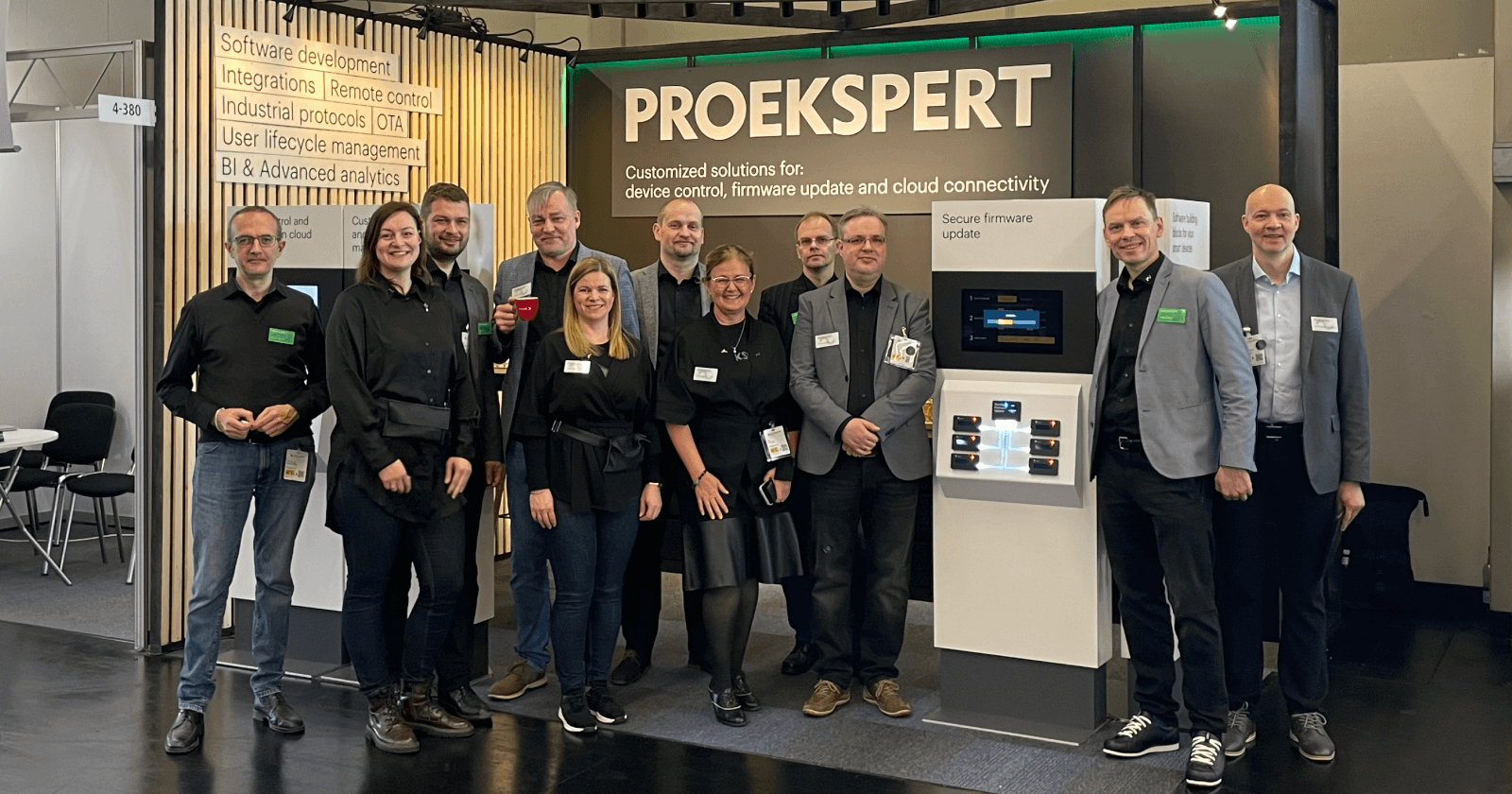
For the second time, Proekspert will be represented at the embedded world Exhibition & Conference taking place in Nuremberg, Germany from March 14-16.

“There is so much interesting happening in embedded systems at the moment,” says Proekspert’s embedded business unit lead Jukka Halttunen. “You have to keep up with technological challenges, and make sure your solutions are innovative and sustainable. We’re attending the fair to introduce our solutions that we find most critical for customers, like our secure firmware update and remote device management. There are many more topics of course, and I encourage people to stop by our booth.“

Our location: Hall 4, Booth 4-380
Come find us at the Proekspert booth, or schedule a meeting!
More about our Secure firmware update solution here.

Embedded World website

Data Innovation Summit 2023

Data Innovation Summit will take place May 11th and 12th in Stockholm, Sweden. 

Proekspert’s BI & Data analytics business unit lead Urmas Kobin says: “Our data team engineers will be in Stockholm as visitors for the whole event. Data Innovation Summit is the most influential data, AI, and advanced analytics event in the region.“

The Data Innovation Summit brings together the most innovative minds, enterprise practitioners, technology providers, start-up innovators and academics, working with Data Science, Big Data, ML, AI, Data Management, Data Engineering, IoT and Analytics, in one place to discuss ways to accelerate AI driven Transformation throughout companies, industries and public organizations.

Drop us a line to schedule a meet!
More about our business intelligence and data analytics unit here: Business intelligence and data analytics | Proekspert

Data Innovation Summit website

Teknologia 23

Teknologia 23 will take place November 7-9, through in Helsinki, Finland. Teknologia is the leading event in technology in the Nordic countries. The event will be built around four key themes: the green transition, supply networks, the hydrogen industry, and artificial intelligence. 

Proekspert’s team will be there again, and this year with our own stand for the whole event to meet with partners, clients, and future clients. 

Terry London, Proekspert`s Product Owner and partner: “We are showcasing our solution that helps device makers from the climate-, energy-, and industrial automation sectors to implement secure update and remote control features for their devices.”

Our location/stand number: 6k68

Come find us at the Proekspert booth, or schedule a meeting!

Teknologia 23 event website

productronica 2023

The world’s leading trade fair for electronics development and production, productronica, 2023 will take place November 14-17 in München, Germany.

productronica, held every two years since 1975, is a summit meeting for innovative start-ups, electronics developers, as well as thought leaders and decision-makers. Proekspert will be there, in collaboration with the Estonian Business and Innovation Agency, as a part of their mission to take companies to world’s largest leading trade fair for electronics development.

Terry London, who holds the dual role of Proekspert’s Product Owner and partner, says, “Proekspert helps industrial machine makers prepare for the constantly evolving requirements for the security of customers’ internet-connected devices. Our secure firmware update solution ensures that individual devices cannot be compromised by attacks against device firmware. In preparation for the upcoming EU Cyber Resilience Act (CRA), we develop custom Secure Firmware Update solutions.”

Get your free entry voucher online 

To get your personal voucher link for your free ticket, please write to marketing@proekspert.ee. The link will then lead you to the registration system of Messe München directly.

You must register online in advance. Vouchers cannot be redeemed on-site.

We’re thrilled to be a part of this. Get in touch to set up a meeting!

productronica website

Digital services licensing and subscriptions management for electric equipment manufacturers

Do device manufacturers need custom service licensing solutions — or will third-party solutions suffice. We’re experts at helping you make that decision.

One of the most visible signs of the evolution of digital services is the way software licensing has changed. Many of us remember the times when software was shipped on floppy disks or CD-ROMs, with a paper label containing a license key. In more complex scenarios, software licenses were protected with hardware license dongles to be plugged in the machines where the applications were running. With Cloud services and Web platform solutions taking the lead in digital services technology, software licensing has moved more and more to online account-based license verification.

As companies expand their value offering with the introduction of web-based customer-oriented digital services, doors are open to new business models, like subscription-based licensing, that gives benefits to both the seller and the customer. 

How Proekspert helps with customer-oriented digital services

At Proekspert, customer-oriented digital services are part of our core business, and good design and implementation practices for licensing and subscription mechanisms have always been part of our skillset. 

For smart device manufacturers, digital services are typically add-on offers to their core business, which is selling devices. This means that, in many cases, most of our customer’s needs are satisfied by a simple licensing portal, where administrators can enable, disable, and manage licenses and subscriptions for their digital services.

In many situations the client has the right to a specific license or subscription depending on the type of contract they have for the devices they are buying from you. Or the financial transaction is handled by a B2B invoicing process already in place for the core business, and a dedicated invoice is issued for digital services. 

Licensing and subscription conditions vary market to market

If you’d like to eliminate the complexity of implementing and managing multiple payment methods across a variety of markets, currencies, and tax jurisdictions, then Proekspert can tell you whether custom solutions are required, or if existing, third-party services can do the job.

Proekspert can help shape your licensing and subscriptions business model with a setup that allows you to: 

  • Define your portfolio of digital services and features. 
  • Define licenses and subscription package offers. Identify what services and features of your portfolio are available under a specific license. 
  • Generate and handle licenses and subscription keys. Example: you offer desktop software applications to your clients that require a license key. 
  • Create a customer portal, where customers can verify their license- and subscription status. 
  • Integrate APIs that allows developers of your digital services to enable/disable features depending on user licenses. 

Solutions may be extended with ad-hoc customization and integration with other backend systems, for example, to turn customer portals into self-service portals, enabling customers to purchase licenses and subscriptions.

For electric equipment manufacturers, subscription management involves overseeing and administering subscriptions for our products or services. This includes handling customer sign-ups, renewals, billing, and cancellations. 

Electric equipment manufacturers ensure a seamless experience for customers who opt for subscription-based access to their products or services, like maintenance packages or software updates. Electric equipment manufacturers can maintain consistent revenue streams, track customer engagement, and tailor offerings based on usage patterns. Effective subscription management is key to customer satisfaction and long-term business sustainability.

Digital services licensing involves granting permissions to use digital content or services, typically through a legal agreement. This includes software, online platforms, digital media, and other internet-based services. 

The licence defines the scope of use, distribution rights, limitations, and the rights of the licensor and licensee. It’s essential to managing intellectual property rights in the digital realm. This ensures compliance and protects both the provider’s and the user’s interests.

Subscription-based licensing is a model where customers pay a recurring fee, typically monthly or annually, to access a product or service. So, unlike traditional perpetual licenses, where a one-time payment grants lifelong access, subscription licenses offer access for a limited period. 

As discussed above, Subscription-based licensing is common in software, digital services, and sometimes physical products because It provides flexibility, with options for upgrading, downscaling, or discontinuing services based on user needs. 

Subscription-based licensing ensures a steady revenue stream and closer customer relationships for electric equipment manufacturers, fostering ongoing product improvements and customer feedback integration – and we at Proekspert can help you do that.

Read more: