Happy 29th to our favorite company!

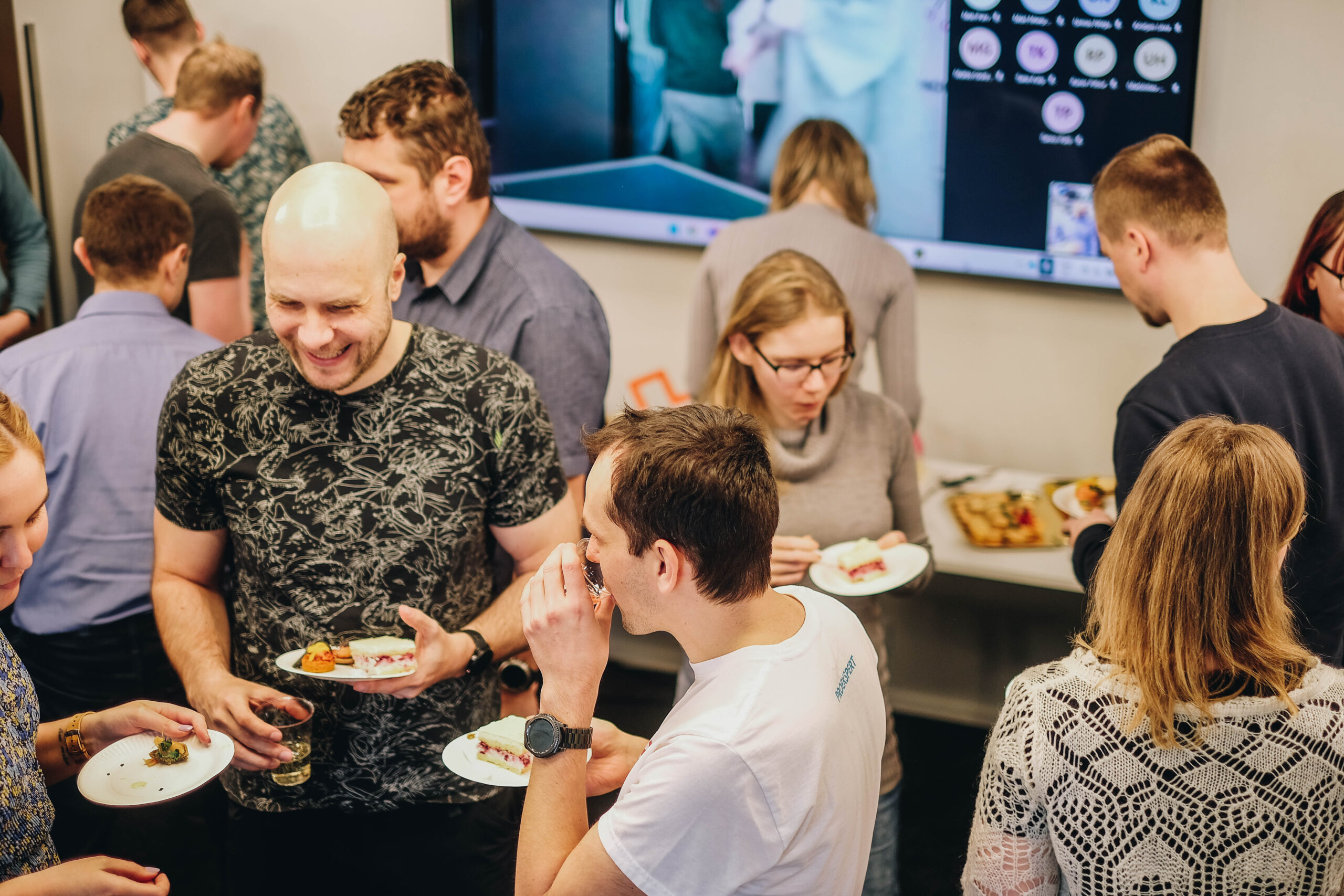
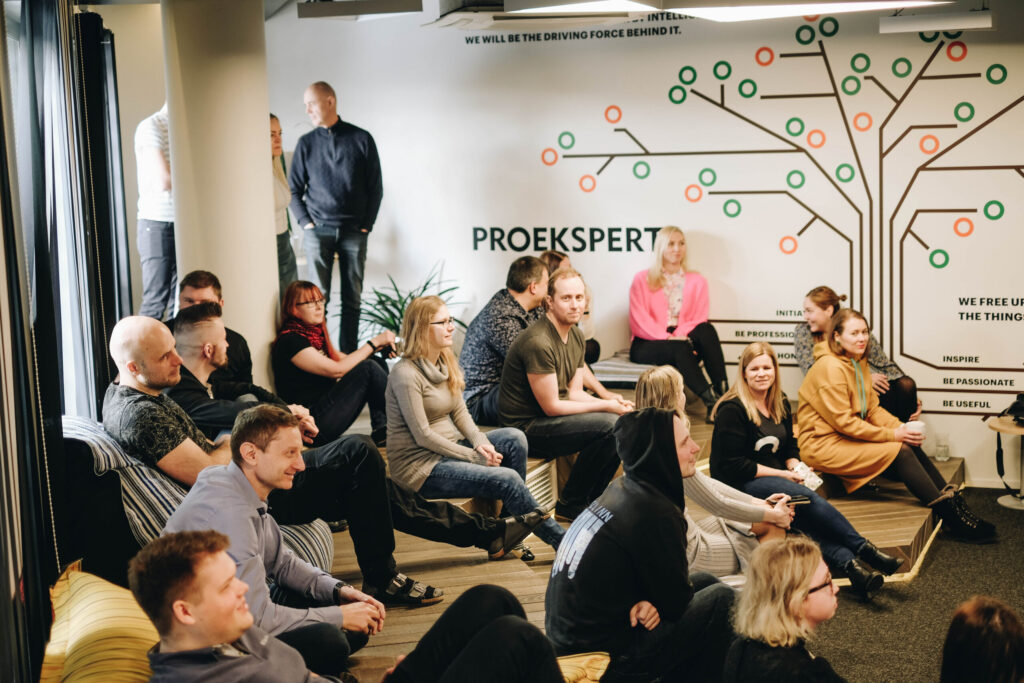
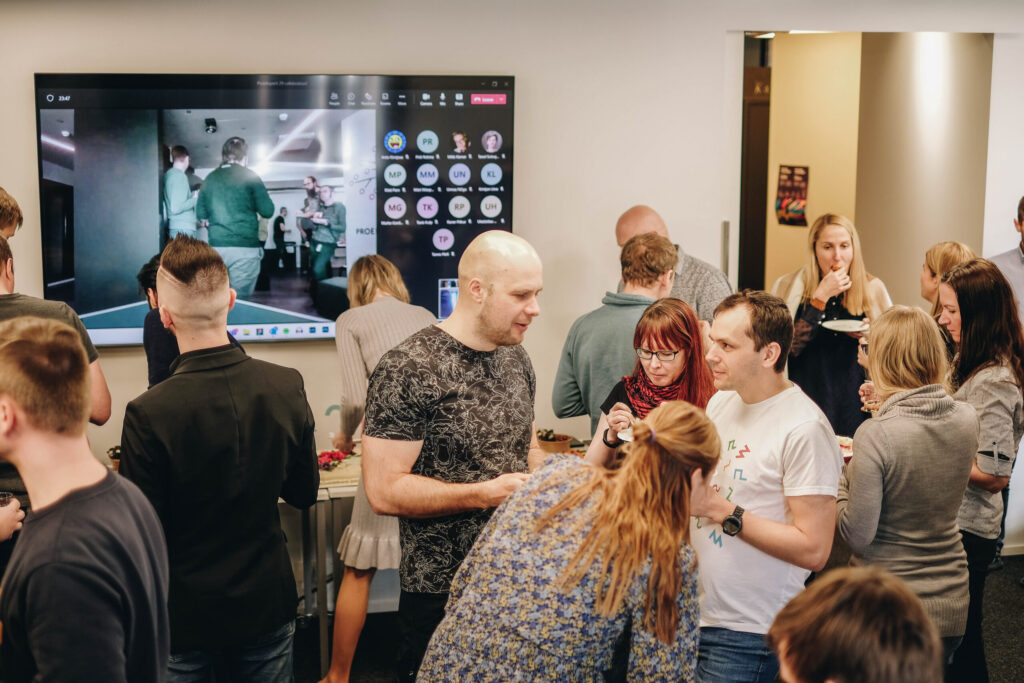
Proekspert turned 29 years old yesterday and, after two years of Covid hibernation, we came together to celebrate in all our offices, as well as online.

The last couple of years have been difficult, since we have not been able to celebrate our company birthday together or meet in person. So coming together and celebrating in all our offices (Tallinn, Tartu, Kuressaare, and Pärnu) with cake and refreshments felt extra special. It’s a wonderful start to our 30th year in business.

Do we look awkward? No one was quite sure how to behave after being apart so long! But it was really great!

And since it was a celebration, there had to be speeches! Among others, CEO Triin Sepp spoke about our culture that’s strongly rooted in engineering. Proekspert was founded by programmers for programmers: a programmer’s utopia. And decades later it’s this working culture that continues to define Proekspert – being humane, direct, and natural.

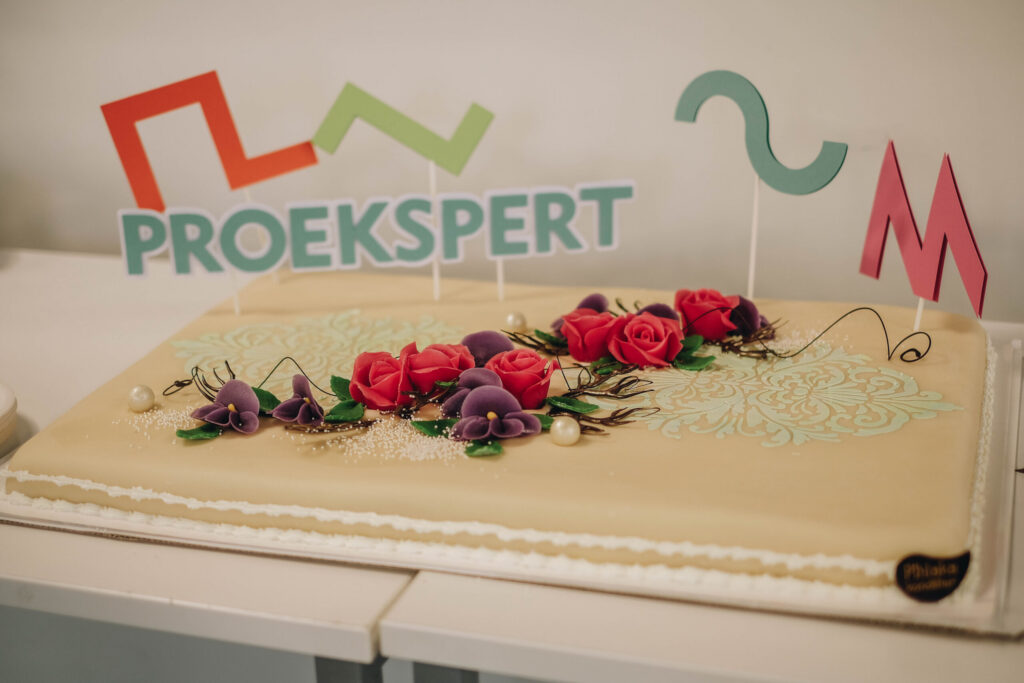
A big cake for a big birthday. This one took up almost two entire tables.

“Proekspert is successful thanks to our engineers who do their jobs well,” said Triin. “We thrive because of our people’s initiative, their business acumen, their awareness of the client’s need, and their desire to create tangible value.”

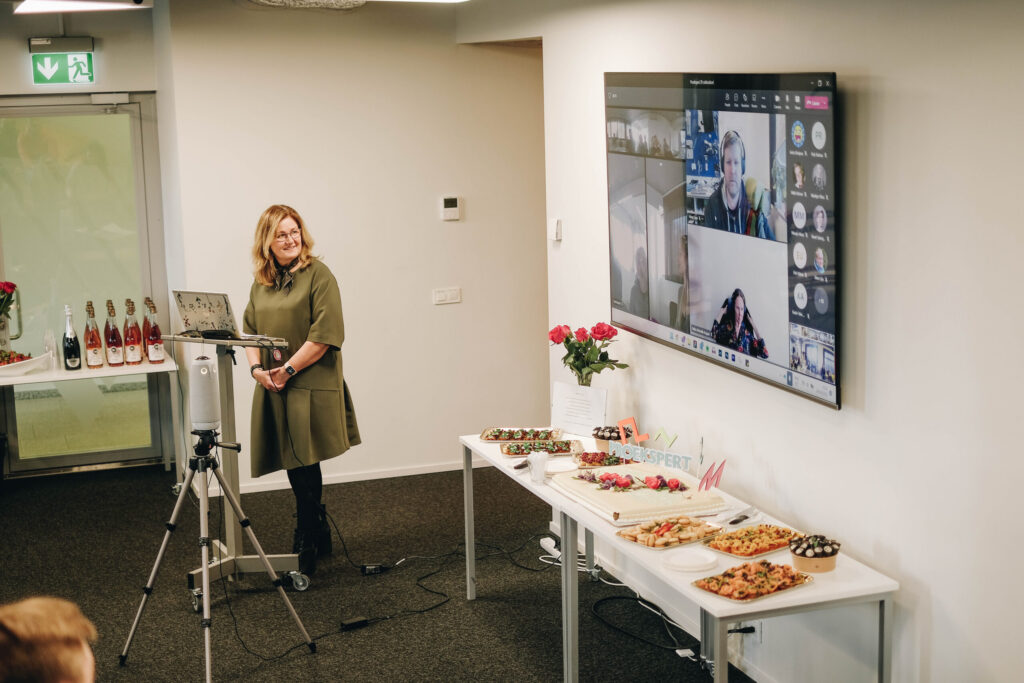
CEO Triin Sepp guards the cake behind her while addressing the Pro team – present both in person and via the internet.

“We thrive because of our people’s initiative, their business acumen, their awareness of the client’s need, and their desire to create tangible value.”

Triin Sepp, Proekspert CEO
Some mingled live, others via video.

“I want to thank our employees, clients, and partners who have been a part of our journey. Because Proekspert is nothing more than our people and the culture that we carry,” she said. “We would not be what we are today without all of you who’ve influenced and shaped us.” 

Here’s to many more birthday celebrations in the years to come!

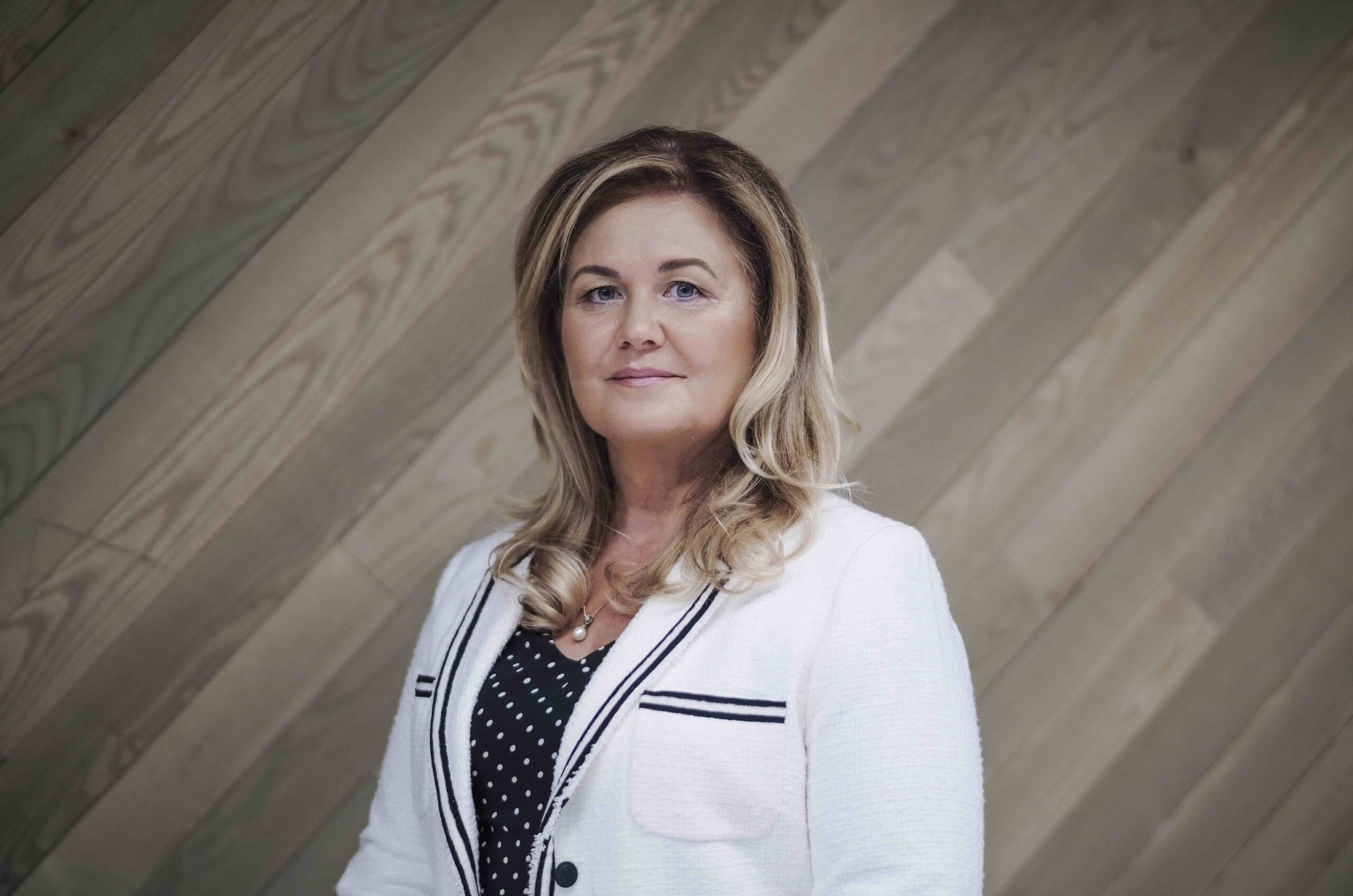
Welcome Triin Sepp, our new CEO!

Effective March 1, 2022, Marko Sverdlik passes the baton to Triin Sepp who assumes leadership of Proekspert.

As Proekspert’s new leader, Triin Sepp will focus on preserving and developing the company’s unique culture that is strongly rooted in engineering, design thinking, and employee satisfaction.

“Building on the company’s core strengths, our aim is to increase added value for our customers. In the long term, we aim to become the preferred partner for top European electrical equipment manufacturers,” said Triin.

Triin has been with Proekspert for over six years, proving herself in a number of different roles across a wide range of areas, while also contributing significantly to the development of corporate culture and strategic planning. Her rich and varied professional experience is complemented by Master’s degrees in systems engineering and international business management, and also an Executive MBA. In her spare time, she enjoys sailing and spending time with her four children.

According to Allan Urb, Chairman of Proekspert’s Supervisory Board, it was ideal to find the next CEO from among the company’s own workforce. “In addition to being well-versed in our company culture, Triin brings in-depth knowledge, extensive experience and a wide-ranging network of contacts for implementing our strategy,” commented Urb.

Our outgoing CEO Marko Sverdlik spent the past 13 years at the helm.

“It is a long time to stay in one role,” said Marko. “During this period, we have learned, evolved and achieved a tremendous amount. I feel that now is a good time to move on and give way to new ideas and energy.”

Under Marko’s leadership, the company was repurchased from the Danish energy giant Danfoss. Proekspert grew into an organization of 160 employees, with 42 of them also shareholders. The company’s turnover increased threefold, reaching 12 million euros in 2021, with 90% attributable to export. Since 2013, Proekspert has operated as a bossless company, with decision-making delegated to self-organizing teams, which have garnered international recognition for this innovative approach.

Established in 1993 by a group of Estonian engineers, Proekspert focuses on software development and human-centric digital services, while also helping customers develop securely connected smart devices and organize their remote management. The company’s key customers include Danfoss, Stiebel Eltron and Telia Finland.

AI in biochemistry: Proekspert’s man on the scene

​​Data scientist Tõnis Laasfeld won Estonia’s Ustus Agur stipend. We talked to him about the intersection of chemistry and data in academia and industry.

Congratulations on being awarded the Ustus Agur stipend. Let’s start by asking what everyone’s wondering: Who is Ustus Agur?

He is the founding father of information technology in Estonia. Since 2003, the Estonian Association of Information Technology and Telecommunications has given an annual stipend in his name for the investment toward scientific education.

But you’re getting a PhD in chemistry. How is that related to IT?

The stipend is for those who use information technology in other areas. In some cases, chemistry and IT are even more closely connected than two areas within chemistry. Even my thesis advisors come from two different areas, Ago Rinken from biochemistry and pharmacology, and Leopold Parts from genomics and deep learning.

How do chemistry and data science intersect in your work?

I develop software, called Aparecium, for pharmacologists who need to analyze data. Many of their experiments are done with microscopes, which make beautiful images of samples. But to analyze data quantitatively, those images must be turned into numbers that correspond to biochemical processes.

I have applied the software in three areas. First, data can be analyzed to study whether a combination of chemotherapies works better than using a single agent. Second, labeled drug molecules can be used to measure how regular drug molecules point to drug targets. This is useful to screen a huge number of candidates for a drug and measure which of them it would bond best with. A third application is to study how viral infections happen over time and take temporal measurements. In our lab, we study baculoviruses this way. Novavax, the American biotech company developing a new Covid vaccine, uses baculovirus technology in their vaccines.

Pharmacological research is of course very international, but the field’s historical connection to Estonia is quite interesting. Experimental pharmacology was developed at Tartu University in the 1800s, which was then known as Dorpat University. There were two German pharmacologists, Rudolf Buchheim and Oswald Schmiedeberg, who later trained most other pharmacology professors in Europe. In their work they studied muscarine which is found in the redcap mushroom and works by activating muscarinic acetylcholine receptors. Today, I’m studying the very same receptors that they studied 150 years ago. (And a fun fact if you’re into trivia: muscarine was extracted in the same year of Estonia’s first song festival, which is also the year Mendeleev published the periodic table of the elements.)

So how is your research relevant to Proekspert and the work done here?

What I do at the university is directly applicable to the data science industry. For example, a cell seen under a microscope and an object on earth seen from space are quite similar in relative scale. The artificial intelligence algorithms you need to apply are the same.

One project I can talk about is a project Proekspert did for the European Space Agency where we created an algorithm to screen satellite images, detect football fields, and determine whether they’re natural grass or artificial turf. The app we developed gives governments and other organizations information that’s critical in city planning, helping them make informed environmental decisions. Where can you place new fields so they’ll be environmentally safe – to avoid runoff of herbicides or keep those black rubber particles from washing into rivers? Or since artificial turf generates heat pockets in summer, where can we put new fields to not exacerbate the problem? Or maybe an artificial turf company wants information about sector growth. Another app can show the condition of artificial turf, which a turf company might use to know where to direct its sales efforts.

There are lots of applications for our work, but the ESA wanted to demonstrate that their satellites have commercial applications beyond just the scientific ones. The ESA funded part of that work, and Proekspert funded part, as well.

What about a project you’re not allowed to talk about?

I can describe in vague terms one we did for cardiovascular diagnoses, helping a client automate the decision process for its medical personnel. There is an imaging measurement they need from the patient that required manual adjustment of equipment before the image went into a processing pipeline. The doctor taking the measurement could not be certain whether the measurement was good enough for analysis, so we created a solution to determine that. By improving the diagnostic tool, we saved the manpower of medical professionals, since they could determine immediately whether their measurement was good enough.

How have you arranged it with Proekspert so that you’re able to work both in academia and business?

For the last year and a half I’ve worked part time as a data scientist at Proekspert, and I should complete my PhD in August 2023. What I’ll do after I get my degree is hard to say. I may do post-doc work at an institution abroad, but I would eventually return to Estonia. I like both academia and the industry side, and Proekspert is good about letting me balance them.

You’re probably not the only one at Proekspert with a foot in both worlds?

There are others at Proekspert who are also PhD students. I know two personally – a chemist and a physicist who are also connected to Tartu University, and working with computational methods. Estonia’s Masters programs are also fairly science-heavy, and these students are also involved with Proekspert.

So the academic-industry partnership is a productive combination?

Yes, it’s useful for both parties. At first glance, you’d think you’d have to split your time, and your efficiency would be reduced. But in reality, the academic world moves slower, and it’s not so likely to adapt to new project management systems. But companies are ready to try things out. So I can learn from industry and apply it in the university to make my work there more efficient. The software development skills help me to analyze huge datasets in a few hours that would otherwise take days or weeks of manual labor.

And the skills transfer the other direction, too. An academic background is important in industry, because data science often focuses on data. It’s data science, not just data analysis. Academia teaches us to think about our assumptions, how to run tests – these things you can miss if you don’t have a good grasp of scientific method. Those without an academic background can make a solution, but it may not be the solution.

This is understood at Proekspert. If you want to learn something, then the teams and people in the organization get that this is useful in the long run. The team compensates and covers for you in your absence so there aren’t hiccups in the processes. It’s a great environment for those of us who straddle the two worlds, or really for anybody who likes to learn.

Tõnis Laasfeld (27)

  • Senior Data Scientist, Proekspert
  • Acquiring PhD at the University of Tartu
  • Expertise: Quantitative image and video analysis, object detection and measurement, deep learning pipelines from data gathering to deployed solution
  • Winner of Ustus Agur Stipend, 2021
  • Fun fact: As a kid, Jules Verne was his favorite author, which sparked an interest in science and innovation

Sounds like a place you’d like to work? Check out Proekspert’s vacancies here.

Further reading (In Estonian):

Proekspert becomes tech-school partner

Proekspert will take a key partnership role in the kood/Jõhvi school created for any person over the age of 18 seeking opportunities in the IT sector.

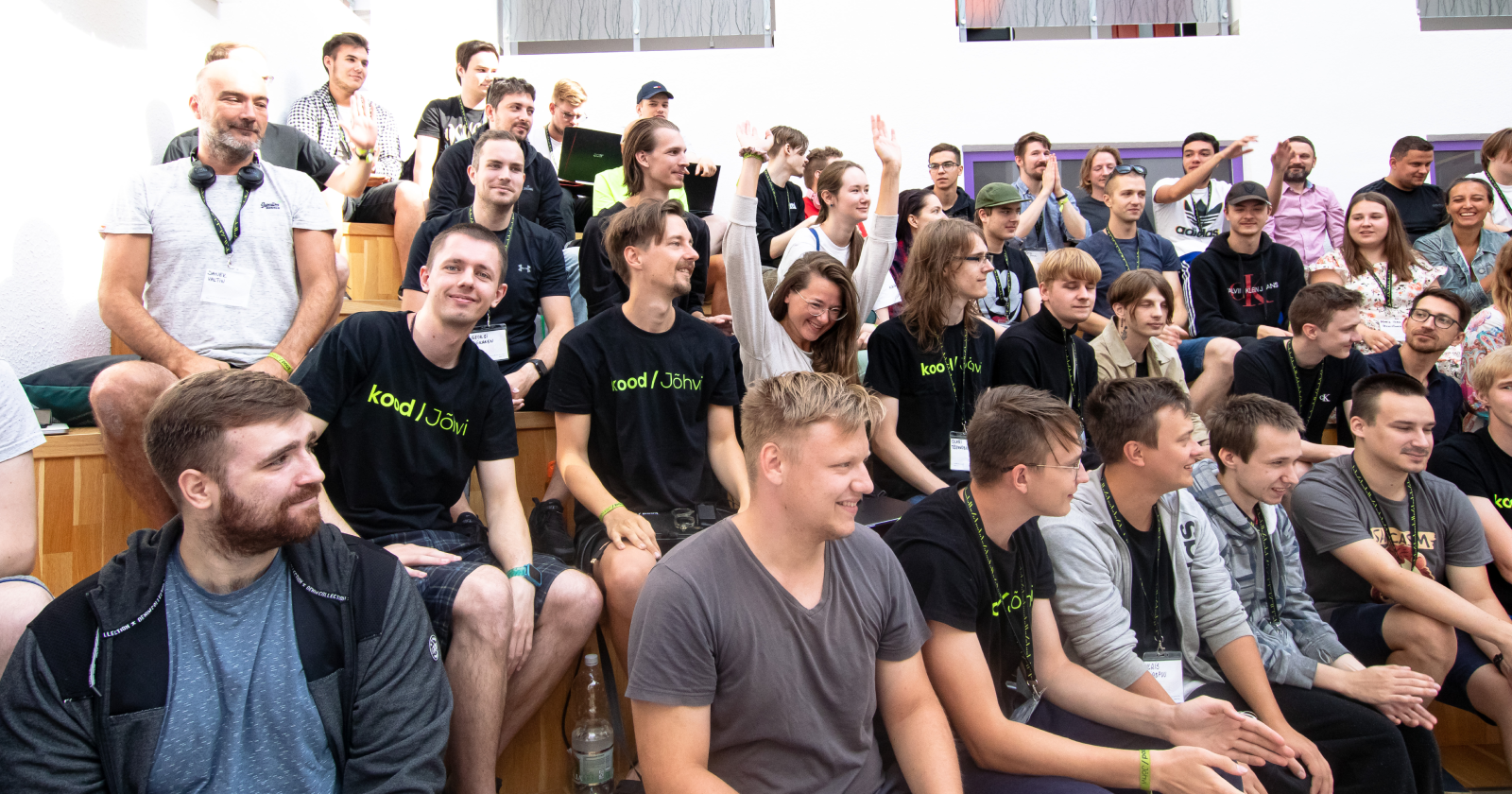
Proekspert announced in October that it will take a key partnership role in the kood/Jõhvi* school, Estonia’s international coding school created for any person over the age of 18 seeking opportunities in the IT sector. (*”kood” is Estonian for “code,” and Jõhvi is the city in eastern Estonia where the school is located.) 

The school is open to anyone who wants to enter the world of tech or further develop their existing skill set. The school creates full-stack developers with an extra six months of specialization in a given field. This is done through practical and project-based assignments where students solve real problems and learn more than just how to write code. 

kood/Jõhvi is a bold initiative undertaken by founders from Estonia’s top IT companies to address the chronic labor shortage in Estonia’s IT sector. In a sense, Estonia has been a victim of its own success, boasting hundreds of successful tech startups, in addition to its world famous unicorns. Rather than look to government to solve the problem, the nation’s IT sector has partnered with the public sector to address the issue. The school is free to qualifying students and no tuition is charged.

As a key partner in the program, Proekspert will collaborate with the school to build the embedded engineering specialization module for kood/Jõhvi. Once a student has learned the basics of coding, they will have the opportunity to specialize by choosing from a number of module options. “Since Proekspert’s recognized strength is making things smart (the internet of things), it’s only natural that we’d build the embedded engineering module,” said Tiina Sakkos, Proekspert’s Chief Culture and HR Officer. “We’re also discussing the possibility of creating a module in service design since that’s another area where we excel.” Proekspert also plans to contribute by delivering lectures and organizing hackathons. “As with all our partners, we hope to see a long future and finding the best possible ways of changing the future of education in Estonia. Proekspert is a great help in our mission to further develop A-tier developers in Estonia.” Karin Künnapas, kood/Jõhvi’s Head of School.

Through collaborative project-based learning, students will be able to use the school’s two-year program to future proof their existing careers, or even begin a new career as a software engineer. On September 13 of this year, the school’s first class of 215 began their studies. The school operates on a cloud-based learning platform, where each student moves at their own pace, solving the tasks set by the system, linking theory to practice. 

The school is supported by the State Shared Service Center and the Ministry of Finance. The school is also supported by dozens of private individuals, companies and organizations. In addition to Proekspert, supporters include organizations such as Bolt, Wise, SEB, LHV, Superangel, Astrec Data, Pipedrive, Confido, Viru Keemia Grupp, Microsoft, Admirals, Adcash, Kaamos, the Estonian Founders Society, the Good Deed Education Fund,  and Startup Estonia. The private-sector contribution to the project is over 700,000 euros to the project.

“As a bossless company, we strongly identify with the 01 Edu System, a collaborative project-based learning methodology, which is the core of kood/Jõhvi,” says Proekspert’s Tiina Sakkos. “No teachers, no classes, no courses. The 01 Edu System offers proven peer-to-peer pedagogy, revealing the best creative coders through constructive socio-cognitive conflict in a caring atmosphere.”

Does pair programming work in data science?

Pair programming is common in coding. But does it work in data science? And with remote work? Our data scientists gave it a whirl.

Pair programming defined

In pair programming, two programmers work side by side at a single workstation. Like a rally team, they have separate but key tasks. One serves as the driver, writing code, while the other navigator, checks the driver’s work. The roles should be swapped frequently. This is a key agile technique used at Proekspert to speed the onboarding of new employees – and it’s especially efficient in an era of remote work. 

Two heads better than one

At the beginning of October, Kaspar Hollo joined the data science team as our newest member and I took on the role of tech buddy. And since Proekspert encourages pair programming as an onboarding technique for new engineers, doubly so in a time of remote work, it was the right time to try it out. 

I have done a lot of pair data science in my scientific career, but mostly using “point and click” data analysis software, rather than developing one myself.  I searched for a few articles about how to go about this activity, finding some like this one and another one). These gave some useful tips and warnings about benefits and dangers, but they reminded me of cookbook instructions, rather than an evidence-based guide.

In my experience, data science tasks can be so diverse and intermixed that general rules have a high likelihood of being oversimplified. So, I created my own guidelines for a working session:  

  1. Define a goal you want to achieve.
  2. The “driver” always writes code and constantly explains what they are doing. They alert their partner (who’s “rides shotgun”) when they get stuck. 
  3. The person riding shotgun keeps an eye on the code, checking for mistakes, bad coding style, etc. The shotgun position stands ready to brainstorm if the driver gets stuck, and can split off to perform quick searches for algorithms, or write key pieces of code. 

In most pair programming sessions, I teamed up with Kaspar. We’d worked on a traffic sign detection and localization project together. We used a single computer (at the office), worked in Jupyter Lab, and used Python.

Session 1: Coding with Kaspar 

During a four-hour session I took the driver’s role. I felt the number of times I got stuck was reduced due to being able to immediately brainstorm. The many relevant questions from Kaspar riding shotgun helped me examine the problem from different angles (quite literally, as the task was about triangulations in 3D space). Since Kaspar has taught Python to thousands of Estonians through MOOCs, I also learned a few coding tips and tricks and a few shortcuts that I didn’t know before. 

There were multiple positives to the whole session: 

  1. As the driver, it was easier to ignore the blinking Teams icon and focus on the technical task. This saved a lot of time switching between tasks.  
  2. If running a piece of code took longer than a few seconds but less than a few minutes, I could fill that time brainstorming the next mini-task, explaining some tech-buddy things, or just cracking jokes while we waited. 
  3. Since two people need breaks at different times, we took shorter breaks more often than I usually do. This is good for the eyes, posture, etc. 

Subsequent sessions: reversing roles

In subsequent sessions, we tried reversing driver- and shotgun roles and even changed roles multiple times during a single session. The sessions continued to be useful and we were able to discuss and immediately test a variety of hypotheses. In one four-hour session we managed to complete most of an entire list of tasks for a two-week sprint. This was only possible thanks to being able to continuously discuss the topic and next steps. 

A data science pair session with Tanel 

After working with Kaspar, veteran data scientist Tanel Peet and I paired up for a data science session. 

Although pair work is suggested for new people, our task was tricky and pairing up seemed useful. We’d found that classical image-based tracking algorithms were not working well, so we decided to move to 3D ray tracking. Since Tanel had been working on tracking, and I had worked on localization, and we now needed to mix both algorithms, the knowledge from both sides proved invaluable. 

We started with a two-hour brainstorming session where we discussed most aspects of the problem and thought deeply about the underlying mathematics. We discovered that the natural data structure for the task was a set of undirected graphs, and the corresponding adjacency matrix (each isolated graph corresponds to a single track and tracking comes down to finding rules which allow deciding if there is an edge between two nodes or not). It would have been tricky to come to that conclusion alone, since the data structure of the original tracking algorithm was a bounding box (rectangle) on an image, and the data structure of localization was a list of 3D vectors. It requires quite a shakeup to think outside the (bounding) box, and the pair session did it for us. After the brainstorming session, we discovered that the actual implementation of the idea does not benefit too much from working on the same code so, instead, I worked on the implementation, and Tanel worked on visualization to check if the set of rules and thresholds we produced were working. 

This kind of separation is not how pair programming is supposed to work, but flexible rules served us well in this case. The visualizations were extremely useful for developing the tracking rules, and writing the rules was not difficult alone, once the natural data structure had been found during our brainstorm. By the evening, the algorithm was good enough that it made mistakes only in about 10% of cases (the previous tracking had around 20-30% mistakes) and around half of the mistakes in the prediction of the new algorithm ended up being mistakes in the ground-truth, instead. For me, this session proved that pair data science can be a useful concept not only for newcomers but for data scientists of all levels. 

Given what we learned, I’d suggest another rule for the next sessions: Take time to think whether the session is more productive than two people working solo. If it is not, then consider stopping the session.

An interview with newcomer Kaspar Hollo 

Proekspert’s agile and people coach Kadri Daljajev interviews onboardee Kaspar Hollo about his experience.

Kadri: Did you have any previous experience with pair programming? 

Kaspar: This was not the first time that I had used pair programming, since most of the projects during my master’s studies my master’s thesis projects were done in pairs, and professors encouraged us to try pair programming. I didn’t see any advantages at first and had my doubts – I thought that it would only overcomplicate things and slow the process down. It turned out to be quite the opposite, especially when a deadline was approaching, and we had to push through. Pair programming forces people to talk through the problems, allows them to brainstorm solutions at a moment’s notice, and it also helps to keep the pair from distractions. Frequent switching of the driver also allows to take minibreaks while maintaining a high tempo. 

How did you find the experience? 

I’ve had a couple of interesting pair programming sessions at Proekspert with my tech buddy Tõnis Laasfeld, some sessions live and some via Teams. While working with Teams the driver shared his screen, and that’s it. The driver needs nothing more than advice and ideas from his shotgun position. 

What was most beneficial? 

Since I joined the team and company in the middle of an ongoing project, I would say that the pair programming sessions served first and foremost as a good introduction to the project code. I was able to ask questions without feeling like I’m interrupting my tech buddy. Afterward, it was much easier for me to solve problems in that particular part of the code-base by myself. 

What else did you like about it? 

I enjoyed the social aspect of the pair programming sessions. Even though I already knew my tech buddy Tõnis from university, I would still say that I got to know him a little better – how he approaches problems, or how many good math/programming related jokes can one person possibly make in a short period of time (he really pushed the boundaries on that one). Learning a couple of new tricks here and there was a real positive.  

How did you prepare for the sessions? 

We defined very clear goals about what we wanted to achieve and what must be done to achieve them. This helped us keep track of progress and decide when to end each session. We also tried to keep the schedule relatively empty on these days so that there wouldn’t be things that could potentially disturb the pair programming sessions.  

What advice would you give to the next newcomer? 

Three things. One: Keep an open mind about pair programming. I also had my doubts in the beginning, but it managed to positively surprise me.  Two: Ask a lot of questions. They might lead to better solutions or eliminate misconceptions. And three: Try to get to know the person you are programming with. The sessions offer a good opportunity for that.  

Would you recommend it? 

I would say that pair programming is a useful method that helps kickstart onboarding for new employees.

Interested in joining Proekspert? Check out our current vacancies here.

Proekspert again table tennis champions

For the third year in a row, Proekspert has proven itself to be the best in Estonia when it comes to dominating in table tennis.

Proekspert is proud to have won again at “Ettevõtete Pinks”, a table tennis tournament organized by Spordipilet.

A total of 77 table tennis players from 30 companies participated in the event. Saku Õlletehase Spordiklubi and Eesti Energia Spordiklubi finished second and third, respectively. 

Proekspert Team
Participants: Tanel Uudeberg, Ilja Keikov, Jaan Reinok, Allan Tamme, Merily Roopärg, Sander Kukk, bottom row Mark Osvald Altpere, Kadri-Ann Valgeväli, Jana Pipar, Ingel-Brit Parmas.

Proekspert has been the champion of that event for the past three years, and our strategy for success has been to have at least one participant in all four categories: men under 40, men over 40, females under 35, and females over 35.

Previous winners:

  • 2020: Proekspert, Telia Sports Club, Eesti Energia Sports Club
  • 2019: Proekspert, Monese Sports, Telema
  • 2018: Eesti Energia Sports Club, Ernst & Young Baltic, Proekspert

Proekspert recognized for remote and flexible work environment

For the second period running, the Smartwork Association has awarded Proekspert the Remote Working Badge.

The award by the NGO, Smartwork Association, is recognition of Proekspert’s core-level commitment to flexible work arrangements that suit both individuals and entire teams, keeping a proper balance between work and private life. Proekspert’s working practice of opening an office in any city where at least five employees request it is one of its commitments to flexibility. In addition to its offices in Tallinn, Tartu, Kuressaare, and Pärnu, the company has tens of home offices around the world. 

“We’re very pleased by this recognition,” says Tiina Sakkos, Proekspert’s Chief Culture and HR Officer. “Employees at Proekspert have always had the opportunity to work remotely, but few of us have preferred it in the past. Currently, of course, teleworking is the norm at Proekspert. So, supporting a flexible work arrangement is just business as usual for us.“

“Our experience shows that flexibility fosters productivity and mental well-being,” says Sakkos. “Above all, employees know they’re valued, and we’ll continue to create a work environment, whether at home or the office, that keeps people both healthy and happy.”

About the Smartwork Association and the Remote Working Badge

The Remote Working Badge recognizes organizations that use remote working practices and whose examples encourage other Estonian organizations to apply flexible working practices in everyday work arrangements. 

More than 130 Estonian organizations have an active Remote Working Badge.

Established in 2007, the Smartwork Association stands for smart and contemporary work practices. The Smartwork Association’s mission is to promote smart work, including remote work in Estonia, to enable people to work in a form and place suitable to them. Through its activities, it contributes to enhancing Estonia’s job market’s flexibility and adaptability to better meet the demands of the external environment – globalization, development of technologies and ICT, changes in employee expectations, and increased competition for talent, to name a few.

Interested in joining Proekspert? Check out our current vacancies here.

Proekspert receives Bronze Label as Responsible Business

We are proud to have received a Bronze Label. It is natural for us to make the right choices when it comes to being a corporate citizen.

Estonia’s Responsible Business Forum has again recognized Estonian businesses and organizations who do more than the law requires when it comes to caring for the world around us.  

We are proud to have received a Bronze Label. It is natural for us to make the right choices when it comes to being a corporate citizen. We support tech education at all levels, both financially and with our time. We value equality in our daily business practices, in hiring practices, and in the selection of partners. We envision a world without digital waste, totally eliminating inefficiency via the creation of new and better human-centric digital solutions. Our head office holds an international Green Building certificate, which means its green-as-possible construction, collects rainwater which is filtered and used, and there are electric vehicle charging stations, and lots of features to encourage bike commuting. And we even make environmentally-friendly choices when it comes to company swag! 

The Responsible Business Index is a self-assessment tool, verified by third parties, that enables the comparison of a business’s activities to both a market standard and to the activities of its competitors. 

This year, 63 companies took part in the index evaluation, the majority from the manufacturing- and service sectors. The indexing process has been carried out by the forum and its partners for over 10 years, and participating businesses are always evaluated by experts in the field. 

Proekspert’s experience with SAP Analytics Cloud

How Proekspert minimized manual tasks and automated forecasting.

What is SAC and how did Proekspert end up using it?

Proekspert was the first Estonian company to use SAP Analytics Cloud (SAC), and we have the longest user experience in the entire region. We started about two years ago, and today all of our planning takes place in SAC. 

Why did we choose SAC? SAP Analytics Cloud is a cloud-based 2-in-1 software service that contains both business analytics and budgeting tools. Budgeting is not definite planning from a financial point of view, but rather the testing and confirming of all kinds of forecasts, whether about finances, human resources, materials, and much more.

SAP Analytics Cloud is unique because it allows you to collect actual data from a variety of sources, analyze the data, monitor the implementation of budgets, and plan on the same screen. Data models need not be pre-set, i.e., the structure of the data is adaptable to the company’s needs and business logic, and the creation of the user interface is also very flexible. It is also possible to use the parts separately, either using business analytics on its own, or business analytics with the planning, and then implementing it step by step. Ready-made solutions can also be imported under SAP Business Content.

Proekspert’s experience and planning challenges

For Proekspert, planning is difficult due to the structure and complexity. We offer a lot of services and products, and several teams will work on a plan together.

Like many companies, we started planning with Excel. We had a single central Excel file that many people filled in. As you might expect, we had a lot of issues getting all the data together:

  • Only one person could enter data at a time. Others had to wait.
  • If a user forgot that the file was “open,” nobody else could continue working.
  • Another user may not have noticed the read-only message, and the work could not be saved. Conflicting versions of the document emerged.

We also tried having everyone work in their own file, with data copied into a single file. This resulted in problems with copying formats and formulas, adding columns/rows.

It took a lot of time just to enter and correct the data. Moreover, it took away time from actual planning.

Planning with SAP Analytics Cloud

As with any great cloud solution, all users can work with SAP Analytics Cloud simultaneously. However, unlike with Office365 Excel, each user decides when to share their work with others. This avoids the misunderstandings of partially finished work (revenue entered, expenses not entered).

SAP Analytics Cloud key features are:

  • Users can make their own versions to play with different scenarios
  • Automatic data back-up

Today, Proekspert does planning without worrying about the availability of data; instead, we focus on creating and improving the plan. Since data management is easy, we have a budget and constantly-updated forecast available to everyone.

User involvement

Once upon a time, Proekspert’s plan was made centrally by one accountant. This plan was also better than nothing, but it lacked precision. Nor did anyone fully embrace the plan, and it could always be argued that the reason for not complying with the plan was that it had been made by someone else. 

To improve the situation, we involved the heads of all departments in the planning process, so each could make their own plan and be responsible for its implementation. However, the involvement of many users created several challenges: 

  • Creating new user accounts: Who can access the applications?
  • User rights management: Who can see what? Who can enter what?
  • Using secure passwords
  • Closing user accounts for employees who have left the company

With SAC, all user management is done through the Active Directory: there is one user account per employee for all tools, and employee access to SAC is managed centrally.

  • Using SAC, we can manage viewing and editing rights for different user accounts.
  • Single-sign-on for all services interfaces with the Active Directory, including SAC
  • Password policy is set by Active Directory

A joint- and readable plan

Years ago, Proekspert was in a situation where all the right people had been involved in the planning, and data management problems had been solved. We were able to focus on actual planning. But then we immediately ran into another set of hurdles.

We did not understand why our plan ended up the way it did. Even if, in January, somebody knew why a plan was made, by the end of summer nobody could remember the particulars.

Proekspert’s joint plan is compiled as a profit-and-loss statement, with money as the common unit. Different departments plan their work in different units. For example, marketing plans on the basis of the number of clients and sales events. The number of clients determines the volume of customer gifts and the extent of the customer satisfaction survey. Meanwhile, the HR department focuses on the number of employees. The number of employees determines the size of company events, the training budget, occupational health visits, etc. As different departments have different planning logic, each department still makes its own plan in Excel. Only the monetary end result is included in the joint plan. However, that means it is not easy to understand in the joint plan why our revenue and expenditure figures are what they are. For example, you can tell what the share of marketing is, but you would not understand why it has to be that way. If you want to understand more, you have to ask the marketing department directly and look at the marketing unit’s Excel table.

Especially in situations where the plan includes fluctuating revenue and expenses, it isn’t easy to understand why some costs are so different during some months. Someone may certainly have a great explanation for it when drawing up the plan, but others cannot see it. And six months later, the planners themselves would not be able to remember why some expenses fluctuate so much.

What opportunities does SAC offer to address these challenges?

First, departments with different logic can have their own data models in SAC. For example, the data model of the HR unit allows planning based on the number of employees and employee-related expenses (volume of training per employee, volume of company events per employee, occupational health expenses per employee). Meanwhile, the marketing plan is based on the number of clients and its particular constants. This ensures that each department plans its activities in a language that the department understands. With such plans, the heads of specific departments no longer need their own Excel tables. 

SAC can also combine data models created for different departments into one central model, which takes the financial part of each department’s model and consolidates the plans of all of these departments into one joint Proekspert plan. As a result, we now have the opportunity to see our joint plan and, if we wish, take a closer look at why the revenue or expenditure of a particular department has been planned to a certain extent. Thus, we can understand the plan a lot better.

SAC also allows for textual comments to be added to the data so that it is possible to understand, even much later, why a significantly different amount has been added to some cells. For example, suppose marketing costs are very high in a particular month. In that case, it is immediately possible to see that it may have been caused by several trade fairs happening in that month or, say, the website being translated into a new language. 

SAC also allows you to have a conversation. For example, you can ask why some information is included in a particular way in SAC and you will receive the reply in SAC.

Analytics and data sources

The plan is done. Now, it would be great to know how we are actually doing. Are we moving toward our goals? Which parts of the organization are doing better, and which parts are doing less well? 

To answer these questions, you first need data to compare to the plan. And second, you need an analytics tool to analyze the data.

SAC allows aggregating data from a variety of sources. Data can be imported manually, and databases and third-party applications can also interface with SAC. 

At Proekspert, we have interfaced four data sources with SAC. 

The main advantage of SAC is that it combines the tools for planning and analytics. We had previously been using one tool for planning and another for data analysis and visualization. Now, we can do it all with a single tool. 

The possibilities for analysis are excellent.

Planning automation

No matter how reliable and convenient we make planning at Proekspert, it is still an extra task for most of our employees. It is a necessary task, but it is not anyone’s primary job. Employees would rather not do it at all.

Problem: Our plans only changed when someone changed them manually. At the same time, planning is not anyone’s main job here, so no one was in a hurry to update the plans. As a result, the forecasts tended to be a bit outdated, and we would often talk about actual changes in the office a fair bit earlier than these changes were also translated into monetary terms in the company’s joint forecast. 

We have now begun to automate forecasting using all the data sources we have made available to SAC. For example, SAC can see who our employees are and how much they get paid via personnel records. SAC can also see in the resource planning application which employees have been scheduled for what periods and for what workload. Using this information, SAC can compile labor cost estimates for all our projects. 

As the next step, we will also be automating revenue forecasting. Again, SAC has access to information about which employees have been booked for what jobs and the pricing model for each project. As most of our work is billed according to time and materials pricing, we also want to automate forecasting our main revenues based on this information.

In summary, interfacing various data sources with the planning application enables automating the planning process, and SAC also allows us to use the built-in capabilities for predictive forecasts.

Summary: the advantages of SAC for Proekspert’s planning processes

  • The actual data and budget entry available in the same environment and the same form. Ongoing analysis of real data at the same time as monitoring budget implementation.
  • Financial planning and resource planning, etc., in the same environment. Everything according to a structure that is defined as necessary. 
  • The ability to identify key indicators from past data and modify these to create future budgets. 
  • The opportunity to communicate in a chat window during the budgeting period.
  • Appointing people responsible for certain parts of the budget. Budget scheduling, task assignment and automatic reminders. 
  • Interface with Excel user interface.
  • Predictive analytics and its use in planning: the ability to forecast sales, reveal workforce thinning trends and much more. Using past data, it is possible to predict future trends and save these forecasts as budgets. 
  • Allocation and automatic data copying processes. Allocations are based on revenue, expenditure, amount of employees or other necessary proportions. Allocated aggregate sums can be transferred or copied between distributable units.

Proekspert – an SAP Silver Partner – has been active in the domain of business intelligence since 1998. First, as a BusinessObjects and Sybase partner, and since 2008, as an SAP Value Added Reseller.

Looking for a planning tool for your company and would like some further guidance? Please contact a member of the Proekspert team today.

Proekspert a winner in Future CityHack

Last weekend, Proekspert’s team won top three honors in the 48-hour Future CityHack Future CityHack, a cross-border Smart City hybrid hackathon on-site and online in Tallinn, Riga, Vilnius, and Helsinki.

Hosted by TalTech’s Mektory Innovation Centre, the hackathon’s objective was to bring innovation to cities, and work together for a more sustainable and thoughtful future.

The team imagined a Tallinn Data Exchange platform to make data accessible between the public- and private sectors. Combining data from a variety of sources to a single platform, and adding Data Governance and Service Design on top, would enable the implementation of new smart and seamless services.

Why Future CityHack?  

A smart city is a place where IT solutions are integrated to ensure resource efficiency and lower emissions, but these solutions also meet the needs of the population and improve their quality of life. It affects many areas of the city, including governance and services, transport, energy, the circular economy, health, construction, and urban planning.

Using data to avoid digital waste 

Proekspert’s team decided to tackle the issue of digital waste. The team focused on the data that it assumed the City of Tallinn gathers daily. Knowing that the private sector also collects data which might be useful to the city, the team addressed the issue of bringing both public- and private data together on a single platform.  

The Pitch: the Tallinn Data Exchange platform  

Nothing irks a team of engineers more than unused data. It may be digital, but if it goes unused it’s still a waste. And since one man’s trash is another’s treasure, our team decided to recycle. They imagined a world where no data is left to collect dust – and they named it the Tallinn Data Exchange. It’s a single platform where public- and private companies can share, sell, and combine data. The organization would also handle data governance. 

Imagine combining bus ticket validation data and location data to better plan bus routes or scooter availability. Or crowd-sourcing bicycling activity, combine it with traffic data, and know where to build new bicycle paths. Need a case study? Telia Finland reduced CO2 emissions by 13 tonnes per day by combining location data with public transportation route information! Bringing real-world data together delivers real results.

Proekspert’s team wanted to demonstrate how data can be used to make products and services more valuable. As denizens of Tallinn, our software company wants to help make Tallinn a data-driven city of tomorrow. And hopefully we’ll make that happen in real life. We’ve already met with the City of Tallinn’s Digital Director and the Tallinn Future City Office to talk about how our work for Future CityHack might have direct application for our city.